
Introduction
Good writing is more than using correct grammar and spelling. It also becomes more interesting when you use figurative language, descriptive words, creative writing techniques, and clear sentence structure. Whether you are writing a school essay, a story, an email, or a social media post, choosing the right word helps readers understand your message without confusion.
Many English learners become confused by words that look almost the same. One of the most common examples is the spelling of the verb that means “to stop living.” Some people write the word with “ie,” while others write it with “y.” Since both spellings appear online, students often wonder which one is correct.
This guide explains the difference in simple language. You will learn the correct spelling, why the confusion happens, how grammar rules work, common mistakes to avoid, plenty of sentence examples, comparison tables, writing tips, figurative language examples, practice exercises, and frequently asked questions. By the end, you’ll feel confident using the correct form in everyday writing.
Why This Confusion Happens
English has many spelling rules, but there are also exceptions. One well-known rule says:
Change “ie” to “y” before adding “-ing.”
Because of this rule, the verb die changes before adding -ing.
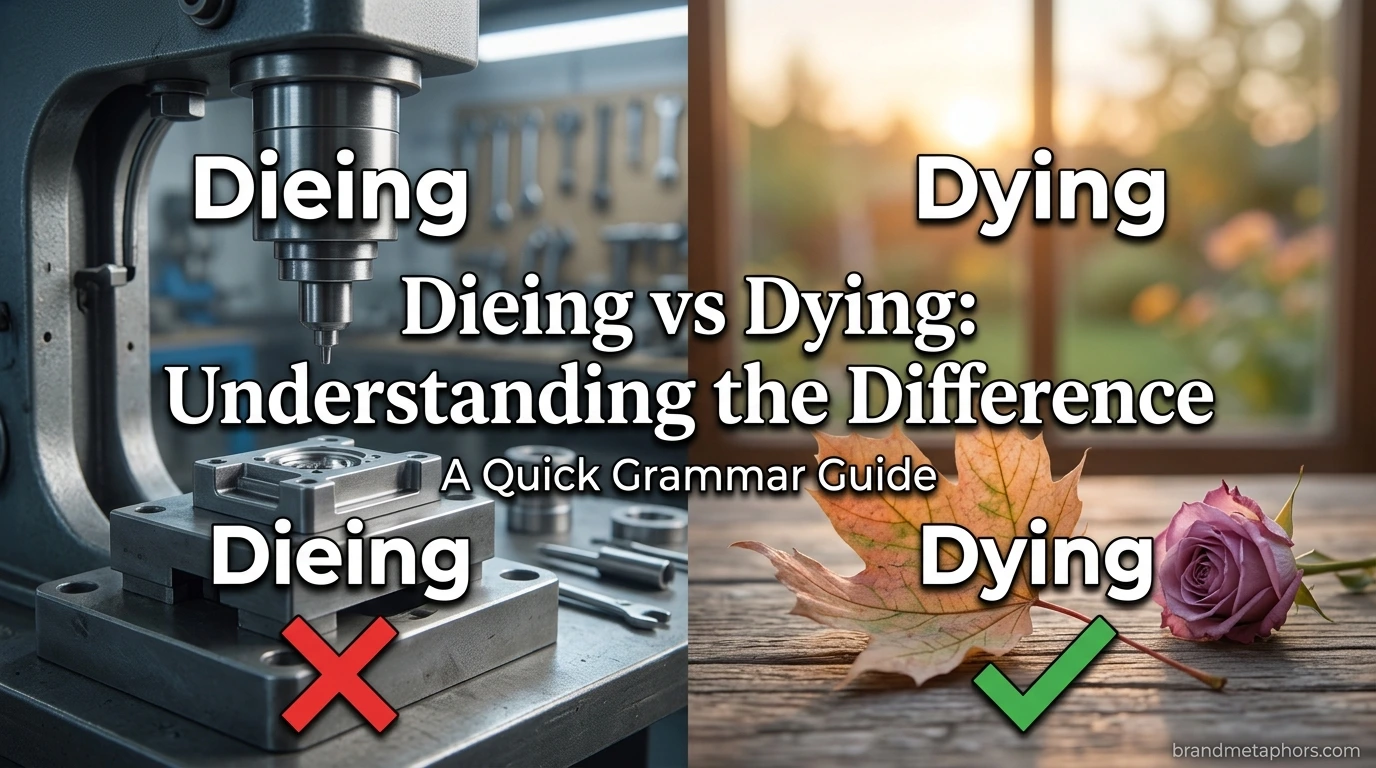
- Die → Dying ✅
- Die → Dieing ❌ (usually incorrect)
Many learners simply add -ing without changing the letters first. This creates an incorrect spelling.
The mistake becomes even more confusing because words like tie and lie also change before adding -ing.
Examples:
- Tie → Tying
- Lie → Lying
- Die → Dying
Learning this spelling pattern makes it much easier to remember.
Which Spelling Is Correct?
The correct present participle of die is:
Dying ✅
The spelling dieing is almost always incorrect when referring to death or something coming to an end.
Quick Comparison Table
WordCorrect?MeaningDying✅ YesThe present participle of “die”Dieing❌ Usually NoMisspelling in most situations
Examples
Correct:
- The flowers are dying because they need water.
- My phone battery is dying.
- The old tradition is slowly dying.
Incorrect:
- The flowers are dieing.
- The battery is dieing.
- The plant is dieing.
Understanding the Grammar Rule
Let’s break the spelling rule into easy steps.
Step 1
Start with the base verb:
Die
Step 2
Notice that it ends with ie.
Step 3
Before adding -ing, change ie to y.
Die → Dy
Step 4
Add -ing.
Dy + ing = Dying
More Examples
Base VerbPresent ParticipleDieDyingLieLyingTieTying
This is one of the easiest spelling rules once you remember it.
Meaning of “Dying”
The word has several meanings depending on the sentence.
1. Literally Near Death
Example:
- The old tree is dying.
2. Stopping Working
Example:
- My laptop is dying.
3. Coming to an End
Example:
- That tradition is slowly dying.
4. Strong Desire (Informal)
Example:
- I am dying to see the new movie.
In this sentence, nobody is actually close to death. It simply means someone is extremely excited or eager.
Literal and Figurative Meanings
English often uses words in both literal and figurative ways.
Literal Meaning
Something is actually losing life.
Examples:
- The fish is dying.
- The patient is dying.
- The plant is dying.
Figurative Meaning
The word describes something emotionally or creatively.
Examples:
- The city was dying after sunset.
- His dreams were dying.
- Their friendship was slowly dying.
- Hope was dying inside her heart.
These examples add emotion and make writing more powerful.
Sentence Examples in Different Situations
Everyday Conversation
- My phone is dying.
- The battery is dying fast.
- Our internet connection keeps dying.
School Writing
- Many endangered animals are dying because of habitat loss.
- The leaves were dying during the long drought.
- Some languages are slowly dying around the world.
Story Writing
- The fire was dying in the cold night.
- The hero believed hope was dying.
- The village looked as though it were dying.
Workplace
- The project is dying because nobody is supporting it.
- Customer interest is dying.
- Sales are slowly dying.
Science
- Cells begin dying without enough oxygen.
- Coral reefs are dying because of rising temperatures.
Common Expressions and Idioms
English speakers often use this word in everyday expressions.
Dying to Know
Meaning:
Very curious.
Example:
- I’m dying to know the answer.
Dying to Meet Someone
Meaning:
Very excited to meet someone.
Example:
- She is dying to meet her favorite singer.
Dying to Go
Meaning:
Very eager.
Example:
- The children are dying to visit the zoo.
Dying Laughing
Meaning:
Laughing very hard.
Example:
- Everyone was dying laughing after the joke.
These expressions are informal but very common.
Figurative Language and Creative Writing

Using descriptive language makes writing stronger.
Metaphor Examples
- Hope was a candle slowly dying.
- The dream was a flower dying in winter.
- His courage was a fading star.
Simile Examples
- The leaves fell like a dying flame.
- The city grew quiet like a dying echo.
- Her smile faded like a dying sunset.
Personification
- The wind whispered as the day was dying.
- The old house seemed to be dying from loneliness.
Imagery
Instead of saying:
- The flowers were dying.
You can write:
- The bright petals curled into brown ribbons beneath the hot sun.
Imagery helps readers picture the scene.
Common Mistakes Students Make
Mistake 1: Adding “-ing” Without Changing “ie”
Incorrect:
- dieing
Correct:
- dying
Mistake 2: Forgetting the Spelling Rule
Always remember:
ie → y + ing
Mistake 3: Confusing Literal and Figurative Meaning
Literal:
- The animal is dying.
Figurative:
- My excitement is dying.
Mistake 4: Using the Wrong Word in Formal Writing
Instead of:
- I’m dying for coffee.
Formal version:
- I would really like some coffee.
Choose your tone carefully.
When to Use and When to Avoid
Use It When
- Talking about death.
- Describing something ending.
- Showing strong emotion.
- Writing stories.
- Writing poems.
- Creating vivid descriptions.
Examples:
- The candle is dying.
- Their friendship is dying.
- The engine is dying.
Avoid It When
Avoid dramatic expressions in formal or sensitive situations.
Instead of:
- I’m dying of homework.
Use:
- I have a lot of homework.
Instead of:
- I’m dying waiting.
Use:
- I’m waiting impatiently.
Being aware of tone helps you communicate respectfully.
Quick Comparison Table
SituationCorrect ChoiceExamplePresent participleDyingThe battery is dying.MisspellingDieingIncorrectFigurativeDyingHope is dying.LiteralDyingThe patient is dying.
Writing Tips for Better Vocabulary
Strong writers use a variety of words instead of repeating the same expression.
Instead of always writing:
- The flowers were dying.
You might write:
- The flowers were fading.
- The flowers were withering.
- The flowers were wilting.
- The flowers were drying out.
- The flowers were losing life.
Using different words improves vocabulary and keeps writing interesting.
Descriptive Language
Simple:
- The fire was dying.
Better:
- The last glowing embers faded into darkness.
Simple:
- The battery is dying.
Better:
- The battery dropped to one percent before shutting off.
Small improvements make writing more engaging.
Practice Exercises

Exercise 1
Choose the correct spelling.
- The flowers are (dying / dieing).
- My phone is (dying / dieing).
- The campfire is (dying / dieing).
- The tradition is slowly (dying / dieing).
- I am (dying / dieing) to know.
Answers
- Dying
- Dying
- Dying
- Dying
- Dying
Exercise 2
Rewrite the sentence with better descriptive language.
Simple:
- The tree was dying.
Possible answer:
- The tree’s dry branches stretched across the sky as its leaves slowly turned brown.
Exercise 3
Identify Literal or Figurative
- My phone is dying.
- The patient is dying.
- Hope is dying.
- I’m dying to hear the news.
- The flowers are dying.
Answers
- Figurative
- Literal
- Figurative
- Figurative
- Literal
Exercise 4
Fill in the Blank
- The battery is ______.
- The old bridge is slowly ______.
- She is ______ to meet her cousins.
- The fire was ______ in the rain.
- Many traditions are ______ over time.
Answers
- dying
- dying
- dying
- dying
- dying
Frequently Asked Questions
1. Is “dieing” ever correct?
In normal English, no. The correct spelling of the present participle of die is dying. The form dieing is generally treated as a spelling mistake in modern writing.
2. Why does “die” become “dying”?
English changes ie to y before adding -ing. The same pattern appears in lie → lying and tie → tying.
3. What does “dying to” mean?
It means someone is extremely eager or excited to do something.
Example:
- I’m dying to visit the beach.
4. Can “dying” be used in stories?
Yes. Writers often use it literally and figuratively to create emotion, suspense, and vivid imagery.
5. How can I remember the correct spelling?
Remember this simple rule:
If a verb ends in “ie,” change it to “y” before adding “-ing.”
Think of:
- Die → Dying
- Lie → Lying
- Tie → Tying
Conclusion
Learning the correct spelling between these two forms is easier once you understand the spelling rule. The present participle of die always changes ie to y before adding -ing, giving us dying. The spelling dieing is almost always incorrect in everyday English.
Beyond spelling, understanding literal and figurative meanings helps you become a stronger writer. Whether you are describing a fading flower, a weak phone battery, an old tradition, or using creative expressions like “dying to know,” choosing the correct word makes your writing clearer and more natural.
Practice the examples, remember the simple ie → y rule, and continue building your vocabulary with descriptive language, metaphors, similes, and other literary devices. These skills will improve your writing in school, at work, and in everyday communication.