
Have you ever heard someone call a person or animal the “smallest of the group” and wondered what they really meant? This common English expression is often used to describe someone or something that is smaller, weaker, or less developed than others in the same group. While it began as a term for animals, it is now widely used in everyday conversations, books, movies, sports, and even business.
Understanding this expression helps you improve your English vocabulary, recognize figurative language, and communicate more naturally. It also teaches an important life lesson: being the smallest or weakest does not mean you cannot become successful.
In this guide, you’ll learn the true definition, history, examples, positive and negative meanings, common mistakes, similar expressions, and practical tips for using this phrase correctly in conversations and writing.
What Does This Expression Mean?
The phrase refers to the smallest, weakest, or least developed member of a group, especially among baby animals born at the same time.
In everyday English, people also use it figuratively to describe someone who seems less powerful, less skilled, or less likely to succeed compared to others.
Simple Definition
It describes:
- The smallest baby in a group of newborn animals.
- A person considered weaker or less capable than others.
- Someone who is underestimated because of size or ability.
Easy Example
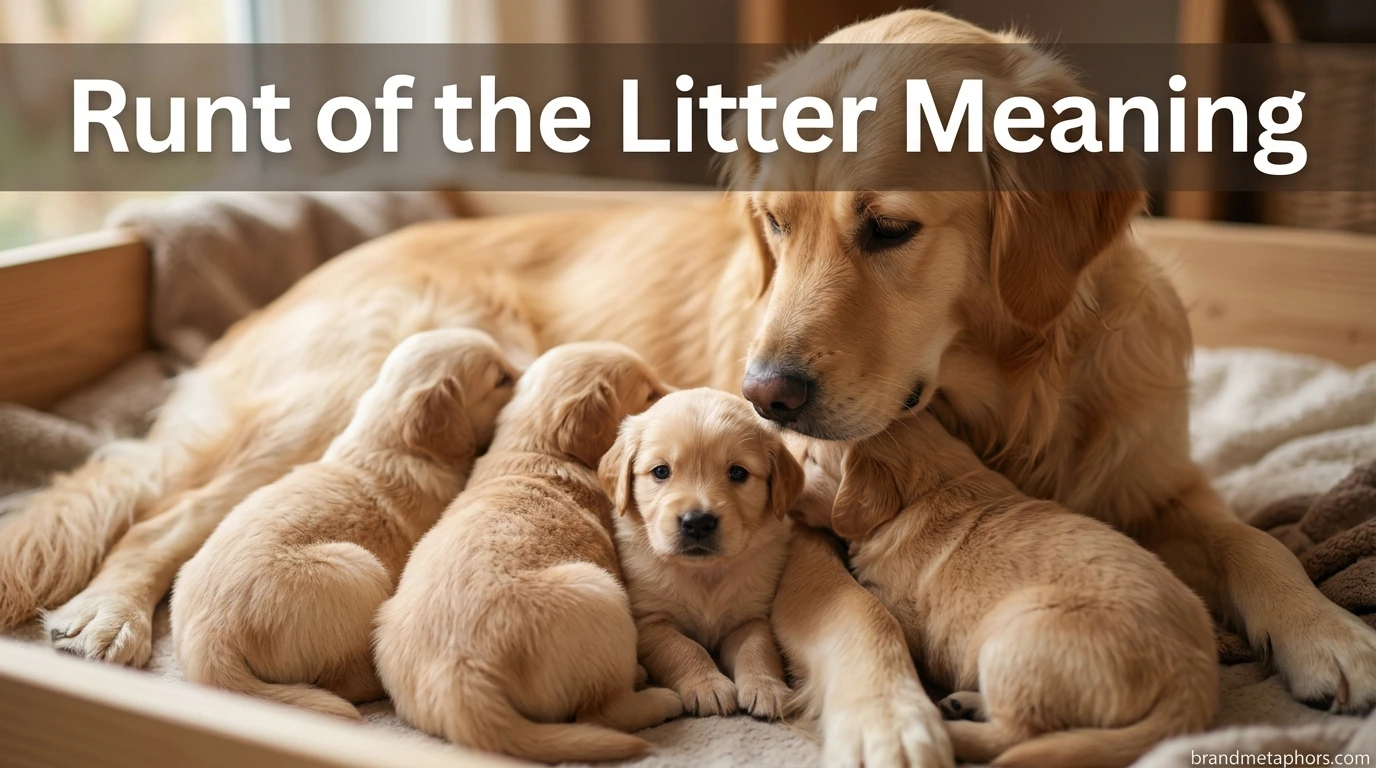
Imagine a litter of six puppies.
Five puppies are large and healthy.
One puppy is much smaller than the others.
That tiny puppy would traditionally be called the smallest member of the litter.
Today, people often use the same idea to describe humans in a figurative way.
Where Did This Expression Come From?
The phrase originally came from farming and animal breeding.
A litter is a group of baby animals born together, such as:
- Puppies
- Kittens
- Piglets
- Rabbits
- Foxes
Sometimes one baby is much smaller than the rest because it received fewer nutrients before birth or simply developed more slowly.
Farmers noticed this difference and began using the expression.
Over time, English speakers started using it as a metaphor for people who seemed weaker, younger, or less successful than those around them.
Today, it appears in:
- Books
- Movies
- Television
- Sports
- Business
- Everyday conversations
Literal Meaning vs Figurative Meaning
Understanding the difference helps avoid confusion.
MeaningExplanationExampleLiteralSmallest baby animal born in the same litterThe tiny puppy struggled to nurse.FigurativePerson seen as weaker, smaller, or less successfulEveryone underestimated him, but he became a champion.
Most modern conversations use the figurative meaning.
Different Ways People Use This Expression
Although the idea stays the same, people apply it in different situations.
1. Talking About Animals
This is the original use.
Example:
- The smallest puppy needed extra care from the veterinarian.
2. Talking About Children
Sometimes families jokingly call the youngest or smallest child this expression.
Example:
- He was the youngest brother, so everyone teased him for being the smallest one.
This is usually playful, not insulting.
3. Sports
Athletes who are smaller than competitors often receive this label.
Example:
- The shortest player became the team’s top scorer.
This often creates an inspiring story.
4. Business
Small companies competing with huge corporations may be described this way.
Example:
- The small startup defeated several large competitors.
5. School
Students who are shy, younger, or physically smaller sometimes receive this description.
Fortunately, many prove everyone wrong.
Why This Expression Is Popular

People enjoy using vivid language.
Instead of saying:
“He was smaller.”
They may say:
“He was the smallest member of the group.”
The expression creates a stronger picture in the reader’s mind.
It also adds emotion and storytelling.
Reasons people like it include:
- Easy to understand
- Creates clear mental images
- Works in many situations
- Sounds natural in English
- Makes stories more interesting
Positive and Negative Meanings
Like many idioms, the meaning depends on the situation.
Positive Meaning
Sometimes it highlights determination.
Examples:
- The smallest player became the team captain.
- Everyone doubted her, but she became a successful scientist.
- He surprised everyone by winning the competition.
Here, the expression shows courage and persistence.
Negative Meaning
Sometimes it suggests weakness.
Examples:
- The smallest puppy struggled to survive.
- People ignored his ideas because they underestimated him.
In these cases, it emphasizes disadvantage.
Neutral Meaning
Sometimes it is simply descriptive.
Example:
- The smallest kitten slept beside its mother.
No positive or negative judgment is intended.
Real-Life Examples
Let’s look at common situations.
Family Example
Among four brothers, Daniel was the smallest growing up.
Everyone expected him to stay weak.
Years later, he became the strongest athlete in the family.
School Example
Emily was the shortest student in her class.
Many classmates ignored her during sports.
She practiced every day and later became captain of the volleyball team.
Business Example
A tiny local bakery competed against large chain stores.
Because of excellent customer service and fresh products, it became the community favorite.
Animal Example
A farmer noticed one piglet was much smaller than the others.
With extra care and feeding, it grew into a healthy adult.
Life Lessons Behind the Expression
One reason this saying remains popular is the powerful lesson it teaches.
Being smaller does not decide your future.
Many successful people started with disadvantages.
Important lessons include:
- Never judge by appearance.
- Hard work matters.
- Growth takes time.
- Confidence beats doubt.
- Persistence often wins.
These lessons make the expression inspiring rather than negative.
Common Examples in Everyday Conversations
Here are natural sentences.
People
- Everyone underestimated him because he was the smallest in the family.
- She turned out to be the most successful sibling.
- The youngest employee became the best manager.
Sports
- The smallest boxer defeated the favorite.
- The shortest basketball player impressed everyone.
- The young athlete became the tournament champion.
Business
- The smallest company introduced the most innovative product.
- Their little startup challenged giant corporations.
- Nobody expected them to win the contract.
Animals
- The tiny puppy needed extra feeding.
- The smallest kitten found a caring home.
- The little piglet eventually became healthy.
Similar Expressions and Synonyms
English has many phrases with similar meanings.
ExpressionMeaningUnderdogPerson expected to loseLate bloomerSomeone who succeeds laterSmall but mightySmall yet powerfulDark horseUnexpected winnerHidden gemSomeone with overlooked talentTiny but toughSmall and strongAgainst all oddsSuccess despite difficultiesDiamond in the roughSomeone with hidden potential
These expressions often appear in motivational stories.
Common Mistakes to Avoid
Many English learners misunderstand this expression.
Mistake 1: Using It for Any Small Person
Not every small person fits the expression.
It usually compares one member with others in the same group.
Mistake 2: Thinking It Always Means Failure
Many believe it describes someone who cannot succeed.
Actually, many stories use it to show unexpected success.
Mistake 3: Using It as an Insult
The phrase can sound rude if spoken carelessly.
Consider your audience before using it.
Mistake 4: Forgetting the Animal Origin
Knowing where it came from makes its figurative meaning much easier to understand.
Why Learning Idioms Like This Improves English
Idioms make English sound natural.
Learning them helps you:
- Understand movies
- Enjoy books
- Follow conversations
- Improve speaking
- Write creatively
- Expand vocabulary
- Recognize figurative language
- Communicate like native speakers
Even if you don’t use every idiom yourself, recognizing them improves listening and reading skills.
Tips for Remembering This Expression

Memory becomes easier when you connect ideas.
Try these strategies:
Picture a Puppy
Imagine six puppies.
One is much smaller.
That image helps you remember the original meaning.
Connect It to Underdog Stories
Think of heroes who were underestimated but later succeeded.
Practice with Sentences
Write your own examples.
For instance:
- The smallest player scored the winning goal.
- Nobody believed she could succeed.
- The little company became famous.
Watch English Movies
Many films use similar expressions when describing unlikely heroes.
Listening repeatedly helps the phrase become familiar.
When Should You Use This Expression?
Good situations include:
- Casual conversations
- Storytelling
- Motivational speeches
- Sports discussions
- Family stories
- Business examples
- Creative writing
Avoid using it in formal reports or professional documents unless discussing animal breeding or using it intentionally as a metaphor.
Why This Expression Still Matters Today
Although it began hundreds of years ago, people still use it because it tells a universal story.
Many people have felt:
- Too young
- Too small
- Too weak
- Too inexperienced
- Overlooked
Yet many eventually succeed.
That emotional connection keeps the expression popular across generations.
Frequently Asked Questions (FAQs)
1. What does this expression mean?
It refers to the smallest or weakest member of a group, especially among baby animals. It can also describe a person who is underestimated because of size, age, or ability.
2. Is it always negative?
No.
Sometimes it simply describes size.
Other times it highlights someone who overcomes challenges and achieves success.
3. Can it describe people?
Yes.
Modern English often uses it figuratively for people, teams, businesses, or organizations.
4. Where did the phrase come from?
It originated from animal breeding, where one newborn animal in a litter is smaller than the others.
5. Is it an idiom?
Yes.
Although it has a literal meaning, it is commonly used as an idiomatic expression in everyday English.
6. Can it be offensive?
Sometimes.
If used to insult someone’s abilities or appearance, it may hurt feelings. Context and tone matter.
7. What are similar expressions?
Common alternatives include:
- Underdog
- Late bloomer
- Small but mighty
- Hidden gem
- Dark horse
- Against all odds
8. Why should English learners know this phrase?
Learning common idioms improves reading, speaking, listening, vocabulary, and understanding of native English conversations.
Conclusion
This expression began as a simple farming term describing the smallest newborn animal in a group, but today it carries a much deeper meaning. It often represents people, teams, or businesses that appear weaker, less experienced, or overlooked. In many stories, these underdogs surprise everyone by achieving remarkable success.
Understanding its literal and figurative meanings helps you recognize it in books, movies, conversations, and everyday English. More importantly, it reminds us not to judge others by their size, age, or first impression. With determination, practice, and confidence, even the smallest member of the group can become the strongest success story.