
Introduction
Strong writing is more than using big words. It is about choosing the right words to express the exact meaning you want. Whether you are writing a school essay, a business email, a novel, or a social media post, precise vocabulary helps readers understand your message clearly.
Figurative language also plays an important role in improving communication. Writers often use metaphors, similes, descriptive language, and other literary devices to create vivid images and emotional impact. However, even the most creative writing loses its power if commonly confused words are used incorrectly.
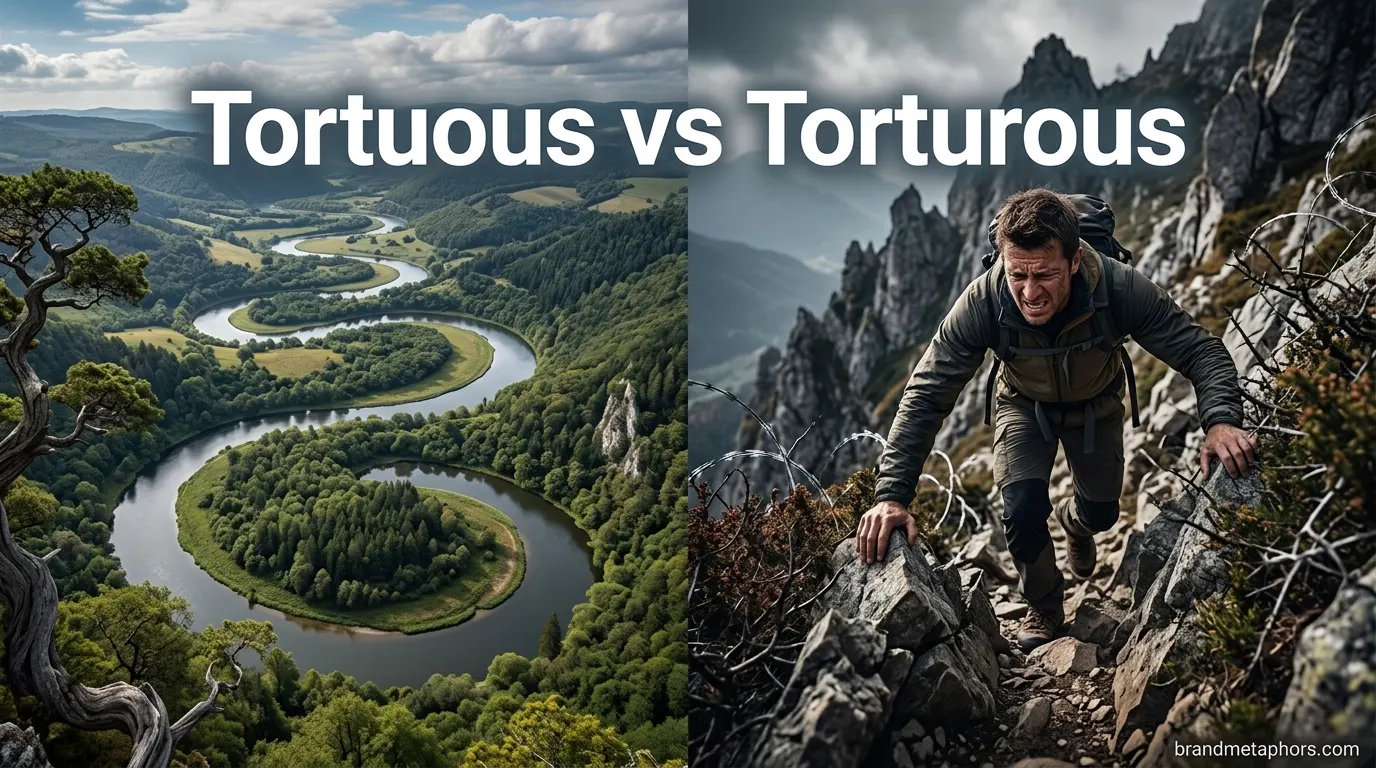
One of the most confusing word pairs in English is tortuous vs torturous. Although they look and sound similar, they have very different meanings. Mixing them up can change the meaning of an entire sentence.
This guide explains each word in simple language with comparison tables, sentence examples, writing tips, common mistakes, exercises, and practical advice. By the end, you’ll know exactly which word to choose in every situation while improving your vocabulary enhancement, writing skills, and descriptive language.
What Does “Tortuous” Mean?
Tortuous describes something that has many twists, turns, bends, or complications. It can refer to physical paths or complicated ideas, situations, or processes.
Simple Definition
Tortuous = Full of twists, turns, or complexity.
It often describes something that is difficult to follow because it is winding or complicated.
Common Uses
- A winding mountain road
- A complicated legal process
- A confusing explanation
- A twisting river
- A difficult journey
Sentence Examples
- The hikers followed a tortuous trail through the mountains.
- We faced a tortuous path to complete the project.
- His explanation became so tortuous that everyone looked confused.
- The river carved a tortuous route through the valley.
- Negotiations took a tortuous course before reaching an agreement.
Easy Memory Trick
Think of tortuous as twisting.
Both begin with the letter T, making it easier to remember:
Tortuous = Twisting.
What Does “Torturous” Mean?
Torturous means extremely painful, agonizing, or causing severe physical or emotional suffering.
Simple Definition
Torturous = Painful or full of suffering.
It describes experiences that feel like torture.
Common Uses
- Emotional pain
- Physical pain
- Long waiting periods
- Difficult recoveries
- Exhausting experiences
Sentence Examples
- Waiting for the exam results was torturous.
- She experienced a torturous recovery after surgery.
- The heat made the race torturous.
- The silence during the interview felt torturous.
- Climbing the steep hill became a torturous experience.
Easy Memory Trick
Notice the word torture inside torturous.
If something causes suffering, torturous is the correct choice.
Quick Comparison Table
FeatureTortuousTorturousMain MeaningTwisting or complicatedPainful or agonizingRefers ToShape or complexityPain and sufferingPhysical UseYesYesEmotional UseSometimesVery oftenCommon ContextRoads, rivers, argumentsPain, waiting, recoveryMemory TipTwistsTorture
Understanding the Difference

Although these words share similar spellings, they describe completely different ideas.
Tortuous
Focuses on shape, direction, or complexity.
Examples:
- A winding road
- A confusing argument
- A lengthy legal process
Torturous
Focuses on pain and suffering.
Examples:
- A painful injury
- Emotional heartbreak
- Miserable waiting
Compare these sentences:
- The tortuous road climbed the mountain.
- The torturous climb exhausted every hiker.
The road twists.
The climb hurts.
Why Writers Confuse These Words
Several reasons explain why many English learners make this mistake.
Similar Pronunciation
The words sound nearly identical.
Similar Spelling
Only two letters create the difference.
Shared Origin
Both come from the Latin word meaning “twist.”
Over time, English developed separate meanings.
Lack of Context
Writers often rely on spelling instead of meaning.
Always ask yourself:
- Is it twisting?
- Or is it painful?
The answer tells you which word to use.
Sentence Examples in Different Contexts
Travel
- The tortuous road crossed five mountain passes.
- The hike became torturous because of the extreme heat.
Education
- The professor explained the theory in a tortuous way.
- Waiting for final grades was torturous.
Sports
- The race followed a tortuous forest trail.
- Marathon runners described the last miles as torturous.
Business
- The company faced a tortuous approval process.
- The long negotiations became torturous for everyone involved.
Daily Life
- We drove along a tortuous coastal highway.
- Sitting in traffic for four hours felt torturous.
Figurative Language and Creative Writing
Good authors often combine precise vocabulary with figurative language.
Metaphor Examples
- Her thoughts followed a tortuous maze.
- His regret became a torturous chain around his heart.
Simile Examples
- The road twisted like a snake through the valley.
- Waiting felt as torturous as standing under the blazing sun.
Descriptive Language
Instead of saying:
“The path was difficult.”
Write:
“The tortuous mountain path curled through thick forests.”
Instead of saying:
“The wait was hard.”
Write:
“The torturous wait stretched into what felt like forever.”
These choices make writing more vivid.
Tone and Style Usage
Formal Writing
Suitable:
- The investigation followed a tortuous process.
- Recovery proved torturous for many patients.
Academic Writing
Appropriate when discussing:
- Complex procedures
- Medical experiences
- Historical events
- Literature
Creative Writing
Excellent for:
- Building suspense
- Creating emotional scenes
- Describing landscapes
- Character development
Journalism
Both words appear frequently in news reports.
Examples:
- A tortuous political negotiation.
- A torturous recovery after injury.
When to Use Each Word

Use “Tortuous” When
Describing winding roads
Talking about complicated ideas
Explaining confusing arguments
Describing twisting rivers
Referring to indirect processes
Examples
- The trail became increasingly tortuous.
- The legal case followed a tortuous path.
Use “Torturous” When
Talking about pain
Describing emotional suffering
Referring to difficult recovery
Explaining miserable experiences
Describing physical agony
Examples
- The treatment was torturous.
- Waiting for the phone call became torturous.
When to Avoid These Words
Avoid tortuous if you simply mean:
- Difficult
- Long
- Painful
Instead, ask whether something actually twists or is unusually complex.
Avoid torturous if there is no suffering involved.
Incorrect:
The torturous river flowed through the valley.
Correct:
The tortuous river flowed through the valley.
Incorrect:
The tortuous headache lasted all day.
Correct:
The torturous headache lasted all day.
Common Mistakes
Mistake 1
❌ The torturous road climbed the mountain.
✔ The tortuous road climbed the mountain.
Mistake 2
❌ Waiting for surgery was tortuous.
✔ Waiting for surgery was torturous.
Mistake 3
❌ The torturous river bent around the cliffs.
✔ The tortuous river bent around the cliffs.
Mistake 4
❌ Her tortuous pain continued for weeks.
✔ Her torturous pain continued for weeks.
Mistake 5
Using either word when a simpler word works better.
Sometimes words like:
- winding
- painful
- confusing
- exhausting
communicate the idea more naturally.
Comparison Examples
SituationCorrect WordExampleMountain roadTortuousThe tortuous road had many sharpturns.Surgery recoveryTorturousRecovery wastorturous.Legal processTortuousThe tortuous procedure lasted months.Broken legTorturousThe injury was torturous.RiverTortuousThe tortuous river curved around the hills.Emotional waitingTorturousThe wait became torturous.
Related Vocabulary
Learning related words improves vocabulary enhancement.
Words Related to Tortuous
- winding
- twisting
- indirect
- crooked
- circuitous
- meandering
- complicated
- complex
- intricate
Words Related to Torturous
- painful
- agonizing
- unbearable
- excruciating
- miserable
- distressing
- exhausting
- cruel
- difficult
Practice Exercises
Exercise 1
Choose the correct word.
- The mountain road was __________.
Answer:
Tortuous
- Waiting for the doctor was __________.
Answer:
Torturous
- The river followed a __________ path.
Answer:
Tortuous
- The recovery after surgery was __________.
Answer:
Torturous
- The legal process became __________.
Answer:
Tortuous
Exercise 2
Fill in the blanks.
- The hikers followed a __________ trail.
- The final exam week felt __________.
- The explanation became so __________ that nobody understood it.
- His injury caused __________ pain.
- The winding river looked beautifully __________.
Answers
- tortuous
- torturous
- tortuous
- torturous
- tortuous
Tips to Remember Forever
- Tortuous = Twists
- Torturous = Torture
- Roads twist.
- Rivers twist.
- Pain hurts.
- Waiting hurts.
- Recovery hurts.
When unsure, ask:
“Is it twisting or painful?”
That simple question usually gives the correct answer immediately.
Frequently Asked Questions
1. Are tortuous and torturous interchangeable?
No. Although they sound alike, they describe different ideas. Tortuous refers to something winding or complex, while torturous refers to something painful or agonizing.
2. Which word describes a winding road?
Use tortuous because roads can have many twists and turns.
3. Which word describes emotional pain?
Use torturous, since emotional suffering is a form of agony.
4. Why do people confuse these words?
They have similar spellings, nearly identical pronunciation, and a shared historical origin, making them easy to mix up.
5. How can I remember the difference?
Remember:
- Tortuous = Twisting
- Torturous = Torture
This memory trick works in almost every situation.
Conclusion
Choosing precise words is one of the easiest ways to become a stronger writer. While tortuous and torturous may look almost identical, they express very different meanings. One describes something that twists, winds, or becomes complicated. The other describes experiences filled with pain, suffering, or emotional distress.
Understanding this distinction helps students write clearer essays, enables professionals to communicate accurately, and allows creative writers to craft richer descriptions. Pairing precise vocabulary with figurative language, metaphor examples, simile examples, descriptive language, and other literary devices also makes writing more engaging and memorable.
The next time you encounter these similar-looking words, pause for a moment and ask yourself a simple question: Is it twisting, or is it painful? If it twists, choose tortuous. If it causes suffering, choose torturous. With regular practice and careful word choice, your writing skills and vocabulary will continue to grow.