
Education begins long before a student opens a textbook. It starts with curiosity—the quiet spark that asks why the sky changes color at sunset, how bridges stay standing, or what stories hide inside old books. Imagine a child sitting by a rainy window, tracing patterns on the glass while wondering about the world beyond it. That simple moment of wonder is where education truly begins.
Education is more than classrooms, exams, and report cards. It is a journey of discovery, transformation, and growth. Because learning can be difficult to describe directly, writers, teachers, and speakers often use metaphors for education to make its meaning more vivid and memorable. Metaphors turn abstract ideas into images we can see and feel. They help us understand the value of knowledge, the challenges of learning, and the rewards of personal growth.
From ancient philosophers to modern educators, people have compared education to gardens, bridges, keys, and countless other symbols. These comparisons reveal different aspects of learning and inspire students to see education as more than a requirement—it becomes an adventure.
In this article, we will explore powerful metaphors for education, their meanings, examples, and practical ways to use them in writing and daily life.
Why Metaphors for Education Matter
Understanding Learning Through Imagery
Education is a complex process. Metaphors simplify that complexity by connecting learning to familiar experiences.
When someone says, “Education is a key,” we instantly understand that learning unlocks opportunities.
Metaphors help:
- Make ideas memorable
- Inspire students
- Improve writing and speaking
- Create emotional connections
- Explain difficult concepts simply
They transform education from an abstract concept into a vivid experience.
Education as a Journey
Learning One Step at a Time
One of the most common metaphors for education is the journey.
Just as travelers move toward a destination, learners progress toward knowledge and wisdom.
Meaning:
Education involves growth, challenges, discoveries, and milestones.
Example Sentence:
“Her education was a long journey filled with unexpected turns and valuable lessons.”
Alternative Expressions:
- Education is a road
- Learning is an adventure
- Knowledge is a pathway
- School is a voyage
Mini Story:
A student struggling with mathematics feels discouraged after several poor test scores. Yet, like a traveler climbing a mountain trail, each step teaches persistence. Years later, those difficult lessons become part of a successful engineering career.
The journey metaphor reminds us that progress matters more than speed.
Education as a Key
Unlocking Doors of Opportunity
A key opens doors that would otherwise remain closed. Education works in much the same way.
Meaning:
Learning provides access to opportunities, careers, and personal growth.
Example Sentence:
“Education is the key that unlocks countless possibilities.”
Alternative Expressions:
- Knowledge is a master key
- Learning opens doors
- Wisdom unlocks potential
Sensory Detail:
Imagine hearing the click of a lock opening. That sound mirrors the feeling of understanding something new.
Throughout history, education has empowered individuals to overcome barriers and create better futures.
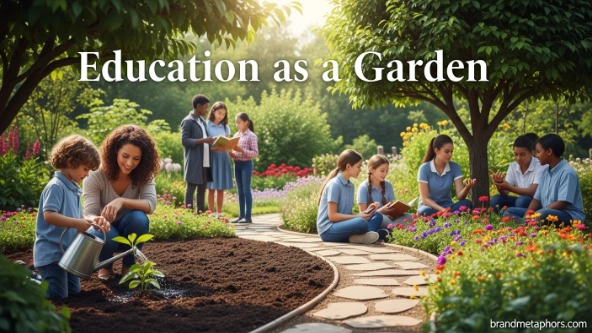
Education as a Garden
Growing Knowledge and Character
Gardens flourish when they receive attention, care, and patience. Learning follows a similar pattern.
Meaning:
Education nurtures intellectual and personal growth over time.
Example Sentence:
“A good teacher tends the garden of young minds.”
Alternative Expressions:
- Learning plants seeds
- Knowledge blossoms
- Education cultivates growth
Literary Connection:
Many cultures compare wisdom to growing trees. Ancient teachings often emphasize planting seeds today for tomorrow’s harvest.
Like a gardener, a student must water ideas through practice and patience.
Education as a Bridge
Connecting Dreams and Reality
Bridges help people cross obstacles and reach new places.
Meaning:
Education helps individuals move from where they are to where they want to be.
Example Sentence:
“Education became the bridge between his dreams and reality.”
Alternative Expressions:
- Learning spans gaps
- Knowledge creates connections
- Education links possibility and achievement
Real-Life Example:
Many first-generation college students describe education as the bridge that helped them reach opportunities unavailable to previous generations.
This metaphor highlights education’s transformative power.
Education as a Lighthouse
Guiding Through Uncertainty
A lighthouse provides direction during storms and darkness.
Example, Meaning, and Usage
Meaning:
Education offers guidance, wisdom, and clarity.
Example Sentence:
“Education served as a lighthouse during difficult times.”
Alternative Expressions:
- Learning lights the way
- Knowledge provides direction
- Wisdom guides the journey
Emotional Detail:
Imagine a ship battling rough waves at night. The distant light offers hope and direction. Education often provides that same reassurance.
Education as a Foundation
Building a Strong Future
Every strong building requires a solid foundation.
Example, Meaning, and Usage
Meaning:
Education creates the base upon which future success is built.
Example Sentence:
“A quality education forms the foundation of lifelong achievement.”
Alternative Expressions:
- Learning lays groundwork
- Knowledge builds strength
- Education supports growth
Without a strong foundation, even the tallest structure becomes unstable. The same principle applies to life and learning.
Education as a Treasure
A Wealth That Cannot Be Stolen
Unlike material possessions, knowledge remains with us wherever we go.
Example, Meaning, and Usage
Meaning:
Education is a valuable asset that grows over time.
Example Sentence:
“Her education became a treasure that enriched every part of her life.”
Alternative Expressions:
- Knowledge is gold
- Learning is priceless wealth
- Wisdom is a hidden gem
Mini Story:
A young woman loses many belongings during a difficult period. Yet the skills and knowledge she gained through education help her rebuild her future.
This metaphor emphasizes lasting value.
Education as a Compass
Finding Direction in Life
Compasses help travelers navigate unfamiliar territory.
Example, Meaning, and Usage
Meaning:
Education provides guidance for decision-making and personal growth.
Example Sentence:
“Education acted as a compass throughout his career.”
Alternative Expressions:
- Knowledge points the way
- Learning guides choices
- Wisdom directs the path
Students often face uncertainty. Education equips them with tools to navigate those challenges confidently.
Education as a Window

Expanding Perspectives
Windows allow us to see beyond our immediate surroundings.
Example, Meaning, and Usage
Meaning:
Education broadens understanding and exposes learners to new ideas.
Example Sentence:
“Books became windows to worlds she had never imagined.”
Alternative Expressions:
- Learning widens horizons
- Knowledge reveals new views
- Education opens perspectives
Cultural Reference:
Many famous authors describe reading as a way to travel without leaving home.
Education helps people see beyond their own experiences.
Education as a Flame
Igniting Curiosity and Passion
A single spark can light an entire room.
Example, Meaning, and Usage
Meaning:
Education inspires curiosity, creativity, and motivation.
Example Sentence:
“A great teacher ignited a flame of curiosity that lasted a lifetime.”
Alternative Expressions:
- Learning sparks imagination
- Knowledge fuels ambition
- Education lights inspiration
Emotional Detail:
The warmth of a fire mirrors the excitement of discovering a new idea.
The best education does not simply fill minds—it ignites them.
Three Powerful Metaphors for Education You Can Use Today
Quick Examples for Writing and Speaking
1. Education Is a Garden
Meaning: Growth requires care and patience.
Example: “Every lesson planted a seed for future success.”
Alternative: Learning is a field waiting to bloom.
2. Education Is a Key
Meaning: Knowledge creates opportunities.
Example: “Her education unlocked doors around the world.”
Alternative: Learning opens gates of possibility.
3. Education Is a Lighthouse
Meaning: Wisdom provides guidance.
Example: “Education guided him through uncertainty.”
Alternative: Knowledge shines through darkness.
These metaphors work especially well in essays, speeches, and social media posts.
Interactive Exercises for Practicing Education Metaphors
Creative Activities for Readers
Exercise 1: Complete the Sentence
Finish this statement:
“Education is a ______ because ______.”
Examples:
- Education is a river because it keeps moving forward.
- Education is a ladder because it helps people climb higher.
Exercise 2: Create a Personal Metaphor
Think about your own learning experiences.
Ask yourself:
- What does learning feel like?
- What image comes to mind?
- What object represents your educational journey?
Write three unique metaphors.
Exercise 3: Story Challenge
Write a short paragraph using one education metaphor.
Example:
“Education was a bridge stretching across uncertainty. Each lesson became a plank, helping me cross toward my goals.”
Bonus Tips for Using Metaphors for Education
Improve Writing, Social Media, and Everyday Communication
For Essays
Use metaphors in introductions and conclusions to create memorable impressions.
Example:
“Education is the compass that guides society toward progress.”
For Social Media
Short metaphors perform well in captions.
Examples:
- “Education is a key to endless possibilities.”
- “Learning is a journey worth every step.”
For Public Speaking
Use metaphors to connect emotionally with audiences.
Example:
“Teachers do more than share information; they light flames that illuminate futures.”
For Teaching
Metaphors help students understand difficult concepts quickly.
For Personal Reflection
Create your own learning metaphor to stay motivated during challenges.
Frequently Asked Questions About Metaphors for Education
What is a metaphor for education?
A metaphor for education compares learning to another object, experience, or idea without using “like” or “as.” Examples include education as a journey, key, or garden.
Why are metaphors useful in education?
Metaphors make complex ideas easier to understand, remember, and relate to emotionally.
What is the most common metaphor for education?
Education as a journey is one of the most widely used metaphors because learning involves progress, challenges, and growth.
How can students use education metaphors in writing?
Students can use metaphors in essays, speeches, stories, and presentations to make ideas more vivid and engaging.
Can teachers use metaphors in the classroom?
Yes. Metaphors help explain difficult concepts, improve comprehension, and encourage creative thinking.
Conclusion
Education is far more than a collection of lessons and examinations. It is a journey that leads to discovery, a key that unlocks opportunity, a garden that nurtures growth, and a lighthouse that provides guidance through uncertainty. These metaphors for education help us see learning not merely as a task but as a transformative experience that shapes who we become.
Whether you are a student, teacher, writer, or lifelong learner, metaphors can deepen your understanding of education and make your communication more powerful. The next time you think about learning, ask yourself: What metaphor best describes your educational journey? The answer may reveal something meaningful about where you have been—and where you are going next.