

Writing an essay can feel like standing at the edge of a vast landscape with nothing but a blank page in front of you. The cursor blinks. Ideas swirl in your mind like leaves caught in a gentle wind. You know what you want to say, but finding the right words can seem difficult.
This is where metaphors become magical tools.
A metaphor is more than a figure of speech. It transforms ordinary writing into something vivid, memorable, and emotionally engaging. Instead of simply stating facts, metaphors help readers see, feel, and experience your ideas. They turn essays from collections of sentences into journeys filled with imagery and meaning.
Whether you’re writing a school assignment, college paper, blog post, or personal essay, metaphors can make your arguments stronger and your descriptions more colorful. Great writers throughout history have used metaphors to capture attention and communicate complex thoughts with clarity.
In this guide, you’ll discover powerful metaphors for essays, practical examples, creative exercises, and useful strategies that will help elevate your writing to the next level.
What Are Metaphors for Essays?
Understanding the Power of Metaphorical Writing
A metaphor directly compares one thing to another without using “like” or “as.”
Instead of saying:
“Writing an essay is difficult.”
You could say:
“Writing an essay is climbing a mountain.”
The second sentence creates an image. Readers immediately understand the challenge, effort, and reward involved.
Metaphors help essays by:
- Creating vivid imagery
- Simplifying complex ideas
- Building emotional connections
- Making writing memorable
- Improving reader engagement
Think of metaphors as bridges connecting ideas to imagination.
Why Metaphors Make Essays More Engaging
Turning Facts into Experiences
Imagine reading two introductions.
The first says:
“Education is important for success.”
The second says:
“Education is the key that unlocks countless doors throughout life.”
Which one stays in your memory?
The second example works because it transforms an abstract concept into something visual and meaningful.
Many famous speeches and essays rely heavily on metaphors. They help audiences understand difficult concepts while making the message more compelling.
A Real-Life Example
A teacher once compared essay writing to baking a cake.
The thesis was the recipe.
The evidence became ingredients.
The conclusion was the finished dessert.
Students instantly understood the structure because they could visualize the process.
Essay Writing as a Journey
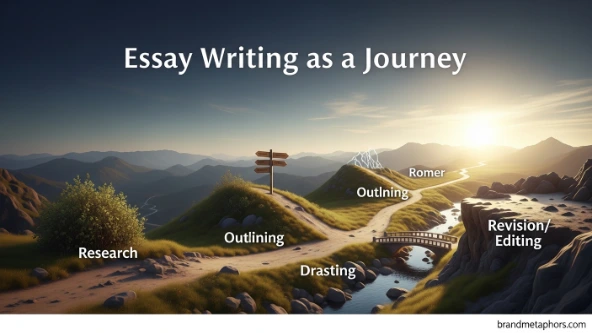
One of the Most Popular Essay Metaphors
Perhaps the most common metaphor is:
“An essay is a journey.”
Every journey has:
- A starting point
- A path
- Important stops
- A destination
Similarly, every essay has:
- An introduction
- Supporting paragraphs
- Key arguments
- A conclusion
Example Sentence
“The essay guides readers through a winding journey of discovery.”
Alternative Expressions
- An essay is a road trip.
- An essay is a voyage across the sea.
- An essay is a path through a forest.
- An essay is an adventure.
Emotional Impact
Journey metaphors create curiosity. Readers feel invited to travel alongside the writer.
Essay Writing as Building a House
Constructing Strong Arguments
Another powerful metaphor is:
“An essay is a house.”
A house requires planning, structure, and support.
Likewise, an essay needs organization and evidence.
How the Comparison Works
- Foundation = Thesis statement
- Walls = Supporting arguments
- Rooms = Body paragraphs
- Roof = Conclusion
Example Sentence
“Without evidence, the essay’s walls begin to crumble.”
Alternative Ways to Express It
- An essay is a skyscraper.
- An essay is a castle.
- An essay is a bridge.
- An essay is an architectural masterpiece.
Mini Storytelling Example
Imagine a builder rushing through construction without a blueprint.
Soon cracks appear.
The same happens when writers skip outlining. Strong essays, like strong houses, require careful planning.
Essay Writing as Gardening
Growing Ideas into Strong Arguments
Writers often start with small ideas.
These ideas grow over time.
That makes gardening an excellent metaphor.
“An essay is a garden.”
Meaning Behind the Metaphor
- Seeds = Ideas
- Water = Research
- Sunlight = Creativity
- Flowers = Finished arguments
Example Sentence
“Her essay blossomed into a vibrant garden of thoughtful insights.”
Alternative Expressions
- An essay is a growing tree.
- An essay is a field of ideas.
- An essay is a blooming landscape.
Sensory Details
Picture fresh soil after rain.
Imagine tiny sprouts pushing toward sunlight.
That same growth happens when ideas develop into polished essays.
Essay Writing as Painting a Picture
Creating Images with Words
Artists use brushes.
Writers use language.
This comparison leads to a beautiful metaphor:
“An essay is a painting.”
Why It Works
All sentence adds color.
Every paragraph adds depth.
Every detail creates a clearer image.
Example Sentence
“The author painted a vivid picture of modern society through carefully chosen words.”
Alternative Expressions
- An essay is a mural.
- An essay is a portrait.
- An essay is a masterpiece.
- An essay is a canvas of ideas.
Literary Connection
Many celebrated authors describe writing as artistic creation. Their essays often feel like paintings brought to life through language.
Essay Writing as Weaving a Tapestry

Connecting Ideas Seamlessly
A tapestry combines many threads into one beautiful design.
Essays work the same way.
“An essay is a tapestry.”
Symbolic Meaning
- Threads = Evidence
- Colors = Perspectives
- Patterns = Structure
- Finished tapestry = Complete essay
Example Sentence
“The writer wove personal experiences and research into a rich tapestry of ideas.”
Alternative Expressions
- An essay is woven fabric.
- An essay is a quilt.
- An essay is an intricate design.
Cultural Reference
Ancient cultures often used tapestries to tell stories. Modern essays also tell stories—just through words rather than threads.
Essay Writing as Solving a Puzzle
Bringing Pieces Together
Complex essays often require careful thinking.
That’s why puzzle metaphors work well.
“An essay is a puzzle.”
Explanation
- Pieces = Facts
- Connections = Analysis
- Missing pieces = Research gaps
- Completed puzzle = Finished argument
Example Sentence
“Each source added another piece to the puzzle of understanding climate change.”
Alternative Expressions
- An essay is a mystery.
- An essay is a treasure map.
- An essay is an investigation.
Real-Life Application
Research papers especially benefit from puzzle metaphors because they involve gathering information and finding meaningful connections.
Essay Writing as a Conversation
Speaking Directly to Readers
Essays are not one-sided lectures.
They often resemble conversations.
“An essay is a dialogue.”
Why This Metaphor Matters
Writers present ideas.
Readers respond mentally.
Arguments and evidence answer questions.
Example Sentence
“The essay invites readers into an ongoing conversation about technology and society.”
Alternative Expressions
- An essay is a discussion.
- An essay is a debate.
- An essay is a friendly exchange.
Emotional Connection
Conversation metaphors make writing feel personal and approachable.
Three Powerful Metaphor Strategies for Better Essays
Strategy 1: Match the Metaphor to Your Topic
A science essay might use exploration metaphors.
A history essay might use journey metaphors.
A personal essay might use gardening metaphors.
Example
“My confidence grew from a fragile seed into a towering oak tree.”
Strategy 2: Stay Consistent
Avoid mixing unrelated metaphors.
Bad example:
“My essay is a ship climbing a mountain while planting flowers.”
Good example:
“My essay is a ship navigating challenging waters toward discovery.”
Strategy 3: Use Metaphors Sparingly
Too many metaphors can overwhelm readers.
One strong metaphor often has greater impact than ten weak ones.
Interactive Exercises to Practice Essay Metaphors
Exercise 1: Transform a Plain Sentence
Take this sentence:
“Learning requires effort.”
Turn it into a metaphor.
Possible answers:
- Learning is a mountain to climb.
- Learning is a marathon.
- Learning is forging steel in a fire.
Exercise 2: Build Your Own Essay Metaphor
Choose one topic:
- Friendship
- Success
- Technology
- Education
Complete this sentence:
“__________ is a __________.”
Then explain why.
Exercise 3: Expand the Metaphor
Start with:
“Life is a book.”
Now identify:
- Chapters
- Pages
- Characters
- Plot twists
This exercise strengthens creative thinking and essay development skills.
Bonus Tips for Using Metaphors in Writing and Daily Life

Make Social Media Posts More Memorable
Instead of:
“I’m busy today.”
Try:
“Today feels like a whirlwind carrying me from task to task.”
Improve Presentations
Metaphors help audiences remember information.
A memorable image often lasts longer than a statistic.
Enhance Personal Writing
Journals, blogs, and stories become more engaging when metaphors add emotion and depth.
Read Great Writers
Pay attention to metaphors used in novels, speeches, and essays.
Notice how they transform ordinary ideas into unforgettable images.
Create a Metaphor Notebook
Whenever an interesting comparison comes to mind, write it down.
Over time, you’ll build a valuable collection of creative ideas.
Common Mistakes When Using Metaphors in Essays
Avoid Clichés
Overused metaphors can feel predictable.
Examples include:
- Time is money.
- Life is a journey.
- Busy as a bee.
Try creating fresh variations.
Don’t Force Comparisons
Metaphors should feel natural.
If readers struggle to understand them, simplify.
Keep Your Audience in Mind
Academic essays may require subtle metaphors.
Creative essays can support more imaginative comparisons.
Focus on Clarity
The best metaphors illuminate ideas rather than confuse them.
Always prioritize understanding.
Frequently Asked Questions About Metaphors for Essays
What is a metaphor in an essay?
A metaphor is a direct comparison between two unlike things that helps explain an idea or create vivid imagery.
Why are metaphors important in essay writing?
Metaphors make essays more engaging, memorable, and easier for readers to understand.
Can metaphors be used in academic essays?
Yes. When used appropriately, metaphors can clarify complex concepts and strengthen explanations.
How many metaphors should I use in an essay?
Quality matters more than quantity. A few strong metaphors are usually more effective than many weak ones.
What is the best metaphor for essay writing?
Popular choices include essays as journeys, houses, gardens, paintings, or conversations because these comparisons clearly illustrate the writing process.
Conclusion
Metaphors are among the most powerful tools available to writers. They transform plain statements into vivid experiences, helping readers see ideas from fresh perspectives. Whether you think of an essay as a journey, a house, a garden, a painting, or a puzzle, metaphors provide structure, clarity, and emotional depth.
The next time you sit down to write, imagine your essay becoming something more than words on a page. Perhaps it’s a road leading toward discovery. Maybe it’s a carefully built home filled with ideas. Or perhaps it’s a garden waiting to bloom.
Whatever metaphor you choose, let it guide your creativity. With thoughtful comparisons and vivid imagery, your essays can become more engaging, memorable, and meaningful for every reader who follows the path you’ve created.