
Fear has a way of arriving quietly. Sometimes it creeps into a room like a shadow at sunset. Other times it crashes into our thoughts like thunder rolling across a dark sky. Imagine standing backstage before a speech, your heart beating fast, your palms damp, and your mind racing. In moments like these, fear feels almost alive.
That is why writers, speakers, and storytellers often use metaphors for fear. A metaphor turns an invisible emotion into something we can see, hear, or touch. Instead of simply saying “I was afraid,” we can say “Fear was a cage around my thoughts” or “Fear was a storm gathering in my chest.”
Metaphors make writing more vivid and memorable. They help readers connect emotionally with a scene, character, or personal experience. Whether you are writing fiction, poetry, social media captions, speeches, or journal entries, understanding fear metaphors can transform ordinary words into powerful imagery.
In this guide, you will discover meaningful metaphors for fear, learn how to use them effectively, explore literary examples, and practice creating your own. By the end, fear itself may become one of the most expressive emotions in your writing toolbox.
Why Metaphors for Fear Matter
Turning Emotions into Images
Fear is invisible. People cannot see anxiety, nervousness, or dread directly. Metaphors give those feelings shape.
Instead of saying:
- I felt scared.
You could write:
- Fear wrapped around me like a cold blanket.
The second sentence creates a stronger emotional picture.
Making Writing More Memorable
Readers remember images more than simple statements. A vivid metaphor stays in the mind long after the page is turned.
Creating Emotional Connection
Fear is universal. Nearly everyone has felt it. Strong metaphors help readers recognize their own experiences in your words.
Fear as a Dark Storm
Meaning and Symbolism
One of the most common metaphors for fear is a storm. Storms represent uncertainty, danger, and overwhelming emotions.
Fear often feels like dark clouds gathering before a difficult event.
Example
“Fear was a storm brewing inside her chest, filling every corner with thunder.”
Alternative Expressions
- Fear was a hurricane of doubts.
- Anxiety was a lightning strike waiting to happen.
- Worry was a raincloud hanging overhead.
Mini Story
Before his final exam, Amir sat quietly at his desk. Outside, the sky was clear. Inside, however, a storm raged. Every possible mistake flashed through his mind like lightning.
Sensory Details
- Rumbling thunder
- Cold wind
- Dark clouds
- Sudden flashes of light
Fear as a Shadow
Meaning and Symbolism
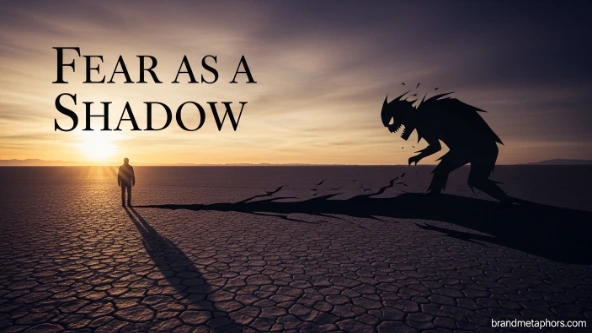
Shadows follow us. They appear silently and often seem larger in darkness. This makes them powerful symbols for fear.
Fear frequently grows when we cannot clearly see what lies ahead.
Example
“Fear was a shadow trailing behind her every step.”
Alternative Expressions
- Fear lurked in the shadows.
- Anxiety stretched across the room like darkness.
- Worry followed him like a silent silhouette.
Literary Connection
Many gothic novels use shadows to symbolize hidden fears and unknown dangers. Darkness often represents emotional uncertainty.
Writing Tip
Use shadow metaphors when describing fears that linger over time rather than sudden moments of panic.
Fear as a Cage
Meaning and Symbolism
Fear often prevents people from acting. It limits choices and traps potential.
That is why a cage works as such a powerful metaphor.
Example
“Fear was a cage built from invisible bars.”
Alternative Expressions
- Anxiety locked every door.
- Worry imprisoned her confidence.
- Doubt became a prison of hesitation.
Real-Life Example
Someone may dream of starting a business but never take the first step because fear keeps them trapped inside their comfort zone.
Emotional Details
This metaphor conveys:
- Restriction
- Frustration
- Powerlessness
- Isolation
Fear as an Iceberg
Meaning and Symbolism
An iceberg shows only a small portion above water. Most of it remains hidden.
Fear often works the same way. People may appear calm while carrying deep worries beneath the surface.
Example
“His fear was an iceberg drifting beneath calm waters.”
Alternative Expressions
- Anxiety hid below the surface.
- Worry floated silently beneath his smile.
- Fear was buried deep underwater.
Why It Works
This metaphor is especially useful for describing hidden emotional struggles.
Practice Prompt
Think of a time when you looked calm but felt nervous inside. Write three sentences using the iceberg metaphor.
Fear as a Monster
Meaning and Symbolism
Throughout history, cultures have described fear as a monster. Monsters represent threats, uncertainty, and danger.
Example
“Fear was a monster feeding on every negative thought.”
Alternative Expressions
- Anxiety bared its teeth.
- Worry growled from the corner of his mind.
- Dread stalked him like a beast.
Cultural References
Ancient myths often featured dragons, giants, and creatures that heroes had to overcome. These monsters frequently symbolized inner fears.
Storytelling Advantage
Monster metaphors create dramatic imagery and work particularly well in fiction and fantasy writing.
Fear as a Thick Fog
Meaning and Symbolism
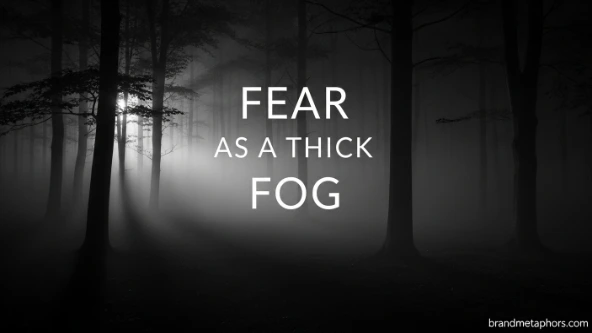
Fog limits visibility. It makes it difficult to know what lies ahead.
Fear often clouds judgment in the same way.
Example
“Fear was a thick fog that blurred every possibility.”
Alternative Expressions
- Anxiety clouded his vision.
- Worry covered the path ahead.
- Doubt settled like mist across her thoughts.
Real-Life Application
This metaphor works well when describing uncertainty about the future.
Sensory Details
Imagine:
- Damp air
- Muted sounds
- Limited visibility
- Slow movement
These details make the metaphor more immersive.
Fear as a Chain
Meaning and Symbolism
Chains symbolize restraint and limitation.
Fear can keep people from pursuing opportunities, relationships, and dreams.
Example
“Fear chained her to the safety of the familiar.”
Alternative Expressions
- Anxiety tied him down.
- Worry shackled his ambitions.
- Doubt bound his confidence.
Writing Insight
This metaphor is particularly effective when discussing personal growth and overcoming obstacles.
Mini Story
A talented artist kept her paintings hidden for years. Fear chained her creativity until one day she finally shared her work with the world.
Fear as a Fire
Meaning and Symbolism
Fire can destroy, but it can also motivate action.
Fear sometimes pushes people to prepare, improve, and survive.
Example
“Fear was a fire burning at the edge of his thoughts.”
Alternative Expressions
- Anxiety smoldered beneath the surface.
- Worry sparked endless questions.
- Dread blazed through his mind.
Interesting Perspective
Unlike many fear metaphors, fire can represent both negative and positive energy.
Creative Exercise
Write two sentences:
- One where fear-fire is destructive.
- One where fear-fire motivates success.
Fear as an Ocean
Meaning and Symbolism
The ocean is vast, deep, and unpredictable. Fear often feels equally overwhelming.
Example
“Fear was an endless ocean stretching beyond the horizon.”
Alternative Expressions
- Anxiety rose like towering waves.
- Worry pulled him under.
- Dread drifted through deep waters.
Literary Feel
Ocean metaphors add a poetic quality to writing and often create a sense of emotional depth.
Sensory Elements
- Salt air
- Crashing waves
- Endless horizon
- Deep currents
These details enrich the metaphor.
Fear as a Thief
Meaning and Symbolism
Fear often steals things from us:
- Confidence
- Opportunities
- Peace of mind
- Happiness
This makes the thief metaphor particularly powerful.
Example
“Fear was a thief stealing moments of joy.”
Alternative Expressions
- Anxiety robbed her of sleep.
- Worry stole his focus.
- Doubt picked the lock on his confidence.
Real-Life Example
Many people realize years later that fear stole opportunities they were capable of pursuing.
Emotional Impact
This metaphor encourages reflection and personal growth.
How to Create Your Own Metaphors for Fear
Step 1: Identify the Feeling
Ask yourself:
- Is the fear sudden?
- Is it hidden?
- Is it overwhelming?
- Is it limiting?
Step 2: Find a Similar Object
Compare the emotion to something physical:
- Storm
- Shadow
- Monster
- Ocean
- Fire
- Fog
Step 3: Add Sensory Details
Describe:
- Sounds
- Colors
- Textures
- Movement
Example Process
Basic:
“Fear was strong.”
Improved:
“Fear was a giant wave crashing against the walls of his confidence.”
Bonus Tip
Choose fresh imagery instead of overused comparisons whenever possible.
Creative Exercises for Using Metaphors for Fear
Exercise 1: Complete the Sentence
Finish these prompts:
- Fear was a __________.
- Anxiety moved like __________.
- Worry felt like __________.
Exercise 2: Memory Challenge
Think about a frightening moment.
Write:
- What you saw
- What you heard
- What you felt
Turn those details into a metaphor.
Exercise 3: Character Creation
Create a character facing a challenge.
Describe their fear as:
- An animal
- A weather event
- A landscape
Bonus Social Media Prompt
Write a caption beginning with:
“Today my fear felt like…”
Keep it under 30 words.
Bonus Tips for Writers, Students, and Content Creators
For Fiction Writers
Match the metaphor to your story’s mood.
- Horror: shadows, monsters, fog
- Adventure: storms, oceans, fire
- Drama: cages, chains, thieves
For Poets
Combine multiple senses.
Example:
“Fear tasted like metal and sounded like distant thunder.”
For Social Media
Short metaphors often perform well.
Example:
“Fear is a locked door. Courage is turning the handle.”
For Public Speakers
Use metaphors to make emotional stories memorable.
Audiences often remember imagery long after facts.
For Daily Reflection
Try journaling with one fear metaphor each day. You may discover patterns in your emotions and reactions.
Conclusion
Fear is one of the most powerful human emotions, yet it can be difficult to describe. Metaphors bridge that gap by transforming invisible feelings into vivid images. Whether fear appears as a storm, a shadow, a cage, an iceberg, a monster, a fog, a chain, a fire, an ocean, or a thief, each metaphor reveals a different aspect of the experience.
The best metaphors for fear do more than decorate writing. They help readers feel, understand, and remember. They turn ordinary descriptions into unforgettable scenes. As you write stories, poems, journal entries, speeches, or social media posts, experiment with these images and create your own unique comparisons.
After all, fear may be universal, but the way you describe it can be entirely your own.
FAQs About Metaphors for Fear
What is a metaphor for fear?
A metaphor for fear is a comparison that describes fear as something else, such as a storm, shadow, cage, or monster, to create vivid imagery and emotional impact.
Why are metaphors for fear important in writing?
They help readers visualize emotions, connect with characters, and remember key moments more effectively than simple descriptions.
What is the most common metaphor for fear?
Fear as a storm is one of the most common metaphors because it captures uncertainty, intensity, and emotional turbulence.
Can fear metaphors be used in everyday communication?
Yes. Metaphors make conversations, speeches, social media posts, and personal reflections more engaging and expressive.
How can I create my own metaphor for fear?
Start by identifying how the fear feels, then compare it to a physical object, force, creature, or experience that shares similar qualities. Add sensory details to make the image stronger.