
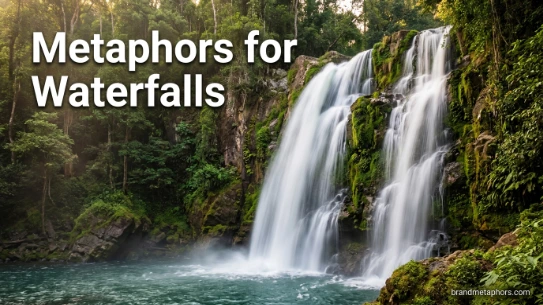
1. Metaphors for Waterfalls: A Journey into Flowing Imagery
Stand at the edge of a waterfall and you feel it before you truly see it—the deep vibration of water hitting stone, the mist kissing your face, the thunder of nature speaking in a language older than words. Waterfalls are not just landscapes; they are living poetry. They fall, they crash, they shimmer, and in doing so, they become one of the richest sources of metaphor in language and storytelling.
Writers, poets, and everyday speakers often turn to waterfalls when they want to describe emotions, transformation, or unstoppable energy. Why? Because waterfalls represent motion that cannot be paused, beauty that is wild rather than controlled, and power that is both destructive and life-giving.
In this article, we will explore metaphors for waterfalls that you can use in writing, storytelling, poetry, social media captions, or even personal reflection. Each metaphor will open a different emotional doorway—some peaceful, some chaotic, all deeply expressive.
Let’s step closer to the edge.
2. The Waterfall as a Roaring Voice of Nature
One of the most common metaphors for waterfalls is a voice that cannot be silenced.
A waterfall is often compared to:
- A roaring giant speaking through stone
- Nature shouting its truth across valleys
- A thunderous choir that never stops singing
Meaning & Explanation: This metaphor emphasizes power, intensity, and constant expression. Just like a waterfall never stops falling, certain emotions—anger, passion, grief, excitement—can feel unstoppable.
Example Sentence: “The waterfall was the mountain’s voice, roaring its ancient secrets into the forest below.”
Alternative Expressions:
- “a voice of thunder wrapped in water”
- “nature’s unstoppable speech”
- “a hymn carved in stone and spray”
Mini Storytelling Moment: Imagine a traveler standing alone in a canyon. They came seeking silence, but instead they find a waterfall that speaks louder than thoughts. At first it overwhelms them. Then slowly, they realize—it is not noise. It is honesty. The waterfall is not shouting at them; it is simply refusing to be anything but itself.
Creative Exercise: Write three sentences describing an emotion (love, anger, fear) using the idea of a “voice like a waterfall.” Try changing the tone each time—gentle, chaotic, and mysterious.
3. Waterfalls as Falling Thoughts: The Mind in Motion
Another powerful metaphor is seeing waterfalls as thoughts pouring endlessly from the mind.
Waterfalls can represent:
- Overthinking
- Creativity in overflow
- Mental overwhelm or inspiration
Meaning & Explanation: Just as water spills continuously over a cliff, thoughts sometimes spill without control. This metaphor is especially useful in poetry and introspective writing.
Example Sentence: “Her mind was a waterfall of unanswered questions, tumbling faster than she could catch them.”
Alternative Expressions:
- “a cascade of thoughts”
- “a spillway of memory”
- “an endless drop of ideas”
Sensory Detail: Imagine standing under that mental waterfall. Each drop is a memory, a worry, a dream hitting you at different speeds. Some are soft like mist; others strike like stones.
Mini Storytelling: A young writer sits at a desk staring at a blank page. Instead of words, she feels a rush inside her head. Ideas pour too fast to hold. She laughs softly—her mind is not empty. It is a waterfall waiting for shape.
Interactive Prompt: Describe your current thoughts as a waterfall. Is it calm and steady or violent and rushing? What color would it be?
4. Waterfalls as Emotional Release and Healing Flow
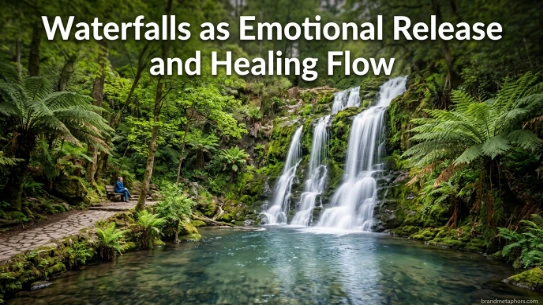
Waterfalls are often used as metaphors for emotional release, especially crying or letting go.
They symbolize:
- Tears turning into healing
- Emotional cleansing
- Relief after pressure
Meaning & Explanation: Just as water falls and disperses, emotions also need release. This metaphor is gentle and deeply human.
Example Sentence: “Her tears were a quiet waterfall, washing away the weight she had carried for years.”
Alternative Expressions:
- “a river of release”
- “a cascade of healing”
- “emotion spilling into light”
Literary Reference Idea: Many poets across cultures use water imagery to describe grief and renewal. In Japanese haiku, water often represents impermanence—everything flows, nothing stays.
Mini Storytelling: After months of silence, someone finally cries—not loudly, but steadily. It is not sadness alone; it is relief. Like a blocked river finally opening, the waterfall inside them begins to move again.
Bonus Tip for Writing: Use waterfall metaphors when describing emotional turning points in characters—breakups, forgiveness, or personal breakthroughs.
Exercise: Write a short paragraph describing a “silent waterfall of emotions” without using the word “cry.”
5. Waterfalls as Time Falling Through Space
Time is often imagined as a waterfall—constantly moving, never returning.
Waterfalls symbolize:
- Irreversible change
- Aging and memory
- Life moving forward
Meaning & Explanation: Once water falls, it cannot climb back. Similarly, time only moves forward.
Example Sentence: “Time fell like a waterfall over her life, shaping her gently but forever.”
Alternative Expressions:
- “the cascade of years”
- “time spilling forward”
- “moments dropping into memory”
Philosophical Reflection: This metaphor reminds us that life is not a still lake but a flowing descent. Every moment becomes part of the pool below—our memories.
Mini Storytelling: An old man returns to a place he visited as a child. The waterfall is still there, but he is not. As he watches the water fall, he realizes something simple: the waterfall remembers nothing, but he remembers everything.
Creative Prompt: Write about your childhood using the metaphor of a waterfall. What is still falling? What has already reached the pool?
6. Waterfalls as Love That Cannot Be Controlled
Love is often described as a waterfall—powerful, overwhelming, and natural.
It represents:
- Passion
- Emotional intensity
- Unstoppable connection
Meaning & Explanation: Like water over a cliff, love cannot always be contained or predicted.
Example Sentence: “Falling for him was like standing beneath a waterfall—beautiful, dizzying, impossible to escape.”
Alternative Expressions:
- “a rush of affection”
- “love spilling over the edge”
- “a cascade of longing”
Sensory Detail: Imagine warmth mixed with mist—soft touch and overwhelming force at once.
Mini Storytelling: Two people meet unexpectedly. At first, it is just a conversation. Then something shifts. It is not gradual—it is a fall. Like stepping too close to a waterfall’s edge, they are swept into something bigger than themselves.
Exercise: Describe a moment of attraction using water imagery without using the word “love.”
7. Waterfalls as Creative Energy and Inspiration
For artists and writers, waterfalls symbolize creative overflow.
They represent:
- Inspiration
- Artistic flow state
- Burst of ideas
Meaning & Explanation: Creativity is not always slow; sometimes it pours out uncontrollably like water breaking free.
Example Sentence: “I couldn’t stop writing—ideas poured from me like a waterfall breaking through stone.”
Alternative Expressions:
- “a flood of imagination”
- “ideas cascading”
- “a stream of creation”
Mini Storytelling: A painter wakes in the middle of the night with colors in her mind. She rushes to her canvas. She doesn’t think—she paints. Hours later, she realizes she has been in a waterfall of inspiration.
Bonus Tip: When describing creative work, use waterfall metaphors to show intensity and flow rather than effort.
Interactive Exercise: List five ideas that feel like they are “falling” out of your mind right now.
8. Cultural Symbolism of Waterfalls Across Traditions
Across cultures, waterfalls are seen as sacred and symbolic.
They often represent:
- Purification
- Spiritual power
- Connection between worlds
In some traditions, waterfalls are believed to be places where spirits dwell or where cleansing energy is strongest.
Meaning & Explanation: Waterfalls are not just physical structures—they are symbolic thresholds between calm and chaos, earth and sky.
Example Sentence: “The villagers believed the waterfall was a doorway where the earth spoke to the heavens.”
Mini Storytelling: A pilgrim travels for days to reach a sacred waterfall. When they arrive, they do not pray with words. They simply stand in silence, letting the falling water cleanse everything they cannot name.
Creative Prompt: Invent your own cultural belief about a waterfall. What would it represent in your imagined world?
9. Writing Tips: How to Use Waterfall Metaphors Effectively
To use waterfall metaphors well, focus on clarity and emotion.
Tips:
- Match the metaphor to emotion (calm waterfall = peace, violent waterfall = chaos)
- Use sensory language (sound, mist, pressure)
- Avoid overloading sentences with too many metaphors
- Combine movement verbs: spill, crash, tumble, cascade
Example Sentence Improvement: Weak: “Her thoughts were like water.” Strong: “Her thoughts spilled over like a waterfall breaking loose after heavy rain.”
Mini Storytelling Insight: Good writing does not just describe a waterfall—it makes the reader feel the drop.
Exercise: Rewrite one memory using at least one waterfall metaphor.
10. Interactive Reflection: Creating Your Own Waterfall Metaphors
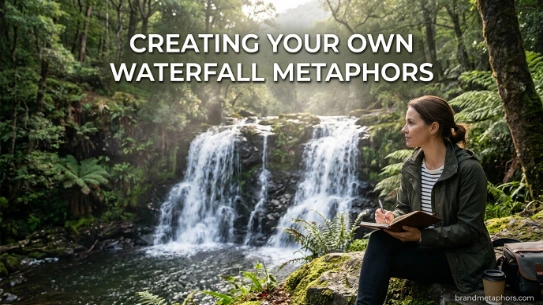
Now it’s your turn to step into the flow.
Try these creative challenges:
- Describe your personality as a type of waterfall
- Write a poem using only water-based imagery
- Turn a stressful moment into a “storm feeding a waterfall”
- Describe your future as water falling into an unknown valley
Bonus Writing Idea: Use waterfalls in social media captions for emotional or aesthetic posts:
- “Falling into something I can’t explain”
- “Let it flow, let it fall”
- “Some things are meant to cascade”
The beauty of waterfall metaphors is that they are never static. They move, shift, and change with you.
Conclusion
Waterfalls remind us that beauty is not still—it is movement. It is sound. It is surrender. Through metaphors, waterfalls become more than landscapes; they become emotions, thoughts, time, love, and creativity itself.
When you use waterfall imagery in writing, you are not just describing water—you are capturing motion that cannot be stopped. You are turning language into flow.
And perhaps that is the deepest truth of all: We are not still beings. We are waterfalls of experience, constantly falling into who we are becoming.
FAQs: Metaphors for Waterfalls
1. What are common metaphors for waterfalls? Waterfalls are often compared to roaring voices, cascading thoughts, emotional release, flowing time, and creative energy.
2. Why are waterfalls powerful in writing? Because they symbolize movement, intensity, and transformation, making them perfect for emotional and descriptive language.
3. Can waterfall metaphors describe emotions? Yes, they are often used for crying, overwhelm, joy, and passion due to their flowing and unstoppable nature.
4. How can I use waterfall metaphors in poetry? Focus on sensory details like sound, mist, and motion, and connect them to inner experiences or emotions.
5. What makes waterfall imagery unique? Its combination of beauty and power—it is both peaceful and overwhelming, making it highly versatile in creative writing.