
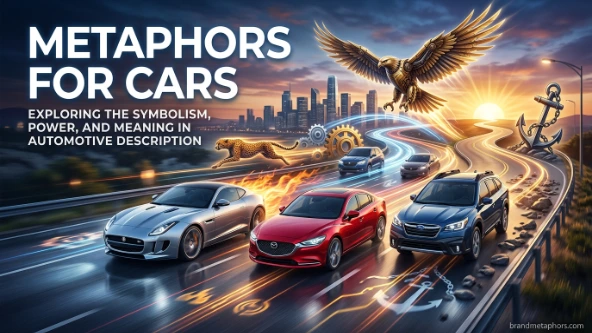
A Moving World on Four Wheels: An Engaging Introduction
The moment you open a car door, a familiar mix of scents greets you—faint leather, warm plastic, maybe yesterday’s coffee still lingering in the air. The seat holds the memory of every journey it has ever carried. The ignition turns, and suddenly, the machine wakes like a sleeping animal. The dashboard lights flicker like stars coming alive in a night sky. And just like that, a simple vehicle becomes something more than metal and mechanics—it becomes a companion.
Cars are never just transportation. They are moving metaphors of our lives, reflecting who we are, where we are going, and how fast we’re willing to change. A slow drive through empty streets can feel like reflection, while speeding down a highway can feel like chasing a dream that refuses to slow down. This is why writers, poets, filmmakers, and everyday people use metaphors for cars—to express emotions that ordinary words cannot fully hold.
In this article, we’ll explore how cars become powerful symbols of life, identity, emotion, and imagination. You’ll discover creative metaphors, storytelling techniques, and practical writing exercises that will help you see every journey in a new light. Whether you’re a writer, student, or simply someone who enjoys thoughtful reflection, these metaphors will shift the way you look at every road you travel.
What Are Metaphors for Cars and Why Do They Matter?
Metaphors for cars are imaginative comparisons that describe vehicles as something else entirely—living beings, emotional spaces, or symbolic objects. Instead of saying “the car is fast,” a metaphor might say “the car is a lightning bolt tearing through the night.” This transforms plain description into emotional imagery.
Why does this matter? Because cars are part of daily life. We commute, travel, escape, return, and explore inside them. By using metaphors, we give emotional meaning to these ordinary moments. A traffic jam becomes more than delay—it becomes “a river frozen in hesitation.” A road trip becomes not just travel, but “a long sentence written across the landscape.”
Writers use car metaphors to:
- Add emotional depth to storytelling
- Make scenes more vivid and memorable
- Reflect characters’ inner emotions
- Turn ordinary experiences into symbolic journeys
Even in everyday speech, metaphors help us communicate feelings we don’t always understand ourselves.
Cars as Life Journeys: The Road as a Living Story
One of the most powerful metaphors is the idea of the car as a life journey. The road becomes a timeline, stretching from past to future, with every turn representing a choice.
In this metaphor:
- The windshield is the future—clear, uncertain, and wide open
- The rearview mirror is the past—visible but shrinking
- The steering wheel is control—how we guide our direction
Example in storytelling:
“Her life felt like a long highway at midnight—sometimes lit by streetlights of hope, sometimes swallowed by darkness she couldn’t name.”
Alternative expressions:
- Life is a road trip
- Destiny is a winding highway
- Choices are turns in the road
Sensory detail:
Imagine tires humming against asphalt, headlights cutting through fog, and the faint vibration of uncertainty beneath your hands.
Mini storytelling:
A young man drives away from his hometown after graduation. Every mile feels like shedding an old version of himself. The city fades in his mirror like a dream dissolving at dawn. He doesn’t know where he’s going, but the engine keeps moving forward anyway—just like life.
Cars as Human Bodies: Engines of Emotion and Thought
Another rich metaphor is seeing the car as a human body. This comparison brings mechanical parts to life.
- Engine = Heart (pumping power and emotion)
- Fuel = Energy or passion
- Brakes = Self-control or discipline
- Horn = Voice or expression
- Tires = Stability and grounding
Example sentence:
“The old car coughed like a tired man, its engine struggling like a heart that had lived too long.”
Alternative expressions:
- The car is a breathing machine
- The engine has a heartbeat
- The vehicle is a metal body with a restless soul
Emotional tone:
This metaphor often feels intimate. A broken car doesn’t just “malfunction”—it “falls ill.” A fast car doesn’t just speed—it “runs wild with adrenaline.”
Mini storytelling:
A mechanic listens closely to an engine and says, “It’s not dead. It’s just exhausted.” He treats it like a patient. In that moment, metal becomes flesh, and repair becomes healing.
Cars as Freedom Machines: Escape, Independence, and Identity
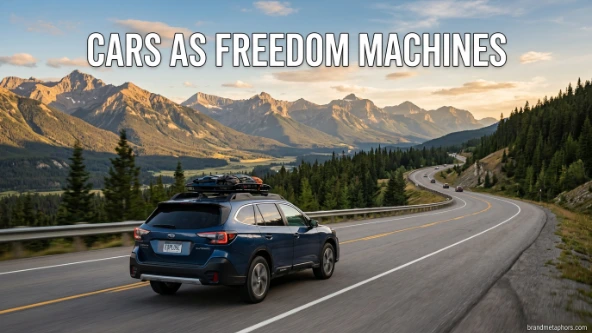
Cars often symbolize freedom—the ability to leave, explore, and decide your own direction. The moment the engine starts, the world opens like a book waiting to be read.
Example metaphor:
“The car was her wings, stitched from steel and silence, carrying her beyond the borders of expectation.”
Meaning:
Here, the car represents independence, especially in cultures where mobility equals personal freedom. It becomes a private space where identity can be rewritten.
Alternative expressions:
- The car is a passport on wheels
- The engine is a key to escape
- Driving is flying on land
Sensory detail:
Open windows, rushing wind, music spilling into the night, and the feeling that nothing is holding you back.
Mini storytelling:
A teenager borrows an old car for the first time. There’s no destination, just movement. For the first time, they realize freedom doesn’t always announce itself—it hums quietly at 60 miles per hour.
Cars as Time Machines: Memory, Nostalgia, and Reflection
Cars are powerful containers of memory. Every scratch, seat stain, and radio preset tells a story. In this metaphor, a car becomes a time machine carrying fragments of the past.
Example metaphor:
“The car smelled like old songs and forgotten summers, as if time itself had settled into the seats.”
Meaning:
Driving becomes a journey through memory rather than distance.
Alternative expressions:
- The car is a memory capsule
- The dashboard holds echoes of yesterday
- Every ride rewinds time
Sensory detail:
Warm sunlight through the windshield, familiar songs playing softly, and the strange ache of remembering moments you cannot return to.
Mini storytelling:
An old couple drives through the same road they once took on their first date. Nothing outside has changed much, but everything inside them has. The car carries them not just forward, but backward into memory.
Cars as Beasts of Power: Speed, Energy, and Wild Motion
Cars are often described as living beasts—fierce, untamed, and powerful. This metaphor is especially common in racing culture and action storytelling.
Example metaphor:
“The sports car roared like a lion breaking free from its cage.”
Meaning:
The car is not controlled machinery—it is raw energy in motion.
Alternative expressions:
- The car is a steel predator
- The engine growls like thunder
- The machine devours the road
Sensory detail:
The vibration of acceleration, the roar of the engine, and the blur of surroundings as speed takes over.
Mini storytelling:
On a racetrack, a driver feels the car respond like a living partner. It doesn’t obey—it communicates. Every turn is a conversation between human and machine.
Cars as Moving Homes: Shelter in Motion
For many people, a car becomes a second home. It holds snacks, conversations, tears, laughter, and silence. This metaphor turns the vehicle into a personal sanctuary.
Example metaphor:
“The car was a small home rolling through a restless world, carrying pieces of their lives in its quiet corners.”
Meaning:
The car is not just transport—it is comfort, privacy, and emotional space.
Alternative expressions:
- The car is a mobile room
- The interior is a traveling shelter
- The seats hold daily life
Sensory detail:
Soft seats, quiet engine hum, personal objects in the dashboard, and a feeling of safety even while moving.
Mini storytelling:
A mother waits in her parked car after a long day, not ready to enter the house yet. Inside the vehicle, she finds a pause—just a few minutes of silence before life continues.
Cars as Storybooks: Every Ride Writes a Chapter
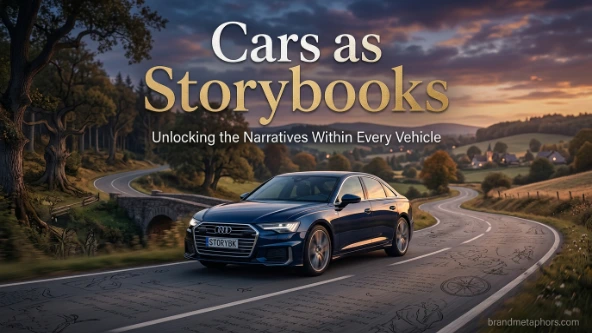
Every car journey is a story unfolding in real time. The road is the page, the driver is the writer, and the destination is the final line.
Example metaphor:
“The car wrote its story across the night, every mile a sentence only the road could read.”
Meaning:
Life is being documented through movement.
Alternative expressions:
- The car is a diary in motion
- Every trip is a chapter
- The road is a written path
Sensory detail:
The rhythm of movement, passing lights like punctuation marks, and changing landscapes like shifting paragraphs.
Mini storytelling:
A group of friends takes a spontaneous road trip. Years later, they don’t remember every detail—but they remember the feeling. The car became the book where their friendship was written.
How to Use Car Metaphors in Writing and Daily Expression
Metaphors are tools of creativity. Using car metaphors can transform ordinary communication into vivid expression.
Tips for writers and creators:
- Replace simple verbs with imagery (“drives fast” → “flies across the road”)
- Connect emotion to movement (“anger shifted gears inside him”)
- Use weather and roads to reflect mood
Interactive exercises:
- Describe your day using a car metaphor
- Turn an emotion into a driving experience (e.g., anxiety = traffic jam)
- Write a 3-line story where a car represents a feeling
Social media ideas:
- “My mind today feels like a car stuck in neutral.”
- “Life is a road trip with unexpected detours.”
Daily life application:
Even conversations become richer when you use metaphors. Instead of “I’m tired,” you might say, “My engine is overheating.”
Cars in Literature, Culture, and Film: Symbolic Roads
Cars have played powerful symbolic roles in storytelling and culture.
In films, cars often represent:
- Escape from reality
- Rebellion against society
- Emotional turning points
In literature, they reflect:
- Identity shifts
- Modern life’s speed
- Emotional distance or connection
From road-trip novels to cinematic chase scenes, cars become emotional engines of storytelling. They are never just background objects—they are participants in the narrative.
Conclusion
Cars are more than machines—they are moving symbols of who we are. They carry our memories, our escapes, our fears, and our dreams. Whether seen as beasts, homes, time machines, or life journeys, they reflect the emotional landscapes we travel every day.
Once you start thinking in metaphors, even a simple drive becomes meaningful. A red light becomes a pause for reflection. A highway becomes possibility. A parked car becomes a moment of rest in a fast-moving world.
The road never truly ends—it only changes shape. And so do the stories we tell along the way.
FAQs
1. What is a metaphor for a car?
A metaphor for a car is a creative comparison that describes a car as something else, like a living being, a home, or a journey, to express deeper meaning.
2. Why are car metaphors important in writing?
They add emotional depth, make descriptions more vivid, and help readers connect with everyday experiences in imaginative ways.
3. Can car metaphors be used in daily conversation?
Yes, they make speech more expressive, such as saying “my brain is stuck in traffic” instead of “I’m confused.”
4. What are some common car metaphors?
Cars are often described as engines of freedom, beasts of speed, time machines, or moving homes.
5. How can I create my own car metaphors?
Think about emotions or life situations and compare them to driving experiences, road conditions, or car parts.
If you’d like, I can also turn this into a downloadable blog post, SEO article format, or even a social media content pack.