
Introduction (The Invisible Language We All Feel)
Close your eyes for a moment and think about the last song that stayed with you. Maybe it was playing in the background of a quiet evening, or maybe it burst through your headphones during a long walk when your thoughts felt too heavy. You might not remember every lyric, but you remember how it made you feel. That is the strange power of music—it speaks without speaking, yet it is understood by almost everyone.
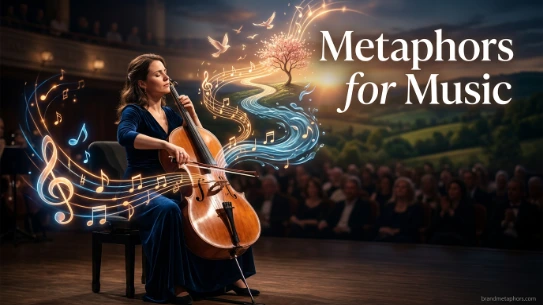
Music often feels like something beyond sound. It can feel like a place, a memory, or even a person standing beside you. This is why we use metaphors for music. We try to explain it through images we already understand—like rivers, fire, or language—because music itself is too wide to fit into simple definitions.
In everyday life, these metaphors help us describe emotions we cannot easily explain. They give shape to feelings, making them easier to share. In this article, we will explore powerful metaphors for music that reveal its deeper meaning and emotional impact. Each metaphor opens a new way of understanding how music moves through our lives, shapes our thoughts, and connects us to ourselves and others.
Music as the Language of the Soul
Music is often described as the language of the soul because it communicates what words cannot. When someone listens to a sad melody, they don’t need translation. They simply understand it. This metaphor suggests that music speaks directly to our inner self, bypassing logic and reaching emotion.
Imagine a person sitting alone at night, unable to explain their feelings. Words feel too small. Then a song begins to play, and suddenly, something inside them feels understood. That is music acting as a language without grammar rules or dictionaries.
Unlike spoken language, music does not demand explanation. A soft piano can whisper sorrow, while a strong drumbeat can express courage. Everyone, regardless of background, can understand it in their own way.
Why this metaphor matters
- It shows music is universal
- It explains emotional connection
- It highlights non-verbal communication
In real life, this metaphor helps us understand why music plays such a big role in human bonding. It connects strangers, heals emotional gaps, and allows people to feel understood without saying a single word.
Music as a River of Emotions
Music is often compared to a river because it flows continuously, carrying emotions with it. Just like water, it can be calm, powerful, or unpredictable. Some songs flow gently like a slow stream, while others rush forward like a wild current.
When you listen to music, you are carried along its movement. You don’t always control where it goes. A soft melody might bring peace, while a sudden rise in tempo might bring excitement or tension. This emotional flow mirrors how rivers shape the land over time—music shapes the mood of the listener.
Emotional Flow in Music
- Slow music → calm, reflection
- Fast rhythm → energy, urgency
- Changing tempo → emotional shifts
Think of a rainy afternoon when you listen to a sad song. The music blends with your thoughts, just like a river blending with the land it passes through. It becomes part of your emotional environment.
This metaphor reminds us that music is not static. It moves, shifts, and carries us along its emotional path whether we expect it or not.
Music as Architecture of Sound
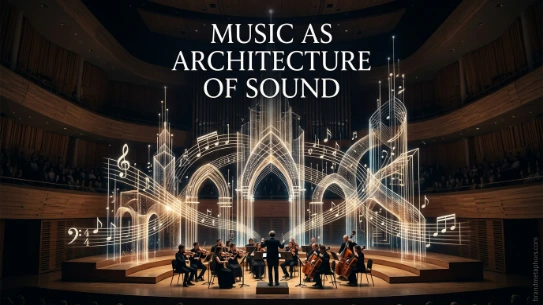
Music can also be seen as architecture. Every note is like a building block, carefully placed to create structure and design. Just as architects design buildings with balance and purpose, musicians arrange sound to create harmony.
A song has layers—melody, rhythm, bass, and harmony. These are like walls, windows, and foundations. Without structure, music would collapse into noise. With structure, it becomes something beautiful and meaningful.
How music resembles architecture
- Rhythm = foundation
- Melody = design
- Harmony = balance
Picture a grand cathedral. Every detail is intentional. Similarly, in a well-composed piece of music, every sound has a role. Even silence is part of the design.
This metaphor helps us understand why some songs feel “complete” or “well-built.” It is not random—it is carefully constructed emotional architecture.
Music as a Time Machine
Music has the strange ability to take us back in time. A single song can instantly return us to childhood, a first love, or an important moment we thought we had forgotten. This is why music is often called a time machine.
When a familiar song plays, your mind does not stay in the present. It travels. You may suddenly remember where you were, who you were with, and how you felt at that moment.
How music triggers memory
- Familiar melodies activate emotional memory
- Lyrics reconnect past experiences
- Rhythm links to personal events
For example, hearing an old school song might bring back the smell of a classroom, the sound of friends laughing, or the feeling of nervous excitement before an exam.
Music does not just remind us of the past—it lets us relive it. This makes it one of the most powerful emotional triggers in human experience.
Music as Weather of the Mind
Music often behaves like weather for our emotions. Just as weather changes from sunny to stormy, music can shift our mental state within seconds.
A bright, cheerful tune can feel like sunshine breaking through clouds. A slow, minor-key melody might feel like rain falling gently on a quiet street. This metaphor helps explain how music influences mood so quickly and naturally.
Emotional weather patterns in music
- Bright music → happiness, clarity
- Dark music → sadness, reflection
- Dynamic music → emotional storms
Imagine walking in heavy rain while listening to soft piano music. The world around you feels slow and reflective. Now imagine listening to an upbeat rhythm on a sunny day. Everything feels lighter and more energetic.
Music shapes our internal weather, often without us realizing it. It can calm storms inside the mind or awaken hidden energy.
Music as Fire and Energy
Music is often described as fire because it can ignite strong emotions. Some songs feel warm and comforting, while others feel intense and powerful, like flames rising higher and higher.
Fire in music represents passion, drive, and transformation. A powerful drumbeat or electric guitar solo can create a feeling of unstoppable energy.
H3: When music becomes fire
- It motivates action
- It builds excitement
- It expresses passion
Think about athletes listening to high-energy music before a competition. The rhythm fuels their focus. It becomes a spark that turns into movement.
At the same time, music-fire can also burn softly. A gentle acoustic song can feel like a warm flame on a cold night—comforting and steady.
This metaphor shows that music is not only emotional but also energizing. It can awaken strength within us.
Music as a Painting in Motion
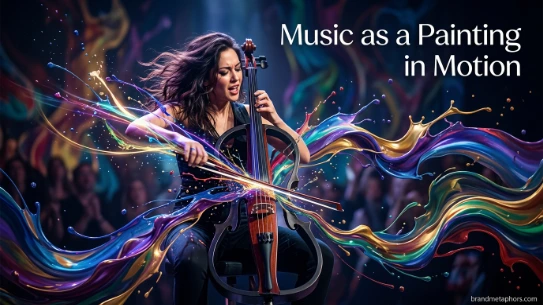
Music can be compared to a painting, but one that moves and breathes. While paintings are fixed in time, music evolves every second, adding new colors and textures as it plays.
Each instrument adds a different shade. A violin might paint sadness in deep red tones, while a flute adds light blue calmness. Together, they create a living artwork.
H3: Musical colors in imagination
- Piano → soft grayscale emotions
- Strings → deep emotional tones
- Percussion → bold and sharp colors
Unlike visual art, music paints inside the mind. Everyone sees a different picture, making it deeply personal.
This metaphor helps us understand why music feels so visual even though it has no images. It creates art that exists in imagination.
Music as a Journey or Road
Music often feels like a journey. It has a beginning, middle, and end, just like a road we travel. Some songs feel like smooth highways, while others feel like winding mountain paths.
As listeners, we move through different emotional landscapes. A calm intro may feel like starting a trip, while a powerful chorus feels like reaching a destination.
This metaphor explains why some songs feel “long” or “short” emotionally, even if their actual length is the same. It depends on how intense the journey feels.
Music journeys can be:
- Peaceful and steady
- Emotional and unpredictable
- Fast and energetic
Every listener travels differently, making each experience unique.
Music as Healing Medicine

Music is often described as medicine because it has the power to heal emotional pain. It does not cure physical illness directly, but it can reduce stress, anxiety, and sadness.
When someone is feeling low, music can act like emotional support. It validates feelings and provides comfort without judgment.
H3: Ways music heals
- Reduces stress levels
- Improves mood
- Provides emotional release
For example, someone going through heartbreak might listen to emotional songs that help them process feelings. In that moment, music becomes a safe space.
This metaphor shows that music is not just entertainment—it is emotional care.
Music as a Conversation Without Words
Music often feels like a conversation between the artist and the listener. Even without language, there is communication happening. The artist expresses emotion, and the listener responds internally.
This conversation is silent but powerful. A sad melody might feel like someone is sharing their pain with you. A joyful tune might feel like laughter exchanged between friends.
Music conversation includes:
- Expression from the artist
- Interpretation by the listener
- Emotional response
This makes music deeply interactive, even though no words are spoken.
Music as a Living Organism
Music can also be seen as something alive. It grows, breathes, and changes. It reacts to how it is played and how it is heard.
Live performances especially show this. A song played in a studio is different from a song played in front of an audience. The energy changes the music itself.
Like a living organism, music:
- Adapts to environments
- Changes with emotion
- Evolves over time
This metaphor helps explain why music never feels the same twice.
Music as Memory Keeper
Music acts like a container for memories. It stores emotions, experiences, and moments inside melodies. When we hear a song again, those memories return instantly.
This is why people often say, “This song reminds me of…” Music becomes a personal archive of life experiences.
It keeps:
- Childhood memories
- Relationships
- Life milestones
Every person carries a unique library of musical memories that shape who they are.
Conclusion
Music is more than sound—it is meaning, memory, and emotion wrapped together. Through metaphors, we understand it as a language, a river, a journey, and even a living being. Each comparison helps us see music not just as entertainment, but as a deeply human experience.
These metaphors remind us that music connects to every part of life. It shapes our emotions, carries our memories, and helps us express what we cannot say directly. Whether it feels like fire, medicine, or a painting in motion, music always finds a way to reach us.
In the end, music does not need a single definition. It lives in many forms at once, changing with every listener. And perhaps that is its greatest strength—it belongs to everyone, yet means something different to each person.