
A Moment Before Words: The Sound of Quiet You Can Almost Hear
There are moments when silence is not empty at all. It is thick, textured, almost physical—like stepping into a snow-covered forest where every sound has been gently wrapped in cotton. Imagine standing in an old library at closing time: the air still smells of paper and time, the last page turned a minute ago still hanging in memory. No voices. No footsteps. Only presence.
Quiet is not the absence of life—it is life lowering its voice.
We often struggle to describe this kind of stillness. That’s where metaphors for quiet become powerful. They give shape to silence, turning something invisible into something we can feel, see, and even taste in our imagination.
In writing, storytelling, poetry, and even everyday speech, metaphors for quiet help us express emotional depth—peace, loneliness, reflection, or awe.
Let’s step into that silence and learn how to describe it beautifully.
What Are Metaphors for Quiet and Why They Matter
Metaphors for quiet are imaginative comparisons that describe silence or stillness using familiar images. Instead of simply saying “it was quiet,” we might say:
- “The room was a frozen lake.”
- “Silence draped itself over the town like fog.”
- “The world held its breath.”
These expressions matter because silence is not one-dimensional. It can be comforting or uncomfortable, peaceful or heavy, sacred or eerie. Metaphors help us capture those emotional shades.
Writers use them to:
- Build atmosphere in stories
- Create emotional impact in poetry
- Deepen realism in descriptions
- Connect readers to sensory experiences
Even in daily life, using vivid language makes communication more expressive and memorable.
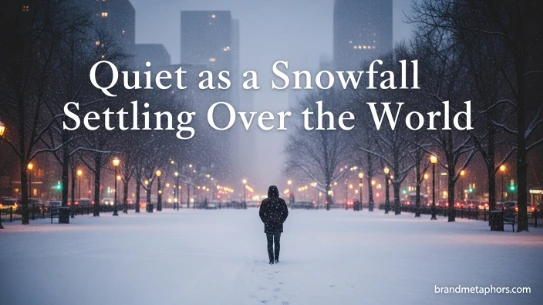
Metaphor 1: Quiet as a Snowfall Settling Over the World
Meaning and Explanation
This metaphor compares quiet to falling snow—soft, gradual, and all-enveloping. It suggests peace, gentleness, and a slowing of time.
Example Sentence
“The argument ended, and silence fell like a snowfall settling over the world.”
Emotional and Sensory Detail
You can almost hear nothing but the faint hush of air. Everything feels slower. Sounds are softened. Even thoughts feel muffled, as if wrapped in white.
Mini Storytelling Moment
In a small mountain village, children once rushed outside during the first snowfall of winter. But as the snow deepened, even laughter turned into whispers. Eventually, the entire village felt paused—like the world itself had chosen not to speak.
Alternative Expressions
- Quiet like falling feathers
- Silence like drifting ash
- Stillness like a white blanket over everything
Why It Works
Snow naturally reduces sound. It creates visual calm and emotional stillness, making it one of the most universal metaphors for quiet.
Creative Prompt
Think of a moment in your life that felt “snowy quiet.” Describe it without using the word “silent.”
Metaphor 2: Quiet as a Library at Midnight
Meaning and Explanation
This metaphor captures structured, thoughtful silence—orderly, intellectual, and slightly sacred.
Example Sentence
“The house after everyone slept was like a library at midnight—organized, heavy with unseen thoughts.”
Emotional and Sensory Detail
There is a faint smell of paper or wood. The air feels serious, like it is holding knowledge. Even small sounds feel important.
Mini Cultural Reference
Old universities in Europe often kept libraries open late for scholars. In those hours, the absence of conversation made thinking feel louder. Every page turned became a private event.
Alternative Expressions
- Quiet like a closed museum
- Silence like an abandoned classroom
- Stillness like books waiting to be opened
Why It Works
Libraries represent knowledge and focus. At midnight, they also represent solitude and reflection—perfect for describing thoughtful quiet.
Creative Prompt
Describe a “library moment” in your own home or environment—even if no books are present.
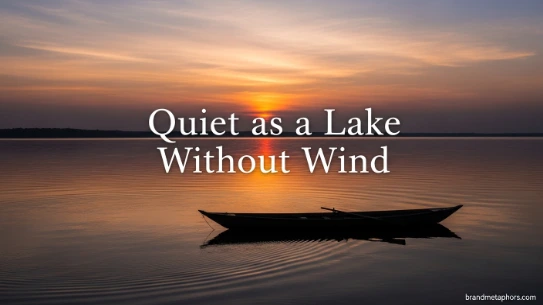
Metaphor 3: Quiet as a Lake Without Wind
Meaning and Explanation
This metaphor represents emotional stillness—deep, reflective, and undisturbed.
Example Sentence
“After the apology, their relationship felt like a lake without wind—clear but fragile.”
Emotional and Sensory Detail
No ripples. No movement. Just still water reflecting everything honestly, almost too clearly.
Mini Storytelling Moment
A traveler once stood by a mountain lake at dawn. Not even a bird disturbed the surface. He realized he could see his own reflection more clearly than ever before—not just his face, but his thoughts.
Alternative Expressions
- Silence like glass water
- Quiet like an unmoving mirror
- Stillness like a paused breath of nature
Why It Works
Water is naturally expressive. When still, it becomes a mirror for emotions, making it a powerful metaphor for inner quiet.
Creative Prompt
Write about a time when your thoughts felt “too clear,” like water without ripples.
The Emotional Spectrum of Quiet: Not All Silence Is Peaceful
Quiet is not always comforting. Sometimes it is heavy, like a closed door that won’t open. Other times, it is healing, like warm sunlight after rain.
That’s why metaphors matter—they help us distinguish:
- Peaceful quiet
- Awkward silence
- Emotional distance
- Deep reflection
- Spiritual stillness
For example:
- “The silence between them was a locked room.”
- “The quiet in the forest felt like a gentle prayer.”
Each version of quiet carries a different emotional temperature.
Interactive Exercise: Build Your Own Metaphor for Quiet
Try this simple creative exercise:
- Think of a quiet moment you recently experienced.
- Ask yourself: What does it remind me of?
- Choose an object, place, or natural phenomenon.
- Complete this sentence:
“The quiet was like _________.”
Now expand it:
- What does it feel like?
- What does it sound like?
- What emotion does it carry?
Example:
“The quiet was like a candle burning in an empty church—soft, watchful, and endless.”
Quiet in Literature and Poetry: How Writers Use Silence

Writers have long treated silence as a character itself.
In poetry, quiet often appears as:
- A pause between emotions
- A space for reflection
- A symbol of loss or peace
In novels, silence can:
- Heighten tension before a revelation
- Show emotional distance between characters
- Create atmosphere in landscapes or rooms
Even classical literature often uses silence to speak louder than dialogue.
For example, in many tragic scenes, what is not said becomes more powerful than spoken words.
Everyday Uses of Metaphors for Quiet in Communication
You don’t need to be a poet to use these metaphors. They can enrich everyday expression:
In Conversation
Instead of saying:
- “It was very quiet at home”
You can say:
- “The house felt like it was holding its breath.”
In Social Media Captions
- “Morning silence like a blank page waiting for stories.”
- “This moment feels like snowfall inside my mind.”
In Journaling
Metaphors help you express emotions you might not fully understand yet.
Bonus Tips: How to Make Your Quiet Descriptions More Powerful
- Combine senses Don’t just describe silence—describe what it feels like, looks like, and emotionally suggests.
- Use contrast Compare quiet with noise that used to exist:
- “The silence after laughter…”
- Keep it simple but vivid One strong image is better than multiple weak ones.
- Use nature often Nature provides the richest metaphors for quiet: snow, water, forests, windless skies.
- Let silence carry emotion Ask: Is this quiet peaceful, sad, tense, or reflective?
Why We Are Drawn to Quiet Imagery
Human beings are surrounded by noise—traffic, conversations, notifications, thoughts. So when we encounter quiet, it feels almost sacred.
Metaphors for quiet help us:
- Slow down mentally
- Reflect emotionally
- Connect with inner calm
- Express subtle feelings
Quiet is not emptiness—it is space. And space gives meaning to everything else.
Conclusion
Quiet is one of the most paradoxical experiences in life. It is invisible, yet deeply felt. It can comfort or unsettle, heal or isolate. And because it cannot be seen, we rely on metaphors to understand it.
When we say “quiet like snowfall,” “quiet like a midnight library,” or “quiet like a still lake,” we are not just describing silence—we are giving it life.
Metaphors turn silence into something we can hold in language.
And in doing so, they remind us that even the quietest moments are never truly empty—they are full of meaning waiting to be heard.
FAQs: Metaphors for Quiet
1. What is a metaphor for quiet?
A metaphor for quiet is a figurative comparison that describes silence using imagery, like “quiet as snowfall” or “silence like a frozen lake.”
2. Why are metaphors for quiet useful in writing?
They make descriptions more vivid, emotional, and relatable by turning abstract silence into something concrete.
3. Can quiet have different meanings in metaphors?
Yes. Quiet can represent peace, loneliness, tension, reflection, or even fear depending on context.
4. What are some common natural metaphors for quiet?
Snowfall, still lakes, windless forests, and mist-covered landscapes are commonly used.
5. How can I create my own metaphor for quiet?
Think of a silent moment and compare it to something with similar emotional or sensory qualities, then expand the image creatively.