
Rain has a language of its own. It doesn’t speak in words, but in rhythms—soft tapping on windows, sudden drumming on rooftops, and long silences where the earth seems to hold its breath. Sometimes it arrives like a whisper, sometimes like a memory too heavy to contain.
And because rain touches almost every human emotion—joy, nostalgia, loneliness, renewal—it has inspired some of the richest metaphors in literature and everyday speech.
In this article, we’ll explore metaphors for rain that help us describe not just weather, but feeling, mood, and meaning.
These comparisons are more than poetic decoration—they are tools for writing, storytelling, journaling, poetry, and even social media expression. By the end, you’ll not only recognize rain differently, but also use it creatively in your own voice.
Understanding Metaphors for Rain in Writing and Expression
A metaphor for rain is a way of describing rain by comparing it to something else without using “like” or “as.” Instead of saying “rain is like tears,” we might say “the sky wept.” This transforms simple weather into emotional storytelling.
Writers use rain metaphors because rain is universal. Everyone has experienced it, but everyone feels it differently. For some, it is calming; for others, it is melancholic. That emotional flexibility makes rain a powerful literary device.
Rain metaphors are important because they:
- Add emotional depth to writing
- Create vivid mental imagery
- Help express abstract feelings
- Make storytelling more immersive
Now let’s explore three powerful metaphors for rain that you can use in writing and everyday expression.
🌧️ Metaphor 1: “The Sky Is Weeping”

Meaning and Explanation
This is one of the most classic and emotionally rich metaphors. When we say “the sky is weeping,” we are giving the sky human emotions—specifically sorrow. Rain becomes tears, and the world becomes a grieving body.
It is often used to express sadness, loss, or emotional cleansing.
Example Sentence or Scenario
“The funeral ended in silence, and soon after, the sky began to weep as if mourning with us.”
Alternative Expressions
- The heavens are crying
- The clouds are mourning
- The sky is shedding tears
Sensory and Emotional Detail
Imagine standing outside as cold droplets fall slowly, not violently, but gently—like a quiet grief that doesn’t need noise. The air feels heavier, as if the world itself is remembering something painful.
Mini Storytelling Moment
In Japanese literature, rain is often used as a symbol of sadness and reflection. In many films by directors like Hayao Miyazaki, rain scenes are quiet emotional pauses where characters process loss or longing without speaking. The rain becomes a silent companion to human emotion.
Interactive Prompt
Write a short paragraph describing a sad moment in your life using the metaphor “the sky is weeping.” What changes when you frame your emotion through nature?
🌦️ Metaphor 2: “Rain Is a Curtain Between Worlds”
Meaning and Explanation
In this metaphor, rain becomes a veil or curtain that separates spaces, moods, or even realities. It suggests transformation, transition, or mystery.
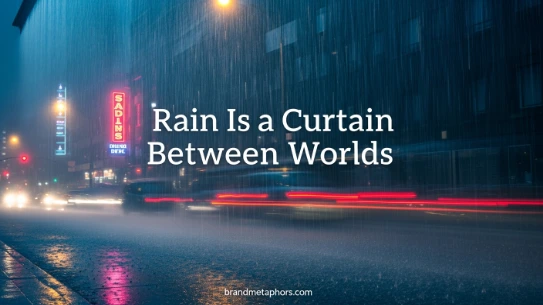
Rain doesn’t just fall—it changes what we see. It blurs distance, softens edges, and creates a temporary world where everything feels slightly unreal.
Example Sentence or Scenario
“Through the rain curtain, the city looked like a forgotten dream fading into morning light.”
Alternative Expressions
- Rain is a veil over the world
- The storm draws a moving curtain across the sky
- The rain blurs the boundary between here and elsewhere
Sensory and Emotional Detail
Think of standing under shelter, watching cars disappear behind sheets of rain. Lights smear into glowing streaks. Sounds become muffled. It feels like reality is paused behind a watery screen.
Cultural and Literary Reference
In many films and novels, rain is used as a transition symbol. It marks change—between past and present, fear and hope, or ignorance and awareness. Even in photography, rain is used to soften scenes and add emotional ambiguity.
Interactive Prompt
Describe a place you know well as if you were seeing it through a “rain curtain.” How does it change emotionally and visually?
🌧️ Metaphor 3: “Rain Is the Earth’s Memory Returning”
Meaning and Explanation
This metaphor treats rain as something ancient and intelligent. It suggests that water once taken from the earth returns as memory—cycles of nature repeating endlessly.
Instead of sadness or mystery, this metaphor emphasizes continuity and life cycles.
Example Sentence or Scenario
“After months of dryness, the first storm felt like the earth’s memory returning to its forgotten skin.”
Alternative Expressions
- Rain is the earth remembering itself
- The sky returns borrowed waters
- Rain is nature’s cycle of remembrance
Sensory and Emotional Detail
The smell of wet soil—known as petrichor—feels like something ancient awakening. Plants lift their heads as if recognizing an old friend. Streets shimmer as though they are remembering their original form.
Mini Storytelling Moment
At South Asian agricultural traditions, rain is not just weather—it is survival, blessing, and rhythm. In rural Punjab, farmers often greet the first monsoon rain as a return of life itself. In places like Gujranwala and surrounding farmland, rain is deeply tied to memory, harvest, and hope.
Interactive Prompt
Write about a time after a long break or emotional distance. Compare that moment to “rain returning the earth’s memory.”
✍️ How to Use Rain Metaphors in Creative Writing and Daily Life
Rain metaphors are not just for poetry. They can enhance many forms of communication:
Writing
- Use “sky is weeping” in emotional scenes
- Use “rain curtain” in transitions or mysteries
- Use “earth’s memory” in reflective or philosophical writing
Social Media
- “Today feels like the sky is weeping softly.”
- “Walking through a rain curtain kind of day.”
- “The earth is remembering itself again.”
Daily Conversation
Metaphors can make everyday language more expressive:
- Instead of “It’s raining a lot,” say “The sky won’t stop crying today.”
- Instead of “It’s foggy,” say “Rain is hiding the world behind a curtain.”
🌧️ Bonus Tips for Using Rain Metaphors Effectively
- Match the metaphor to emotion: sadness, mystery, renewal
- Avoid overuse—one strong metaphor is better than many weak ones
- Combine sensory details (sound, smell, light) for depth
- Draw from personal experience to make it authentic
- Observe real rain before writing about it
🌦️ Quick Creative Exercise: Build Your Own Rain Metaphor
Try completing these prompts:
- Rain is like ___________________________
- The sky feels like ______________________
- When it rains, the world becomes ________
Then rewrite each answer without “like” or “as” to turn it into a metaphor.
Example:
- “Rain is like broken glass falling from the sky” → “The sky breaks into falling glass”
🌧️ The Emotional Power of Rain in Human Experience
Rain has always been more than weather. It is a mirror for human emotion. We project sadness, hope, romance, and memory onto it because it is constantly moving between softness and intensity.
In literature, rain often appears during transformation scenes—moments when characters change internally. At cinema, it marks emotional climax. In music, it becomes rhythm and mood. At life, it becomes a pause button for the world.
Whether it is a gentle drizzle or a thunderstorm, rain reminds us that change is always happening—even when it feels still.
❓ FAQs About Metaphors for Rain
H3: What is a metaphor for rain?
A metaphor for rain is a figurative comparison where rain is described as something else, such as “the sky is weeping,” to express emotion or meaning.
H3: Why are rain metaphors so common in writing?
Rain is universal and emotionally flexible. It can represent sadness, renewal, mystery, or peace, making it ideal for expressive writing.
H3: Can rain metaphors be used in formal writing?
Yes, but carefully. They are more common in creative writing, essays, storytelling, and descriptive passages than in technical writing.
H3: How can I create my own rain metaphor?
Observe rain closely, identify the emotion it evokes, and compare it to something unexpected—like memory, silence, or transformation.
H3: What emotions are commonly linked to rain metaphors?
Sadness, nostalgia, peace, renewal, loneliness, and reflection are the most common emotional associations.
Conclusion
Rain is not just something we watch from windows—it is something we feel, interpret, and carry inside us. Through metaphors, it becomes more than water falling from the sky. It becomes emotion made visible, memory made physical, and silence made alive.
When you describe rain as a weeping sky, a curtain between worlds, or the earth remembering itself, you are not just writing about weather—you are translating experience into art.
And perhaps that is the real beauty of rain metaphors: they remind us that even the simplest things above us can reflect the deepest things within us.