

The room was quiet except for the faint scratch of a pen on paper. Then, almost suddenly, the answer appeared—not as a struggle, not as a guess, but as if a hidden door had swung open in the mind.
You’ve probably seen it before: that moment when someone solves a problem before others even finish reading it. Their eyes brighten, their words land cleanly, and everything they touch seems to “click” into place.
We often call such people smart. But that word, simple as it is, rarely captures the richness of intelligence. Smartness is not just knowledge—it is agility, creativity, perception, timing, and sometimes even quiet intuition.
This is where metaphors come alive.
Metaphors for smart allow us to see intelligence differently. Instead of just labeling someone “clever” or “bright,” we begin to imagine their mind as a tool, a landscape, a machine, or even a force of nature. These comparisons don’t just decorate language—they deepen understanding.
In this article, we’ll explore powerful metaphors for smart, how they work, and how you can use them in writing, storytelling, social media, and everyday expression to make your language more vivid and memorable.
Understanding Metaphors for Smart: Why They Matter in Language and Writing
A metaphor is a way of describing something by comparing it to something else, without using “like” or “as.” When we say someone is “a walking encyclopedia,” we don’t mean they carry books in their pockets—we mean their knowledge is vast and readily accessible.
Metaphors for intelligence help us:
- Express abstract thinking in concrete images
- Make writing more engaging and emotional
- Add personality and depth to descriptions
- Help readers feel intelligence instead of just reading about it
In literature, speeches, branding, and even daily conversation, metaphors shape how we perceive intelligence. A “sharp mind” suggests precision. A “quick wit” suggests speed. A “bright spark” suggests sudden brilliance.
But let’s go deeper and explore more creative and powerful metaphors for smartness.
1. The Human Mind as a Lightning Storm: Fast, Bright, and Unpredictable Intelligence
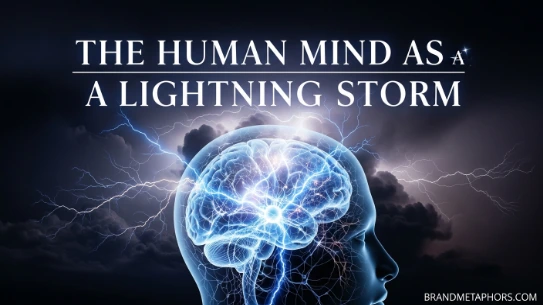
Imagine a dark sky suddenly split open by lightning. There is silence, then brilliance—fast, sharp, unforgettable. This is one of the most powerful metaphors for smartness: the mind as a lightning storm.
Meaning and Explanation
This metaphor represents intelligence as something:
- Rapid and instantaneous
- Powerful and electrifying
- Unpredictable but precise
It reflects people who think quickly, make connections instantly, or surprise others with sudden insight.
Example Sentence / Scenario
“She solved the puzzle like a lightning storm in motion—fast flashes of insight striking one after another until the answer was complete.”
Alternative Expressions
- A mind like a flash of lightning
- Thoughts that strike like thunderbolts
- Intelligence that sparks in an instant
Sensory and Emotional Detail
There is energy here—almost electric. You can “feel” the intensity of thinking, like air charged before rain. It creates excitement, even awe.
Mini Story
In a crowded classroom, everyone struggles with the math problem on the board. Then a student quietly raises her hand. She doesn’t hesitate. Her explanation comes in bursts—clean, precise, unstoppable. The teacher smiles. It feels less like learning and more like watching lightning draw lines across a stormy sky.
Why It Works
This metaphor is powerful because it turns thinking into movement and energy, making intelligence feel alive rather than static.
2. The Smart Mind as a Chess Master: Strategy, Depth, and Anticipation
If lightning is about speed, then chess is about depth. The metaphor of a chess master mind represents intelligence as strategic, patient, and far-sighted.
Meaning and Explanation
This metaphor highlights:
- Planning ahead
- Thinking several steps into the future
- Analyzing consequences before acting
A smart person here is not just quick—they are calculated and thoughtful.
Example Sentence / Scenario
“He doesn’t react like others; he thinks like a chess master, already seeing five moves ahead while the rest of us are still deciding the first.”
Alternative Expressions
- A mind that plays life like chess
- Intelligence that anticipates every move
- Thinking in strategies, not reactions
Sensory and Emotional Detail
This metaphor feels calm, focused, and deliberate. You can almost hear the quiet room, the soft tap of chess pieces, the stillness before a decisive move.
Mini Story with Cultural Reference
Think of grandmasters like those in international chess championships. While spectators see only one move at a time, they are thinking in entire futures. Similarly, in life, some people navigate decisions like a chessboard—carefully positioning themselves for success long before others notice the game has even started.
Why It Works
It shifts intelligence from “instant brilliance” to “deep foresight,” showing that being smart is not always loud or fast—it can also be quiet and patient.
3. The Mind as a Library with Endless Moving Shelves: Knowledge, Memory, and Organized Thought
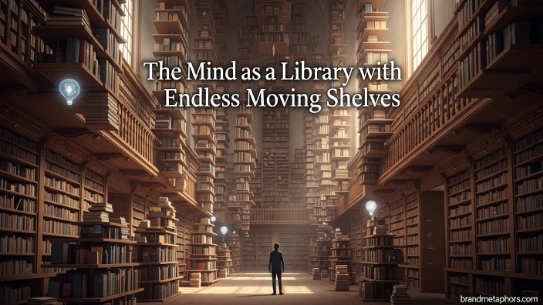
Another rich metaphor for intelligence is the mind as a living library—not static, but constantly reorganizing itself.
Meaning and Explanation
This metaphor suggests:
- Vast knowledge storage
- Easy retrieval of information
- Organized and structured thinking
- Continuous learning and updating
Example Sentence / Scenario
“Her mind is like a library where every idea has a shelf—and somehow, she always finds the right book exactly when she needs it.”
Alternative Expressions
- A walking library of knowledge
- A mind full of well-arranged ideas
- Intelligence stored like books in motion
Sensory and Emotional Detail
Imagine soft library lighting, the smell of old pages, and endless corridors of knowledge. But unlike a traditional library, these shelves shift and move—updating with every new experience.
Mini Story
A teacher asks a difficult historical question. While others flip through notes, one student calmly speaks, connecting events across centuries. It feels like she walked through invisible shelves in her mind, pulled the right book, and opened it instantly.
Why It Works
It makes intelligence feel structured yet infinite, showing that smartness is not just remembering facts, but organizing and connecting them meaningfully.
Interactive Exercise: Create Your Own Metaphor for Smart

Try this simple creative exercise:
- Think of a smart person you know (or yourself).
- Choose an object or force from nature or daily life:
- River
- Computer
- Telescope
- Fire
- Garden
- Now complete this sentence:
“Their mind is like a ______ because ______.”
For example:
- “Their mind is like a river because ideas flow continuously, carving new paths of thought.”
- “Their mind is like a telescope because it sees far beyond what others notice.”
This exercise helps you turn abstract intelligence into vivid imagery.
Bonus Tips: Using Metaphors for Smart in Writing and Daily Life
Metaphors are not just for literature—they can transform how you communicate every day.
Writing
- Use metaphors to avoid repetitive words like “smart” or “intelligent”
- Combine metaphors for emotional depth (e.g., lightning + chess master = fast and strategic thinker)
- Use them in character descriptions to make storytelling more vivid
Social Media
- Instead of saying “He’s smart,” try:
- “His thoughts move like chess pieces in a storm.”
- Metaphors increase engagement and memorability
Daily Conversation
- Helps you express admiration more creatively
- Makes compliments more personal and meaningful
- Adds personality to your language
Why Metaphors for Smart Improve Communication and Creativity
When you describe intelligence through metaphors, you are not just labeling—it becomes storytelling. It allows people to feel intelligence, not just understand it.
Metaphors:
- Expand imagination
- Improve emotional connection
- Strengthen communication skills
- Make language more memorable
In a world full of information, expressive language stands out.
FAQs About Metaphors for Smart
What is a metaphor for smart?
A metaphor for smart is a creative comparison that describes intelligence using imagery, such as calling someone “a lightning mind” or “a chess master thinker.”
Why do we use metaphors for intelligence?
We use them to make abstract ideas like intelligence easier to understand, more vivid, and emotionally engaging.
Can metaphors improve writing skills?
Yes, metaphors make writing more expressive, engaging, and memorable, especially in storytelling and essays.
What is a simple metaphor for a smart person?
Common simple metaphors include “walking encyclopedia,” “sharp mind,” or “bright spark.”
How can I create my own metaphor for smart?
Think of qualities of intelligence (speed, depth, memory) and match them with something visual or natural like storms, machines, or rivers.
Conclusion
Smartness is not a single shape—it is a shifting landscape of thought, imagination, and perception. Through metaphors, we step beyond definitions and into experience. A smart mind can be lightning in the sky, a chess master in quiet concentration, or a vast library of moving knowledge.
When you use metaphors for smart, you are not just describing intelligence—you are giving it texture, motion, and life. And in doing so, you make language not only clearer, but more beautiful.
Because sometimes, to understand how someone thinks, we don’t just define their mind—we paint it.