
Dashes are among the most useful punctuation marks in English writing, yet they are also among the most misunderstood. Many writers confuse them with hyphens or use them incorrectly, making sentences look awkward or unclear. Learning how to use different types of dashes correctly can improve your grammar, strengthen your writing, and make your ideas easier to understand.
Whether you’re writing essays, emails, blog posts, books, or business documents, knowing when to use an em dash, en dash, or hyphen will help you communicate more effectively. This guide explains everything in simple language with plenty of examples, practical tips, and easy-to-follow rules.
What Are Dashes in English Punctuation?
A dash is a punctuation mark used to create a pause, add extra information, show interruptions, or connect related words and numbers. Unlike commas or parentheses, dashes create stronger emphasis and make certain parts of a sentence stand out.
There are three similar-looking marks that people often confuse:
- Hyphen (-)
- En dash (–)
- Em dash (—)
Although they look alike, each has a different purpose.
Why They Matter
Using the correct punctuation helps readers:
- Understand your meaning quickly
- Follow long sentences more easily
- Notice important information
- Avoid confusion
- Improve readability
Good punctuation is one of the easiest ways to make your writing appear more professional.
Understanding the Three Types of Dashes
The table below shows the differences between the three marks.
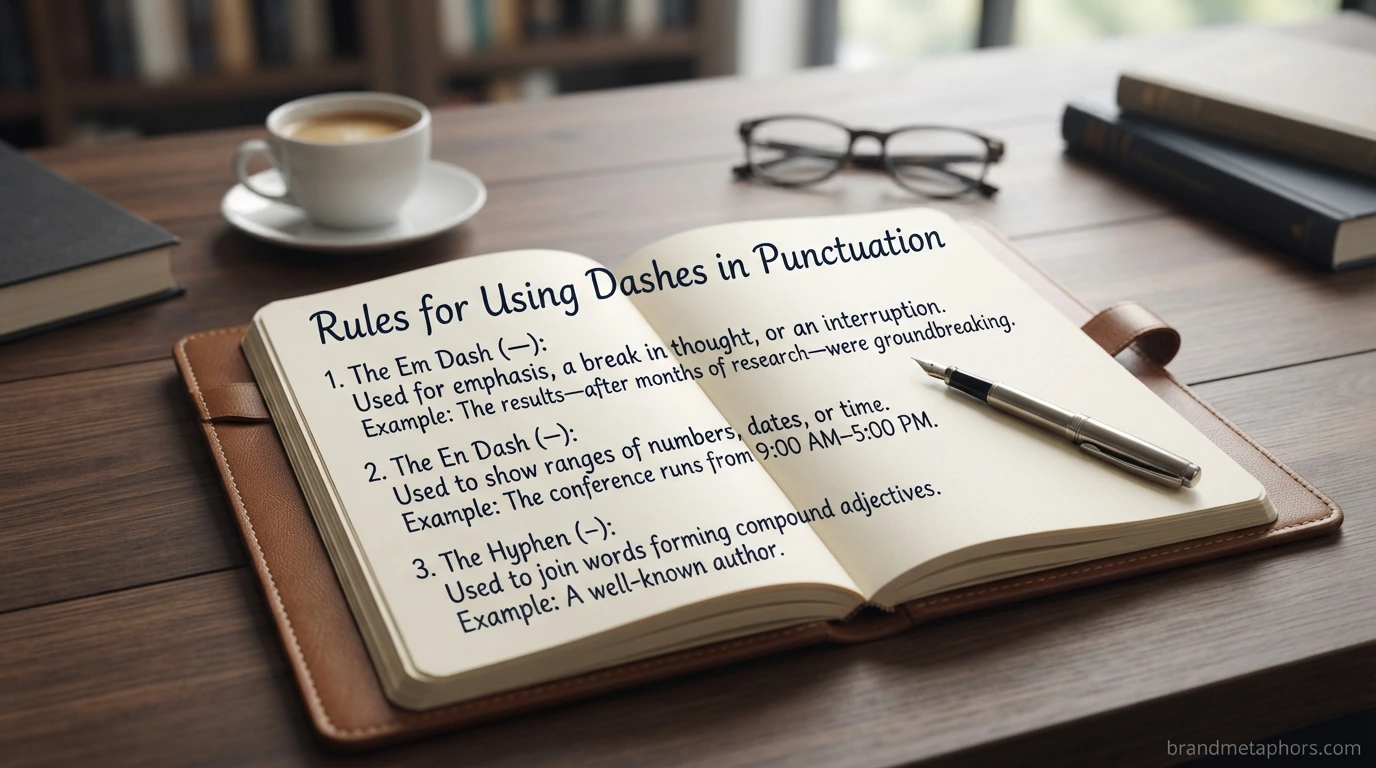
PunctuationAppearanceMain PurposeExampleHyphen-Join wordswell-known authorEn Dash–Show ranges or connectionsPages 20–35Em Dash—Add emphasis or interruptionsShe finally arrived—two hours late.
Remember:
- A hyphen joins.
- An en dash connects.
- An em dash separates or emphasises.
Knowing this simple rule prevents many common punctuation mistakes.
The Em Dash: The Most Versatile Punctuation Mark
The em dash is one of the most flexible punctuation marks in English.
It creates a strong pause that is longer than a comma but less formal than parentheses.
Common Uses
1. Add Extra Information
Example:
My brother—the youngest in the family—loves photography.
The added information could also appear inside commas or brackets, but the dash creates more emphasis.
2. Create Dramatic Emphasis
Example:
There was only one solution—leave immediately.
The dash draws attention to the final idea.
3. Show an Unexpected Change
Example:
I planned to exercise—but then it started raining.
4. Show an Interruption
Example:
“If you would just—”
“No, listen to me first.”
This often appears in dialogue.
5. Replace a Colon
Example:
She packed everything she needed—food, water, maps, and clothes.
The En Dash: Connecting Related Information
The en dash is less common but still important.
Its main job is connecting related ideas rather than joining individual words.
Use It for Number Ranges
Examples:
- Pages 12–25
- 1998–2005
- Monday–Friday
- Chapters 3–8
Use It Between Places
Examples:
- London–Paris flight
- New York–Boston train
- India–Pakistan border
Use It for Relationships
Examples:
- teacher–student relationship
- parent–child communication
- cost–benefit analysis
Unlike the hyphen, the en dash connects equal elements rather than combining words into one adjective.
The Hyphen: Small Mark, Big Job

Many people call every short horizontal line a dash, but the hyphen has a completely different purpose.
It joins words together.
Use Hyphens in Compound Adjectives
Examples:
- well-written article
- high-quality product
- easy-to-read guide
- long-term investment
Without the hyphen, readers may misunderstand the meaning.
Compare:
- small business owner
- small-business owner
The second version clearly shows the business is small.
Use in Some Prefixes
Examples:
- self-esteem
- ex-president
- anti-inflammatory
Use with Numbers
Examples:
- twenty-one
- forty-five
- ninety-nine
Common Grammar Rules Every Writer Should Know
Following these rules will make your writing cleaner and more professional.
Rule 1: Don’t Replace Every Comma with a Dash
Incorrect:
She likes pizza—and burgers—and pasta.
Correct:
She likes pizza, burgers, and pasta.
Rule 2: Don’t Overuse Em Dashes
Too many dashes make writing difficult to follow.
Instead of:
The meeting—which started late—lasted three hours—and everyone became tired.
Write:
The meeting started late and lasted three hours. Everyone became tired.
Rule 3: Use Only One Style Consistently
Choose one formatting style and stay consistent.
Some style guides write:
She smiled—then left.
Others write:
She smiled — then left.
Follow the style guide required for your work.
Rule 4: Don’t Confuse Hyphens with Dashes
These are not interchangeable.
Incorrect:
Pages 10-15
Preferred in formal writing:
Pages 10–15
Rule 5: Keep Sentences Clear
A dash should improve understanding—not make writing more complicated.
Common Mistakes Writers Make
Many punctuation errors happen because writers use the wrong mark.
Mistake 1: Using a Hyphen Instead of an Em Dash
Incorrect:
She forgot one thing-her passport.
Correct:
She forgot one thing—her passport.
Mistake 2: Using Too Many Dashes
Bad:
We visited Paris—the museums—the cafés—the parks—and loved everything.
Better:
We visited Paris, explored museums, relaxed in cafés, and loved every minute.
Mistake 3: Adding Spaces Incorrectly
Different style guides have different rules.
Examples:
- She left—without saying goodbye.
- She left — without saying goodbye.
Consistency matters more than personal preference.
Mistake 4: Using Dashes Where Parentheses Work Better
Sometimes parentheses are easier to read.
Compare:
My teacher—the science teacher—won an award.
or
My teacher (the science teacher) won an award.
Choose whichever best matches the tone.
Real-Life Examples of Correct Usage

Understanding punctuation becomes easier through everyday examples.
In Emails
Please send the report by Friday—no later.
In Stories
He opened the old box—then everything changed.
In Academic Writing
The experiment lasted 2018–2020.
In Business Writing
The company offers three services—consulting, training, and support.
In News Articles
The president—speaking at the conference—announced new policies.
When to Use Commas, Colons, Parentheses, or Dashes
Many writers wonder which punctuation mark works best.
Use a Dash When
- Adding emphasis
- Creating dramatic pauses
- Showing interruptions
- Introducing unexpected information
Utilize a Comma When
- Listing items
- Separating clauses gently
- Keeping the sentence flowing
Use a Colon When
- Introducing a list
- Explaining something
- Presenting examples
Use Parentheses When
- Adding background information
- Including optional details
- Giving explanations that aren’t essential
Choosing the right punctuation improves readability.
Benefits of Using Dashes Correctly
Mastering punctuation offers many advantages.
Better Readability
Readers understand ideas faster.
Stronger Emphasis
Important information stands out naturally.
More Professional Writing
Correct punctuation improves essays, articles, and workplace documents.
Better Exam Scores
Students often receive higher marks for clear grammar and punctuation.
Improved Communication
Your meaning becomes clearer with fewer misunderstandings.
More Engaging Writing
Dashes help create natural rhythm and variety.
Tips for Remembering the Rules

Learning punctuation doesn’t have to be difficult.
Keep these simple tips in mind:
- Think “join” when using a hyphen.
- Think “range” when using an en dash.
- Think “pause” when using an em dash.
- Read your sentence aloud.
- If the pause feels dramatic, an em dash may work.
- If words are connected, consider a hyphen.
- If numbers show a range, use an en dash.
- Avoid using several dashes in one sentence.
- Keep formatting consistent throughout your writing.
- When unsure, choose clarity over style.
Practising with everyday writing helps these rules become natural.
Frequently Asked Questions
1. What is the difference between a hyphen and a dash?
A hyphen joins words together, while dashes separate ideas, show ranges, or add emphasis depending on the type of dash.
2. When should I use an em dash?
Use it to create emphasis, insert additional information, show interruptions, or replace commas or colons when a stronger pause is needed.
3. What is an en dash used for?
It usually connects ranges, such as years, page numbers, dates, times, or relationships between equal terms.
4. Can I use a dash instead of a comma?
Sometimes, yes. A dash creates stronger emphasis than a comma. However, it should not replace every comma in your writing.
5. Should there be spaces around an em dash?
It depends on the style guide. Many American style guides use no spaces, while some British publishers include spaces. Always stay consistent.
6. Are dashes used in formal writing?
Yes. Academic papers, books, newspapers, and professional documents all use dashes correctly when appropriate.
7. Why do people confuse hyphens and dashes?
They look similar on a keyboard, but each serves a different grammatical purpose. Understanding their functions helps prevent mistakes.
8. How can I improve my punctuation skills?
Read high-quality books, practise writing regularly, proofread carefully, and learn the specific purpose of each punctuation mark rather than relying on guesswork.
Conclusion
Understanding how to use dashes correctly is a valuable writing skill that improves clarity, flow, and readability. While the hyphen joins words, the en dash connects ranges and relationships, and the em dash adds emphasis or introduces additional information. Each punctuation mark has a distinct role, and using the right one helps readers follow your ideas with ease.
The best approach is to focus on clear communication rather than using punctuation for decoration. Practise with everyday sentences, stay consistent with your chosen style guide, and avoid overusing dashes. As your confidence grows, you’ll find that these simple marks can make your writing more engaging, polished, and professional across essays, emails, articles, and creative work.