
Introduction
Strong writing is not only about using correct grammar. It is also about choosing the right words. When you understand the meaning of similar-looking words, your writing becomes clearer, more engaging, and easier to understand. Good vocabulary also helps you enjoy figurative language, including metaphors, similes, idioms, and other literary devices that make stories and conversations more interesting.
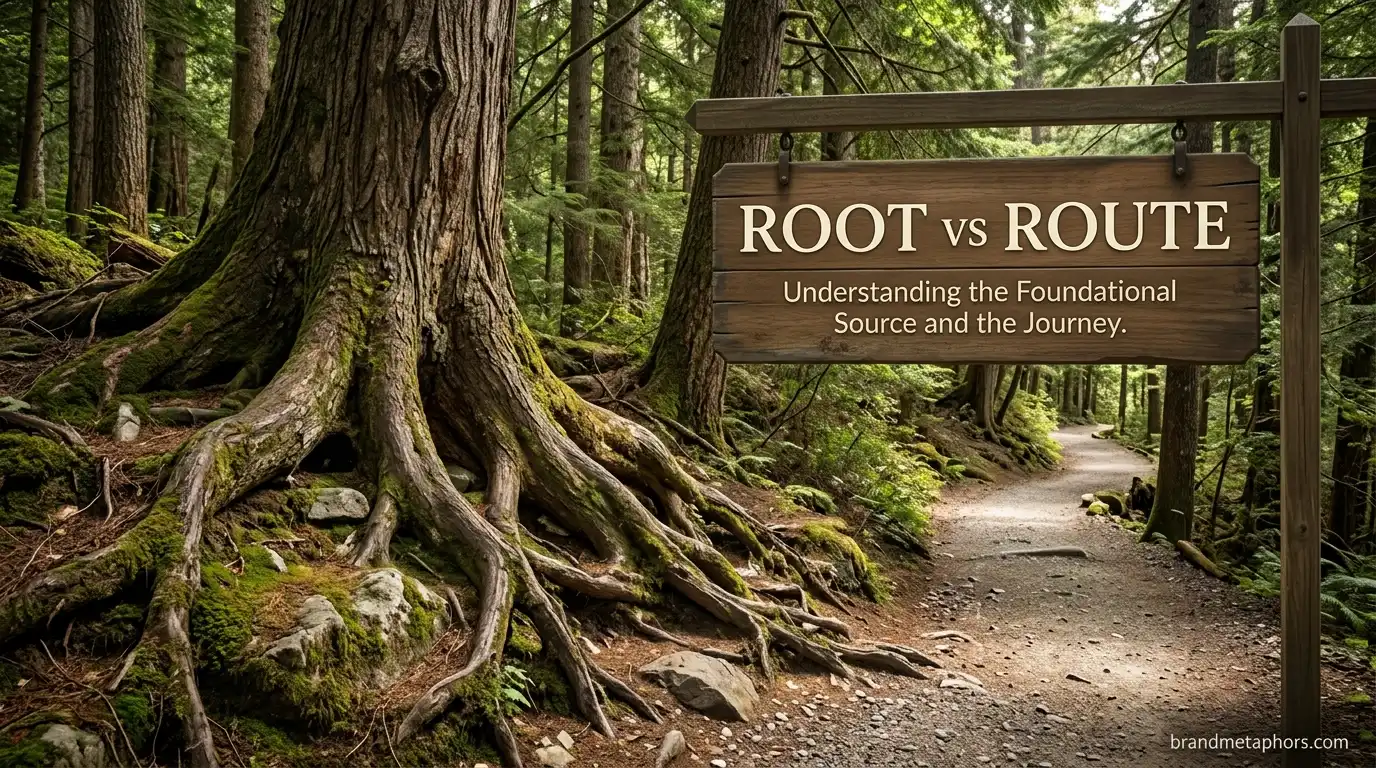
Many English learners confuse root and route because they look alike and are sometimes pronounced the same. However, these words have different meanings and are used in different situations. Knowing the difference helps students write better essays, communicate clearly, and avoid common mistakes.
This guide explains each word in simple language. You’ll learn their meanings, pronunciation, grammar, sentence examples, comparison tables, common errors, memory tips, creative writing uses, figurative expressions, and practice exercises. By the end, you’ll know exactly when to use each word with confidence.
What Do These Words Mean?
Although the two words are similar in spelling, they have different meanings.
WordMeaningPart of SpeechRootThe part of a plant below the ground; the origin or cause of somethingNoun, VerbRouteA path, road, or direction from one place to anotherNoun, Verb
Root
The word root usually refers to:
- The underground part of a plant
- The beginning or origin of something
- The main cause of a problem
- The basic form of a word in grammar
Examples:
- The tree has deep roots.
- We must find the root of the problem.
- “Play” is the root word in “playing.”
Route
The word route refers to:
- A path or journey
- A road to reach a destination
- A planned direction
- A method of sending something
Examples:
- We took a different route home.
- The bus follows the same route every morning.
- The package was routed through another city.
Quick Comparison Table
FeatureRootRouteMain meaningOrigin or underground plant partPath or directionTalks aboutBeginning or causeTravel or movementUsed in biologyYesNoUsed in transportationNoYesCan be a verbYesYesEasy memory tipThink “origin”Think “road”
Pronunciation and Spelling
Pronunciation often causes confusion.
Root
Pronounced:
/root/
It rhymes with:
- Boot
- Fruit
- Shoot
Route
There are two common pronunciations:
- Root
- Rout (rhymes with “out”)
Both are correct depending on the region and accent.
Spelling Tip
Only one extra letter changes the meaning.
- Root → origin
- Route → path
Always check whether you are talking about a beginning or a journey.
Different Meanings of Root
This word has many meanings in English.
1. Plant Root
The underground part that absorbs water.
Example:
- The roots spread deep into the soil.
2. Origin
The place where something begins.
Example:
- The tradition has its roots in ancient history.
3. Cause
The real reason behind something.
Example:
- Stress is the root of many health problems.
4. Grammar
The basic form of a word.
Example:
- “Act” is the root word of “action.”
5. Mathematics
A number multiplied by itself.
Example:
- The square root of 49 is 7.
Different Meanings of Route

This word also has several meanings.
1. Road or Path
The direction used to travel.
Example:
- We found a shorter route to school.
2. Travel Plan
A planned journey.
Example:
- The airline changed our route.
3. Computer Networking
A path for sending information.
Example:
- The internet routed the data quickly.
4. Verb
To send or direct something.
Example:
- Please route the email to the manager.
Sentence Examples
Seeing words in context makes learning easier.
Examples with Root
- The flower’s roots need water.
- Honesty is at the root of friendship.
- Scientists studied the roots of the disease.
- Reading builds strong roots for learning.
- The company returned to its roots.
Examples with Route
- We followed the mountain route.
- The train route crosses three cities.
- The driver changed the route because of traffic.
- The teacher showed us the safest route home.
- The package was routed correctly.
Creative Writing and Figurative Language
Both words appear in creative writing, poetry, and literature.
Root as a Metaphor
Writers often use root to describe:
- Family
- Identity
- Culture
- Love
- Strength
Examples:
- Her kindness was rooted in compassion.
- Dreams grow from strong roots.
- Hope planted deep roots in his heart.
Root in Similes
- Strong as tree roots.
- Firm like ancient roots.
Root in Idioms
Put down roots
Meaning:
To settle in one place.
Example:
- They moved to the village and finally put down roots.
Return to your roots
Meaning:
Go back to your original lifestyle or traditions.
Example:
- He returned to his roots after years abroad.
Route in Figurative Language
Although less common, route is also used creatively.
Examples:
- Success has no easy route.
- Every dream follows a different route.
- Love finds its own route.
- The route to happiness begins with gratitude.
Simile Examples
- Like a winding route through the mountains.
- Like a hidden route through the forest.
Metaphor Examples
- Education is the route to opportunity.
- Kindness is the best route to peace.
These expressions make writing more vivid and descriptive.
When to Use Each Word
Use Root When Talking About
- Plants
- Origins
- Causes
- Family history
- Grammar
- Mathematics
- Culture
- Traditions
Examples
Root cause
Root word
Family roots
Tree roots
Use Route When Talking About
- Roads
- Maps
- Travel
- Directions
- Delivery
- Transportation
- Journeys
Examples
Bus route
Escape route
Travel route
Delivery route
Common Mistakes and How to Avoid Them
Many learners accidentally mix these words.
Mistake 1
❌ We found the fastest root home.
✔ We found the fastest route home.
Mistake 2
❌ The route of the problem is stress.
✔ The root of the problem is stress.
Mistake 3
❌ The plant has long routes.
✔ The plant has long roots.
Mistake 4
❌ The bus root changed today.
✔ The bus route changed today.
Easy Memory Trick
Think of:
Root = Origin
Both contain the letter O.
Route = Road
Both begin with R.
This simple trick helps many learners remember the difference.
Tone, Style, and Writing Tips

Choosing the right word improves your writing style.
SituationBetter ChoiceScienceRootBiologyRootTravel blogsRouteMapsRoutePoetryBothStorytellingBothEssaysDepends on meaning
Formal Writing
Both words work well in formal writing when used correctly.
Example:
- Researchers discovered the root cause.
- The shortest route reduced travel time.
Informal Writing
Examples:
- Let’s take another route.
- Family is my root.
Vocabulary Enhancement
Learning related words improves communication.
Words Related to Root
- Origin
- Source
- Foundation
- Beginning
- Base
- Stem
- Core
- Heritage
- Cause
Words Related to Route
- Path
- Road
- Journey
- Way
- Direction
- Course
- Track
- Passage
- Highway
Using a variety of vocabulary makes essays more interesting.
Practice Exercises
Exercise 1
Choose the correct word.
- The tree has deep ______.
Answer:
Roots
- Which ______ should we take to the airport?
Answer:
Route
- We discovered the ______ cause of the problem.
Answer:
Root
- The delivery ______ changed because of rain.
Answer:
Route
- The family returned to its cultural ______.
Answer:
Roots
Exercise 2
Fill in the blanks.
- Every journey begins with a ______.
Answer:
Route
- The disease has its ______ in poor nutrition.
Answer:
Root
- The pilot changed the flight ______.
Answer:
Route
- Plants need healthy ______.
Answer:
Roots
Exercise 3
Earth Your Own Sentences
Write one sentence using root to mean “origin.”
Write another sentence using route to mean “path.”
Frequently Asked Questions
1. Are root and route the same?
No. One means origin or plant base, while the other means a path or direction.
2. Is route pronounced like root?
Yes. In many places it is pronounced “root,” while others pronounce it “rout.” Both are accepted.
3. Can both words be verbs?
Yes.
- Root can mean to establish or search.
- Route can mean to direct or send.
4. Which word is used in grammar?
Root is used in grammar to describe the basic form of a word.
5. How can I remember the difference?
Remember:
- Root = origin or beginning.
- Route = road or path.
Thinking about “root cause” and “travel route” makes the meanings easy to remember.
Conclusion
Understanding the difference between these two commonly confused words helps you become a stronger writer and speaker. One refers to origins, foundations, causes, and plant structures, while the other describes paths, directions, journeys, and travel. Once you connect each word with its main idea, choosing the correct one becomes much easier.
Keep practicing with real-life examples, reading, and writing exercises. Explore figurative language by using these words in metaphors, similes, and idioms to make your writing more vivid and expressive. With regular practice, your vocabulary will grow, your descriptive language will improve, and you’ll communicate with greater confidence in school, at work, and in everyday conversations.