
Introduction
English can be confusing because many words have more than one correct form. One common example is proved and proven. Many students, writers, and English learners wonder which word is correct and when each one should be used.
Understanding the difference between these two forms can improve writing skills, strengthen grammar accuracy, and enhance vocabulary. Whether you are writing essays, stories, emails, academic papers, or creative content, knowing how to use these words correctly will help you communicate more clearly.
This comprehensive guide explains the meanings, grammar rules, sentence examples, common mistakes, comparisons, exercises, and practical usage of proved and proven in simple language.
Understanding the Meaning of Prove
Before learning the difference between proved and proven, it is important to understand the verb prove.
Prove means:
- To show that something is true
- To demonstrate evidence
- To establish a fact
- To confirm an idea or belief
Examples
- The scientist tried to prove the theory.
- The lawyer must prove the defendant’s innocence.
- Hard work can prove your dedication.
The verb “prove” changes form depending on tense and grammatical structure.
Verb FormWordBase FormProvePast TenseProvedPast ParticipleProved / Proven
This is where many learners become confused.
What Does “Proved” Mean?
Proved is the simple past tense of the verb “prove.”
It describes an action that happened in the past.
Structure
Subject + Proved + Object
Examples
- She proved her point during the debate.
- The experiment proved the hypothesis.
- He proved his skills through hard work.
- They proved their loyalty to the team.
- The evidence proved his innocence.
In these examples, proved simply shows that the action happened in the past.
What Does “Proven” Mean?
Proven is mainly used as a past participle and as an adjective.
It often appears with helping verbs such as:
- has
- have
- had
- was
- were
- be
Examples
- She has proven her ability.
- The method has proven successful.
- They had proven their commitment.
- The strategy was proven effective.
As an Adjective
When used as an adjective, proven describes something that has already been tested and shown to be successful.
Examples
- a proven method
- a proven strategy
- a proven leader
- a proven technique
- a proven solution
This adjective usage is extremely common in modern English.
The Main Difference Between Proved and Proven
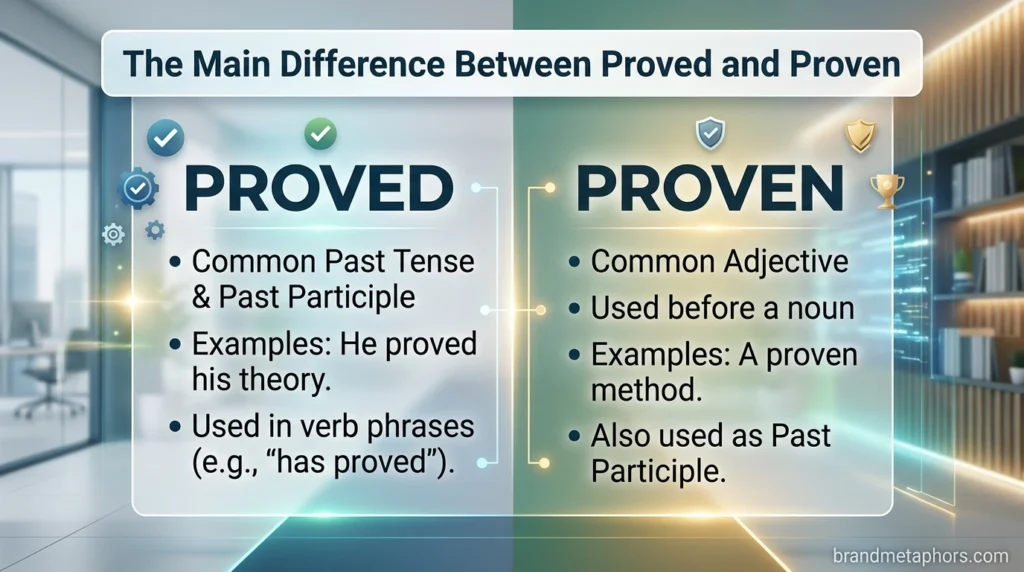
Many learners ask which one is correct.
The answer is that both are correct, but they are used differently.
Quick Comparison Table
FeatureProvedProvenPast TenseYesNoPast ParticipleYesYesAdjectiveRareVery CommonFormal WritingCommonCommonEveryday EnglishCommonCommonExampleShe proved her point.She has proven her point.
Easy Rule
Use proved for simple past actions.
Use proven after helping verbs or as an adjective.
Grammar Rules for Using Proved and Proven
Understanding grammar rules makes usage much easier.
Rule 1: Use Proved for Simple Past Tense
Correct:
- He proved his innocence.
- The test proved the theory.
Incorrect:
- He proven his innocence.
Rule 2: Use Proven After Helping Verbs
Correct:
- He has proven his innocence.
- They had proven their abilities.
Incorrect:
- He has proved his innocence. (Though grammatically accepted in some varieties of English, proven is more common in modern usage.)
Rule 3: Use Proven as an Adjective
Correct:
- This is a proven technique.
- She is a proven performer.
Incorrect:
- This is a proved technique.
Historical Background of Proved and Proven
The history of these words explains why both forms exist.
Originally, proved was both the past tense and past participle.
Over time, proven became popular, especially in American English.
Today:
British English
Often prefers:
- has proved
- had proved
American English
Often prefers:
- has proven
- had proven
Examples
British Style:
- The method has proved effective.
American Style:
- The method has proven effective.
Both forms are accepted by major dictionaries and grammar guides.
Sentence Examples for Better Understanding
Learning through examples is one of the best ways to improve vocabulary and grammar.
Examples with Proved
- The teacher proved the formula.
- She proved her talent in the competition.
- The investigation proved his claims.
- The results proved the prediction correct.
- The athlete proved his strength.
Examples with Proven
- She has proven her dedication.
- The system has proven reliable.
- The treatment has proven effective.
- They had proven their commitment.
- It is a proven fact.
Mixed Comparison
Sentence with ProvedSentence with ProvenHe proved his worth.He has proven his worth.The study proved the claim.The study has proven the claim.She proved her ability.She has proven her ability.
Proved and Proven in Academic Writing
Academic writing requires accuracy and clarity.
When to Use Proved
Use proved when discussing a completed past event.
Examples:
- The experiment proved the theory.
- The researcher proved the hypothesis.
When to Use Proven
Use proven when describing established findings.
Examples:
- The method has proven effective.
- Researchers have proven the relationship.
Academic Tip
Always follow your institution’s style guide because some academic formats prefer one form over another.
Proved and Proven in Creative Writing

Creative writing focuses on storytelling and expression.
Using the correct form helps improve descriptive language and readability.
Story Example with Proved
After months of training, Jake proved himself worthy of joining the team.
Story Example with Proven
Jake had already proven his dedication long before the final competition.
Benefits in Creative Writing
- Improves sentence variety
- Creates natural flow
- Enhances vocabulary
- Strengthens narrative style
- Increases grammatical accuracy
Common Mistakes Learners Make
Many English learners make the same errors.
Mistake 1
Incorrect:
- She proven her skills.
Correct:
- She proved her skills.
- She has proven her skills.
Mistake 2
Incorrect:
- This is a proved method.
Correct:
- This is a proven method.
Mistake 3
Incorrect:
- They has proven success.
Correct:
- They have proven success.
Mistake 4
Incorrect:
- He proven himself.
Correct:
- He proved himself.
- He has proven himself.
When to Use Proved
Use proved when:
Talking About Past Events
- The evidence proved the accusation false.
Writing Narratives
- She proved everyone wrong.
Reporting Completed Actions
- The experiment proved successful.
Describing Historical Events
- The discovery proved important.
When to Use Proven
Use proven when:
Using Perfect Tenses
- The company has proven reliable.
Describing Tested Success
- It is a proven strategy.
Marketing and Business Writing
- proven results
- proven techniques
- proven methods
Professional Communication
- The software has proven effective.
Comparison Table: Proved vs Proven
SituationCorrect ChoiceSimple Past TenseProvedPresent PerfectProvenPast PerfectProvenAdjective UseProvenAcademic Research FindingsOften ProvenStorytelling About Past EventsProvedMarketing LanguageProvenEstablished SuccessProven
Practice Exercises
Try these exercises to test your understanding.
Exercise 1
Choose the correct word.
- She _____ her talent during the competition.
- The technique has _____ effective.
- The evidence _____ his innocence.
- This is a _____ strategy.
- They had _____ their commitment.
Answers
- proved
- proven
- proved
- proven
- proven
Vocabulary Enhancement: Related Words
Learning related vocabulary improves writing and communication.
Synonyms of Prove
- Demonstrate
- Confirm
- Verify
- Establish
- Validate
- Support
- Show
- Substantiate
Example Sentences
- The data confirmed the theory.
- The results validated the findings.
- Evidence established the truth.
Using these alternatives can make writing more engaging and less repetitive.
Tips for Remembering the Difference

Here are simple memory tricks.
Remember This Formula
Past Action = Proved
Example:
- She proved her point.
Helping Verb = Proven
Example:
- She has proven her point.
Adjective = Proven
Example:
- a proven solution
These three rules solve most usage problems.
Frequently Asked Questions (FAQs)
1. Is proven a real word?
Yes. Proven is a correct and widely accepted English word used as a past participle and adjective.
2. Which is more correct, proved or proven?
Both are correct. The choice depends on grammar and sentence structure.
3. Can proven be used as an adjective?
Yes. Examples include:
- proven method
- proven leader
- proven strategy
4. Is has proved wrong?
No. It is grammatically correct, especially in British English. However, has proven is very common in American English.
5. Which form should students use in essays?
Students can use either form correctly according to grammar rules and the writing style required by their school or institution.
Conclusion
Understanding the difference between proved and proven is an important step toward better English writing. While proved is generally used as the simple past tense, proven is commonly used as a past participle and adjective. Both forms are correct and widely accepted in modern English.
By learning the grammar rules, studying sentence examples, avoiding common mistakes, and practicing regularly, students, writers, and English learners can improve writing skills, strengthen vocabulary, and communicate with greater confidence. Mastering this distinction not only enhances grammar accuracy but also makes academic, professional, and creative writing more polished and effective.