
Imagine sitting in a quiet classroom. Sunlight slips through the window like a thin golden ruler laid across your desk. The teacher writes a problem on the board, and suddenly the numbers don’t feel like numbers anymore—they feel like doors with hidden locks, waiting for the right key. For many people, mathematics often appears cold or rigid, like a wall made of symbols. But what if math is not a wall at all? What if it is a story, a language, a bridge, or even a map leading you through hidden landscapes of thought?
This is where metaphors for math become powerful. They transform abstract equations into familiar experiences. Instead of memorizing rules, you begin to see relationships. Instead of fear, you feel curiosity. In this article, we’ll explore how metaphors can reshape the way we understand mathematics, making it more human, creative, and even poetic.
H2: What Are Metaphors for Math and Why Do They Matter?
A metaphor is a way of understanding one thing in terms of another. When we say “time is a thief,” we don’t mean time literally steals—but it helps us feel how quickly moments disappear.
In mathematics, metaphors work the same way. They turn abstract concepts into something we can visualize or emotionally connect with.
For example:
- Equations become puzzles waiting to be solved.
- Functions become machines transforming inputs into outputs.
- Geometry becomes architecture built with invisible lines.
These comparisons matter because they:
- Improve understanding for students
- Reduce math anxiety
- Encourage creative thinking
- Make learning more memorable
When math becomes relatable, it stops being intimidating and starts becoming meaningful.
H2: Metaphor 1 — Math as a Universal Language of Patterns
One of the most powerful metaphors for math is that math is a language.
Just like English or Urdu, math has grammar (rules), vocabulary (numbers and symbols), and sentences (equations). But unlike spoken languages, math is universal—it does not change across countries.
Meaning & Explanation
This metaphor helps us understand that math is not about memorizing isolated formulas. Instead, it is about communication—expressing patterns, relationships, and truths clearly and precisely.
Example Sentence / Scenario
A scientist describing planetary motion doesn’t rely on words alone. They use equations like a poet uses verses. In this sense, math becomes a language that the universe “speaks.”
Alternative Expressions
- Math is the grammar of nature
- Numbers are words of the universe
- Equations are sentences of logic
Sensory / Emotional Detail
Think of it like listening to a symphony where every note follows invisible rules. You may not see the structure, but you feel its harmony.
Mini Storytelling Element
A student once struggled with algebra until a teacher said, “Think of x as a mystery word in a sentence.” Suddenly, solving equations felt like decoding messages rather than fighting symbols.
H2: Metaphor 2 — Math as Architecture and Bridge-Building
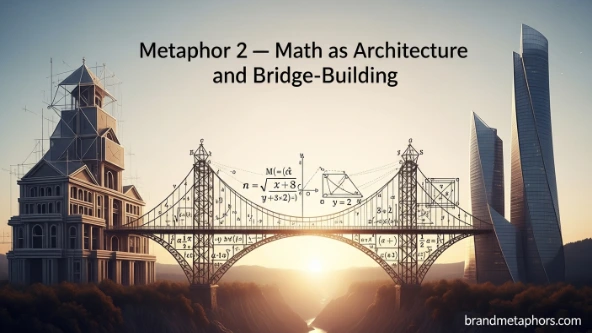
Another powerful metaphor is math as architecture.
Meaning & Explanation
In this view, mathematics is like designing buildings. Each formula is a brick, each theorem a pillar, and each proof a blueprint. You don’t just memorize math—you construct it.
Example Sentence / Scenario
Solving a geometry problem becomes like designing a bridge across a river. Every angle and measurement must support the structure so it doesn’t collapse.
Alternative Expressions
- Math is structural design for ideas
- Equations are building blocks of reasoning
- Proofs are blueprints of truth
Sensory / Emotional Detail
Imagine the sound of scaffolding rising, metal clicking, and plans unfolding across a wide table. Math feels less like abstract symbols and more like construction in motion.
Mini Storytelling Element
Think of ancient civilizations like the engineers of the pyramids. They didn’t just stack stones—they calculated stability, balance, and proportion. Their math was silent architecture carved into history.
Why It Helps
This metaphor teaches learners that mistakes in math are like structural flaws—they help you improve the design, not destroy the process.
H2: Metaphor 3 — Math as a Map Through Hidden Worlds
Math can also be understood as a map of reality.
Meaning & Explanation
A map does not create land—it represents it. Similarly, math doesn’t create reality, but it helps us navigate and understand it.
Example Sentence / Scenario
When you plot a graph, you are essentially drawing a landscape of relationships. Peaks and valleys represent changes, like mountains and rivers on a map.
Alternative Expressions
- Math is navigation for logic
- Equations are coordinates of truth
- Functions are paths through space
Sensory / Emotional Detail
Picture yourself holding an old parchment map. Every line is a clue. Every curve leads somewhere unknown. Math gives you that same sense of discovery.
Mini Storytelling Element
Early explorers used mathematical calculations to navigate oceans. Without maps and numbers, they would have been lost in endless blue. Math became their compass.
Why It Matters
This metaphor helps students see math as exploration, not memorization. Every problem becomes a journey rather than a test.
H2: Creative Exercises — Practicing Metaphors for Math in Real Life
To truly understand metaphors for math, you need to use them actively. Here are some exercises:
Exercise 1: Create Your Own Metaphor
Choose a math concept (like fractions, algebra, or geometry). Now describe it as:
- a machine
- a journey
- a recipe
- a game
Example: “Fractions are slices of a shared pizza of reality.”
Exercise 2: Rewrite Math in Story Form
Take a simple equation like 2x + 3 = 11 and imagine it as a story:
- Who is x?
- What is happening?
- Why must balance be restored?
Exercise 3: Visual Thinking Challenge
Close your eyes and imagine multiplication as:
- a garden growing plants
- a crowd multiplying in a stadium
- echoes bouncing in a canyon
Exercise 4: Real-Life Observation
Look around your room and identify where math appears as:
- symmetry (architecture)
- patterns (tiles, clothes)
- ratios (objects, proportions)
These exercises help shift math from abstract thinking to imaginative understanding.
H2: Math in Literature, Culture, and Human Thought
Math metaphors are not new. Writers, philosophers, and scientists have used them for centuries.
Shakespeare often used numbers and balance as metaphors for order in human life. Ancient Greek thinkers viewed mathematics as the “music of the cosmos,” believing that the universe followed harmonic ratios.
Even modern culture uses math metaphorically:
- Video games use points and levels as progress systems
- Social media algorithms rely on invisible equations shaping what we see
- Music rhythm is deeply mathematical in structure
Math, in this sense, is not separate from culture—it is woven into it like thread in fabric.
H2: Bonus Tips — Using Math Metaphors in Writing and Daily Life
Metaphors for math are not just for classrooms. They can improve communication, creativity, and even content creation.
Tip 1: Use Metaphors in Writing
Instead of saying “data increased,” say:
- “Data climbed like a staircase”
- “Numbers surged like a rising tide”
Tip 2: Social Media Engagement
Math metaphors make content more engaging:
- “Your productivity is a formula—what variables are you changing today?”
Tip 3: Teaching and Learning
Teachers can say:
- “Think of equations as balancing a scale” instead of abstract instructions.
Tip 4: Everyday Thinking
Even budgeting becomes easier:
- Money = water flowing through containers
- Expenses = leaks in a bucket
This makes decision-making more intuitive.
H2: Real-Life Applications — How Math Metaphors Improve Learning
Students often struggle not because math is difficult, but because it feels disconnected from reality. Metaphors bridge that gap.
For example:
- Physics becomes storytelling about forces and motion
- Algebra becomes solving mysteries
- Statistics becomes reading patterns in human behavior
When learners adopt metaphors, they:
- Retain concepts longer
- Reduce anxiety
- Improve problem-solving creativity
A student who sees math as storytelling rather than punishment learns faster and with more confidence.
H2: Frequently Asked Questions (FAQs)
1. What are metaphors for math?
Metaphors for math are creative comparisons that help explain mathematical concepts using familiar ideas like language, maps, or architecture.
2. Why are math metaphors important?
They make abstract ideas easier to understand, reduce fear of math, and improve long-term memory retention.
3. Can metaphors improve math performance?
Yes. They help learners visualize problems and connect concepts to real-life experiences, improving comprehension.
4. Are metaphors used in professional mathematics?
Yes. Even advanced mathematicians use metaphors to describe complex ideas during teaching and research discussions.
5. How can I create my own math metaphors?
Start by choosing a concept and asking: “What real-life object or experience behaves like this idea?”
Conclusion
Mathematics is often seen as rigid, silent, and distant. But through metaphors, it begins to breathe. It becomes a language spoken by stars, a bridge built by logic, a map guiding human curiosity.
When you stop seeing math as isolated symbols and start seeing it as story, structure, and movement, everything changes. You don’t just solve problems—you explore ideas. You don’t just calculate—you interpret reality.
Metaphors for math do more than explain numbers. They restore imagination to logic and humanity to equations.