
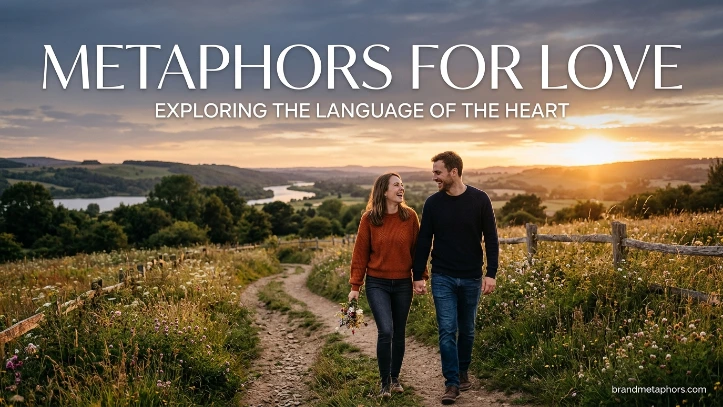
Love rarely arrives quietly. It slips into your life like the scent of rain before a storm, like the hum of a song you didn’t know you remembered. Maybe it’s the warmth of a hand brushing yours in a crowded room, or the ache of missing someone whose laughter still echoes in your bones. We feel love deeply—sometimes overwhelmingly—but when it comes to expressing it, words often fall short.
That’s where metaphors come in.
Metaphors for love transform abstract emotion into something vivid, tangible, and unforgettable. They give shape to feelings that resist definition, helping writers, speakers, and everyday people articulate what the heart knows but the tongue struggles to say. Whether you’re writing poetry, crafting a heartfelt message, or simply trying to understand your own emotions, learning to use metaphors for love can make your expression more powerful and meaningful.
In this article, you’ll explore beautiful and creative metaphors, learn how to use them effectively, and practice turning your own feelings into language that resonates.
Why Metaphors for Love Matter in Writing and Life
Love is one of the most universal human experiences—and one of the hardest to describe. Saying “I love you” is meaningful, but sometimes it feels too small for what you feel.
Metaphors expand that expression.
They:
- Add emotional depth and imagery
- Make writing more memorable and engaging
- Help others feel what you’re saying
- Clarify complex emotions
Think of how different these feel:
- “I love you.”
- “You are the sunrise I didn’t know I needed.”
Both are sincere, but one paints a picture. It lingers.
Metaphors turn emotion into experience.
Metaphor #1: Love as a Journey

Meaning and Explanation
This metaphor compares love to a journey—full of movement, growth, challenges, and discovery. It highlights that love is not static; it evolves over time.
Example Scenario
A couple reflects on their years together: the struggles, the milestones, the unexpected turns.
Example sentence: “Our love has been a long road, winding through storms and sunshine, but I wouldn’t trade the journey for anything.”
Alternative Expressions
- Love is a road we travel together
- Our hearts walk the same path
- We’re navigating life side by side
- Love is a shared adventure
Sensory and Emotional Details
Imagine dusty roads, open skies, sudden rain, laughter echoing across distance. Love here feels dynamic, alive, and resilient.
Mini Storytelling
An elderly couple sits on a bench, holding hands in silence. They don’t need words anymore—their journey speaks for them. Every wrinkle, every shared glance is a map of where they’ve been.
Metaphor #2: Love as Fire
Meaning and Explanation
Love as fire represents passion, warmth, intensity, and sometimes danger. It can comfort or consume.
Example Sentence
“Her love burned in me like a wildfire—beautiful, uncontrollable, and impossible to ignore.”
Alternative Ways to Express It
- Love is a flame that never fades
- His touch sparked something in me
- Our love smolders beneath the surface
- A burning desire
Sensory Details
Heat on your skin, flickering light, crackling sounds, the glow of embers in the dark.
Emotional Layer
Fire can nurture or destroy—this metaphor is perfect for intense, passionate, or complicated love.
Cultural Note
From ancient myths to modern romance novels, fire has long symbolized desire and transformation.
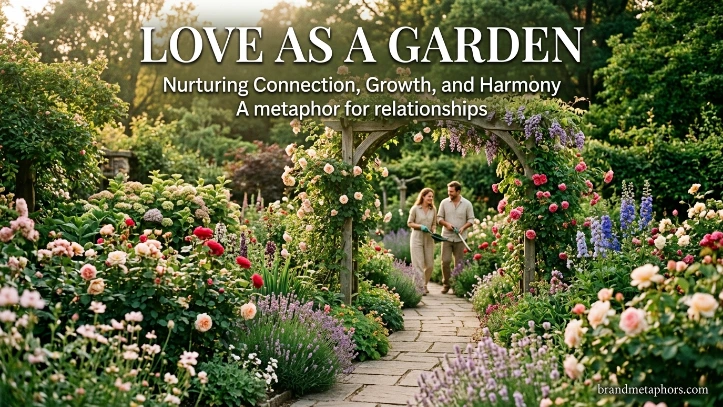
Metaphor #3: Love as a Garden
Meaning and Explanation
This metaphor emphasizes care, patience, and growth. Love needs nurturing to thrive.
Example Scenario
A relationship where both partners actively invest time and effort.
Example sentence: “Our love is a garden—we water it daily, and in return, it blooms.”
Alternative Expressions
- Love blossoms with care
- A relationship takes root
- We planted something beautiful together
- Love grows where it is nurtured
Sensory Imagery
Soft soil, blooming flowers, the scent of fresh petals, sunlight filtering through leaves.
Mini Story
A couple plants a tree together on their first anniversary. Years later, it stands tall—just like their love.
Creative Ways to Use Love Metaphors in Writing
Metaphors shouldn’t feel forced—they should feel natural and meaningful.
Tips:
- Match the metaphor to the emotion (gentle love vs. intense passion)
- Avoid clichés unless you add a twist
- Use sensory details for vividness
- Keep it simple and relatable
Example Transformation: Basic: “I miss you.” Metaphor: “Missing you feels like winter without warmth.”
Interactive Exercise: Create Your Own Love Metaphor
Try this simple activity:
Step 1: Identify the feeling
Is your love calm? Intense? Uncertain?
Step 2: Compare it to something
Nature, objects, experiences, seasons
Step 3: Build the sentence
“Love is like…” or “My love feels like…”
Practice Prompts:
- Love feels like __________ on a rainy day
- Being with you is like __________
- Without you, life feels like __________
Example Answer
“Being with you is like finding shade on a scorching day.”
Using Love Metaphors in Social Media and Daily Life

Metaphors aren’t just for poetry—they work beautifully in everyday communication.
Social Media Ideas:
- “You’re my favorite chapter in a never-ending story.”
- “Love you more than sunsets love the horizon.”
Text Messages:
- “You’re the calm in my chaos.”
- “My heart feels at home with you.”
Daily Conversations:
Even simple metaphors can make your words more meaningful and memorable.
Common Mistakes to Avoid When Using Metaphors
Even beautiful metaphors can fall flat if used poorly.
Avoid:
- Overcomplicating the metaphor
- Mixing metaphors (“Our love is a fire that blooms like a road”)
- Using overly common clichés without originality
Fix:
Instead of: “Love is a rose” Try: “Love is a rose that blooms even in winter.”
Bonus Tips for Mastering Love Metaphors
- Read poetry and literature for inspiration
- Observe real-life relationships
- Write regularly and experiment
- Keep a metaphor journal
Quick Practice:
Write 3 metaphors for love using:
- Nature
- Weather
- Music
Expanding Your Emotional Vocabulary Through Metaphors
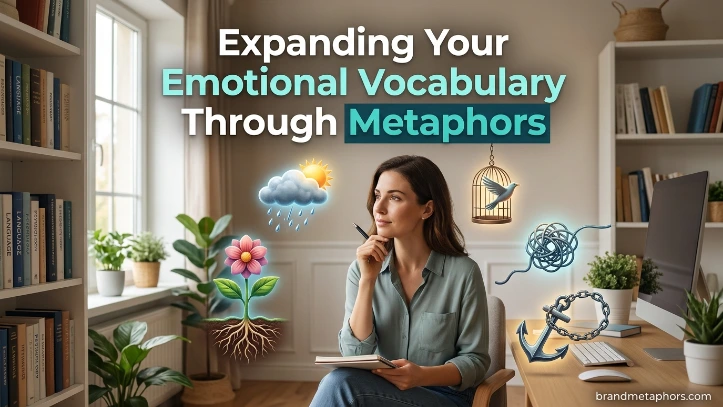
Metaphors don’t just improve writing—they deepen emotional awareness.
They help you:
- Understand your own feelings
- Communicate more effectively
- Connect with others on a deeper level
When you say, “Love feels like home,” you’re not just describing—you’re revealing.
Bringing Metaphors to Life with Storytelling
The most powerful metaphors often live inside stories.
Example:
Instead of saying: “I loved her deeply.”
Say: “I carried her laughter with me like a song I couldn’t forget, even in silence.”
Stories make metaphors breathe.
Final Practice Section: Build a Love Metaphor Paragraph
Try this:
Write a short paragraph describing love using at least one metaphor.
Example:
“Love is a lighthouse in the storm, steady and unyielding. When the waves rise and the night feels endless, it guides me back to safety. With you, I am never lost.”
FAQs About Metaphors for Love
1. What is a metaphor for love?
A metaphor for love is a figure of speech that compares love to something else to make it more vivid and expressive.
2. Why are metaphors important in expressing love?
They help convey complex emotions in a relatable and memorable way, making your words more impactful.
3. Can metaphors be used in everyday communication?
Yes, they work well in texts, conversations, and social media posts.
4. How do I create original love metaphors?
Start by identifying your feelings, then compare them to something familiar or sensory.
5. Are clichés always bad?
Not necessarily—but adding a unique twist makes them more engaging.
Conclusion
Love is too vast, too layered, too alive to be confined to plain language. It deserves color, texture, movement. It deserves metaphors.
When you describe love as a journey, a fire, or a garden, you give it dimension. You invite others not just to understand—but to feel.
So the next time your heart swells with something you can’t quite explain, don’t settle for simple words.
Paint it. Shape it. Let it breathe.
Because sometimes, the most powerful way to say “I love you” is to say it without saying it at all.