
Introduction
Imagine a classroom where knowledge doesn’t feel like dry facts on a page, but like light slowly filling a dark room. At first, everything is unclear. You hear new ideas, but they float like distant echoes. Then suddenly, something clicks—a connection forms, and the idea becomes part of you. That moment often feels hard to explain, yet we all recognize it.
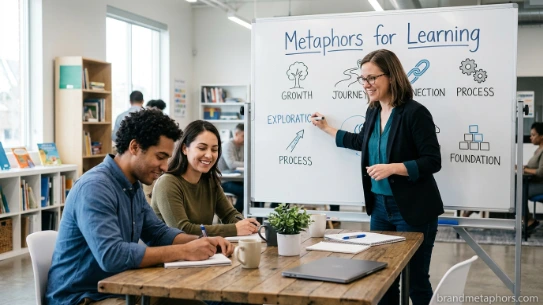
This is where metaphors for learning quietly shape our understanding. We don’t just learn through definitions and rules. We learn through images in the mind—learning as climbing a ladder, building a house, planting seeds, or crossing a bridge. These metaphors help us make sense of complex ideas in simple ways.
In real life, learning is not just about school or exams. It is about growth, problem-solving, and adapting to change. Metaphors act like mental shortcuts that guide how we think, remember, and apply knowledge. They shape motivation, confidence, and even how we see our own intelligence.
In this article, we will explore powerful metaphors for learning, what they mean, and how they influence our everyday understanding of growth and knowledge.
1. Learning as Building a House
One of the most common metaphors for learning is building a house. In this image, knowledge is not something that appears instantly. It is something constructed step by step.
Foundation First
Before walls or roofs, a strong foundation is needed. In learning, this means basic skills and core concepts. Without them, advanced ideas become unstable.
Layer by Layer Growth
As a house rises brick by brick, learning grows through practice and repetition. Each lesson adds another layer of understanding.
Real-Life Meaning
A student learning math cannot jump to algebra without understanding numbers first. Just like a house, skipping steps leads to cracks later.
This metaphor teaches patience. It reminds us that strong learning takes time, effort, and structure. You cannot rush a house into standing, just as you cannot rush deep understanding.
2. Learning as Planting Seeds
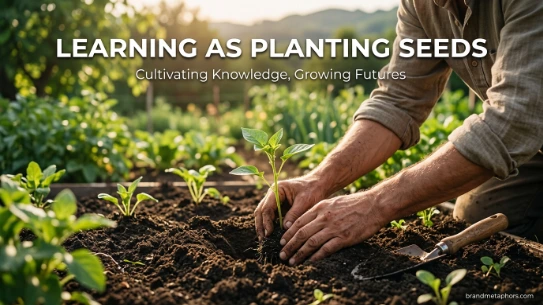
Another powerful metaphor is learning as planting seeds in soil. Knowledge begins small but has the potential to grow into something much larger.
The Role of Time
Seeds do not grow overnight. Similarly, learning needs time to develop. You may not see results immediately, but growth is happening underground.
Water and Care
Just like plants need water and sunlight, learning needs practice, attention, and encouragement.
Hidden Growth
Sometimes, progress is invisible at first. A student may struggle for weeks, but suddenly understanding blossoms.
This metaphor teaches patience and trust in the process. It reminds us that effort today creates growth tomorrow, even if we cannot see it yet.
3. Learning as Climbing a Mountain
Learning is often compared to climbing a mountain. At the start, the goal feels far away and the path looks steep.
Step-by-Step Progress
You do not reach the top in one jump. Every step matters, even small ones.
Challenges Along the Way
There are difficult parts—steep slopes, fatigue, and moments of doubt. These represent challenges in learning.
The View from the Top
When understanding finally comes, it feels like reaching a high point. You can see how far you’ve come.
This metaphor highlights effort, endurance, and reward. It teaches that struggle is part of the journey, not a sign of failure.
4. Learning as Lighting a Fire
In this metaphor, learning begins as a spark. That spark grows into a flame and eventually a steady fire.
The First Spark
A new idea or curiosity starts the learning process. It may come from a teacher, book, or experience.
Fuel and Growth
The fire grows when it is fed with practice, questions, and exploration.
Keeping the Flame Alive
Without care, the fire can fade. This means learning must be maintained through continued interest.
This metaphor shows that learning is alive. It needs energy, attention, and curiosity to stay strong.
5. Learning as Traveling a Road
Learning can also be seen as a journey along a road.
Starting Point
Everyone begins at a different place, with different knowledge and experience.
Crossroads and Choices
Along the way, learners make decisions—what to study, what to focus on, and what to leave behind.
Moving Forward
Even slow progress means you are still moving. Standing still is the only real failure.
This metaphor emphasizes direction and progress rather than speed. It reminds us that every learner has their own path.
6. Learning as Solving a Puzzle
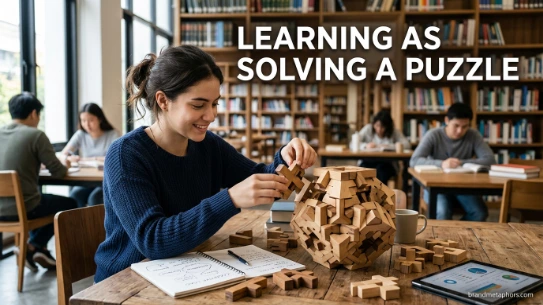
Another strong metaphor is learning as putting together a puzzle.
Missing Pieces
At first, information feels incomplete. Pieces seem random and confusing.
Finding Connections
As learning continues, patterns begin to appear. Pieces start to fit together.
The Final Picture
Eventually, understanding forms a complete image of the topic.
This metaphor helps explain why learning can feel confusing at first. It also shows that patience leads to clarity.
7. Learning as Building Bridges
Learning is sometimes like building bridges between ideas.
Connecting Old and New Knowledge
New information connects with what we already know. This forms mental bridges.
Crossing Gaps in Understanding
When something is unclear, learning helps us cross that gap.
Stronger Thinking
The more connections we build, the stronger our understanding becomes.
This metaphor highlights connection and integration. Learning is not isolated—it links ideas together.
8. Learning as Opening Doors
In this metaphor, knowledge is a series of doors waiting to be opened.
Locked Doors
At first, new subjects may seem closed and difficult to access.
Keys of Understanding
Each new concept acts like a key that unlocks the next level.
New Rooms of Knowledge
Every door opened leads to a new space of ideas and possibilities.
This metaphor shows how learning expands opportunity. Each new skill opens more paths in life.
9. Learning as Navigation
Learning can also be understood as using a map or compass.
Finding Direction
A learner uses guidance—teachers, books, or experience—to find the right direction.
Getting Lost and Refinding the Path
Mistakes are like wrong turns. They are part of learning how to navigate.
Building Confidence
Over time, learners become better at finding their own way.
This metaphor highlights independence. Learning is about developing the ability to guide yourself.
10. Learning as Filling a Container
In this metaphor, the mind is seen as a container being filled with knowledge.
Adding Information
Each lesson adds more content to the container.
Expanding Capacity
As learning grows, the container becomes larger, able to hold more ideas.
Limits of the Metaphor
While useful, this image reminds us that learning is not just storage—it is also understanding and creativity.
This metaphor is simple but powerful. It helps explain accumulation of knowledge over time.
11. Learning as Tuning an Instrument

Learning can also be like tuning a musical instrument.
Adjusting for Clarity
Just as instruments need tuning, understanding needs correction and refinement.
Practice for Harmony
Regular practice improves performance and accuracy.
Finding Balance
When everything is in tune, learning feels smooth and natural.
This metaphor shows that learning is about precision and improvement, not just memorization.
12. Learning as a Mirror
Finally, learning can be seen as a mirror reflecting who we are and how we think.
Self-Discovery
Through learning, we discover strengths and weaknesses.
Reflection of Growth
The more we learn, the clearer our reflection becomes.
Changing the Image
Unlike a fixed mirror, learning allows us to improve what we see.
This metaphor emphasizes self-awareness. Learning is not just about information—it is about personal growth.
Conclusion
Metaphors for learning help us understand something that is often invisible: the process of gaining knowledge. Whether we see learning as building a house, planting seeds, climbing a mountain, or lighting a fire, each image gives meaning to struggle, progress, and discovery.
These metaphors remind us that learning is not instant. It is gradual, sometimes difficult, but always valuable. They also show that every learner experiences growth in different ways.
When we understand learning through these images, we become more patient, motivated, and self-aware. We stop expecting instant results and start appreciating the journey. In the end, learning is not just about what we know—it is about how we grow while discovering it.