
Introduction
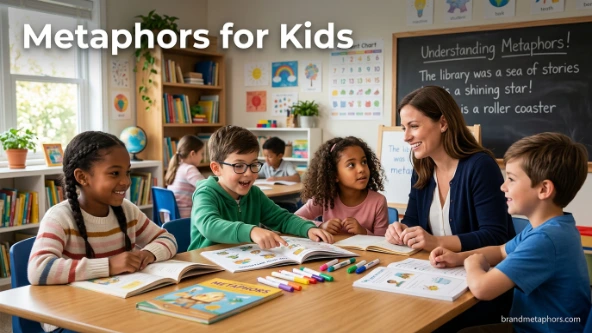
The classroom was quiet except for the soft scratch of pencils on paper. A little boy stared out the window at drifting clouds while his teacher asked the class to describe happiness. One child said happiness felt like “a warm cookie fresh from the oven.” Another whispered that sadness was “a rainy backpack dragging behind you.” Suddenly, the room filled with imagination. The children were no longer just describing feelings. They were painting pictures with words.
That is the magic of metaphors.
Metaphors for kids turn ordinary language into colorful adventures. They help children explain emotions, understand ideas, and make writing sparkle. Instead of saying someone is fast, a child can say, “He is a rocket shooting through the playground.” Simple comparisons like these make stories exciting and easier to remember.
Learning metaphors also helps kids become better readers, writers, and thinkers. They learn how words can carry hidden meanings and deep emotions. From fairy tales to superhero movies, metaphors are everywhere. They shape songs, books, classroom lessons, and everyday conversations.
In this guide, you will explore fun and creative metaphors for kids, learn how to use them, practice building your own, and discover why these imaginative expressions make language come alive.
What Are Metaphors for Kids?
Understanding Metaphors in Simple Words
A metaphor is a way of comparing two different things without using the words “like” or “as.” It says one thing is another thing to create a strong image or feeling.
For example:
- “Time is a thief.”
- “Her smile is sunshine.”
- “The classroom was a zoo.”
These phrases do not mean the words literally. Time cannot steal wallets, and a classroom is not truly filled with wild animals. The comparison simply helps us understand an idea in a vivid way.
Metaphors help children:
- Build imagination
- Improve storytelling
- Understand emotions
- Make writing more exciting
- Remember ideas more easily
Why Kids Love Metaphors
Children naturally think in pictures and emotions. A metaphor turns plain language into something colorful and playful. Instead of saying “I was nervous,” a child might say, “Butterflies danced in my stomach.”
That image feels alive.
Metaphors also make reading more magical. Many famous children’s books use them to create wonder and emotion.
Why Metaphors Matter in Childhood Learning
Metaphors Build Creative Thinking
When children create metaphors, they connect ideas in new ways. This strengthens imagination and problem-solving skills.
For example:
- “My brain is a busy bee.”
- “Homework is a mountain to climb.”
These comparisons help children think beyond simple definitions.
Metaphors Improve Writing Skills
Good writing often depends on strong imagery. Metaphors make stories memorable and emotional.
Compare these sentences:
- “The dog ran fast.”
- “The dog was a lightning bolt across the yard.”
The second sentence creates movement and excitement.
Metaphors Help Kids Express Feelings
Young children sometimes struggle to explain emotions. Metaphors make feelings easier to describe.
Examples:
- “Anger was a volcano inside me.”
- “Fear wrapped around me like a cold blanket.”
These expressions help children communicate emotions clearly.
Fun Everyday Metaphors for Kids
Metaphors About School
School gives children many opportunities to use creative comparisons.
Examples:
- “The classroom was a beehive buzzing with ideas.”
- “The teacher was a lighthouse guiding us.”
- “My backpack is a treasure chest.”
Example Scenario
A child walks into a noisy classroom before recess and says, “This room is a popcorn machine exploding with energy.”
That metaphor instantly paints a lively picture.
Metaphors About Family
Family life is filled with warmth and emotion.
Examples:
- “Mom is my safety blanket.”
- “Dad is a sturdy oak tree.”
- “My baby sister is a tornado.”
These comparisons help children describe relationships in meaningful ways.
Metaphors About Friendship
Friendship metaphors can be sweet and heartfelt.
Examples:
- “My best friend is sunshine on cloudy days.”
- “Friends are glue holding us together.”
- “A good friend is a cozy campfire.”
These phrases work beautifully in school writing projects or greeting cards.
Animal Metaphors Kids Adore
Why Animal Metaphors Are So Popular
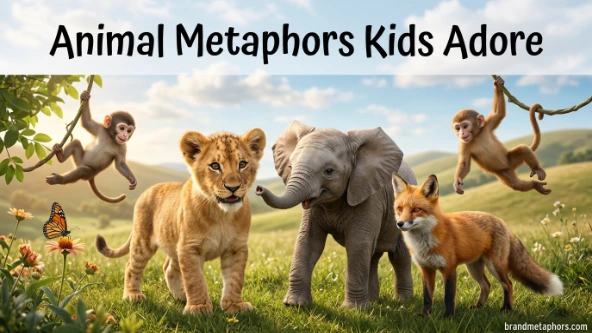
Children love animals because they are easy to imagine. Animals also have strong personalities and behaviors that match human emotions and actions.
Common Animal Metaphors
- “He is a cheetah on the soccer field.”
- “She is a wise owl.”
- “The toddler was a monkey climbing furniture.”
- “My little brother is a puppy following me everywhere.”
Meaning Behind the Metaphors
Wise Owl
Meaning: Someone smart and thoughtful.
Example Sentence: “Grandpa is a wise owl who always knows what to say.”
Alternative Expressions:
- “A walking encyclopedia”
- “A shining lantern of wisdom”
Busy Bee
Meaning: Someone hardworking and active.
Example Sentence: “Mia was a busy bee finishing her art project.”
Sensory Detail: You can almost hear the humming energy around the child.
Lion Heart
Meaning: A brave person.
Example Sentence: “Even though she was scared, Emma had the heart of a lion during the school play.”
Environment Metaphors That Spark Imagination
Nature Makes Language Beautiful
Nature is filled with colors, sounds, and movement. That makes it perfect for metaphors.
Popular Nature Metaphors for Kids
- “Her laughter was music in the wind.”
- “The boy was a growing tree.”
- “Dreams are stars lighting the night.”
- “Hope is a tiny seed.”
Mini Storytelling Example
Imagine a little girl nervous on her first day at school. Her grandmother smiles and says:
“Courage is a flower, sweetheart. It grows every time you try something new.”
That gentle metaphor can stay in a child’s heart for years.
Alternative Ways to Express Nature Metaphors
Instead of saying:
- “She was calm.”
Try:
- “She was a quiet lake at sunrise.”
Instead of:
- “He was angry.”
Try:
- “He was a thunderstorm ready to burst.”
Emotional Metaphors for Kids
Understanding Feelings Through Imagery
Emotions can feel confusing for children. Metaphors help make feelings easier to understand.
Examples of Emotional Metaphors
- “Sadness was a gray rain cloud.”
- “Joy was fireworks in my chest.”
- “Fear was an icy shadow.”
- “Love is a warm blanket.”
Emotional Awareness Through Writing
Teachers often encourage children to journal using metaphors.
For example:
Instead of writing: “I felt nervous.”
A child might write: “My stomach was a washing machine spinning too fast.”
That image is vivid and relatable.
Real-Life Example
A young boy preparing for a spelling bee once said:
“My thoughts are jumping frogs.”
His metaphor perfectly captured nervous energy.
Three Powerful Metaphor Examples Kids Can Use
The Brain Is a Supercomputer
Meaning
This metaphor compares the brain to a powerful machine full of information and ideas.
Example Sentence
“My brain is a supercomputer solving math puzzles.”
Alternative Expressions
- “My mind is a library.”
- “My brain is a toolbox.”
Why It Works
Kids love technology and gadgets. This metaphor makes learning feel exciting.
Life Is a Roller Coaster
Meaning
Life has ups, downs, surprises, and excitement.
Example Sentence
“Fourth grade has been a roller coaster of emotions.”
Sensory Details
The phrase makes readers imagine twists, speed, and sudden drops.
Mini Storytelling
A child nervous about moving to a new school might describe the experience as:
“Life became a roller coaster the day we packed our boxes.”
Books Are Magic Portals
Meaning
Books transport readers to new worlds and adventures.
Example Sentence
“Books are magic portals to hidden kingdoms.”
Alternative Expressions
- “Books are treasure maps.”
- “Stories are flying carpets.”
Cultural Reference
Many fantasy stories use this idea. In famous adventures, children step into magical worlds through wardrobes, rabbit holes, or secret doors.
How Kids Can Create Their Own Metaphors
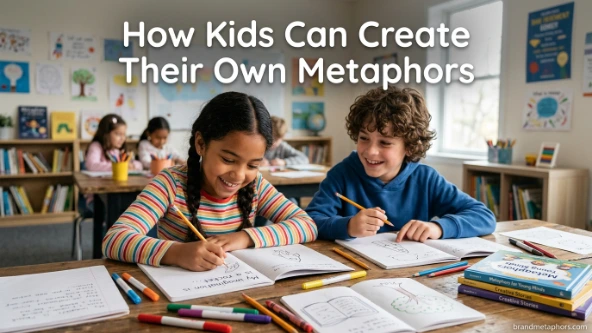
Step 1: Pick a Feeling or Object
Choose something simple:
- Happiness
- School
- Friendship
- Rain
- A pet
Step 2: Think of Something Similar
Ask questions like:
- What does it feel like?
- What does it look like?
- What does it remind me of?
Step 3: Build the Comparison
Turn the idea into a creative statement.
Examples:
- “Homework is a mountain.”
- “Excitement is popcorn popping.”
Practice Prompt
Finish these metaphors:
- My room is a ________.
- My teacher is a ________.
- Summer vacation is a ________.
Bonus Tip
Encourage kids to use their senses:
- What does the feeling sound like?
- What color does it seem?
- Does it move quickly or slowly?
Sensory details make metaphors stronger.
Interactive Metaphor Activities for Kids
Metaphor Treasure Hunt
Ask children to find metaphors in:
- Storybooks
- Songs
- Movies
- Cartoons
This helps them recognize figurative language naturally.
Draw Your Metaphor
Children can illustrate metaphors visually.
Example: If “anger is a volcano,” they can draw lava bursting from a mountain.
This activity mixes creativity with language learning.
Build a Metaphor Jar
Write random nouns on slips of paper.
Examples:
- Moon
- Tiger
- Candy
- Storm
- Rainbow
Kids pull two slips and invent a metaphor connecting them.
Writing Challenge
Write five sentences using metaphors about:
- Winter
- Friendship
- Sports
- School lunch
- Rainy days
This builds confidence and imagination.
Using Metaphors in Stories and Daily Life
Metaphors Make Stories Memorable
Great stories often use figurative language to create emotional depth.
Instead of: “The castle was scary.”
Try: “The castle was a sleeping giant watching the valley.”
That sentence feels dramatic and magical.
Using Metaphors in Conversations
Kids can use metaphors in everyday speech too.
Examples:
- “I’m drowning in homework.”
- “My room is a jungle.”
- “The cafeteria was a tornado.”
These expressions make conversations more colorful.
Social Media and Creative Writing Tips
Older children and teens can use metaphors in:
- Instagram captions
- School essays
- Poetry
- Short stories
- Journals
Example Caption: “Dreams are tiny lanterns guiding the dark.”
Simple metaphorical phrases often feel emotional and memorable online.
Common Mistakes Kids Should Avoid
Mixing Too Many Metaphors
Sometimes children combine unrelated images.
Example: “My brain is a rocket swimming through soup.”
That sounds confusing because the images clash.
Keeping Metaphors Simple
The best metaphors are easy to imagine.
Good: “Her voice was honey.”
Too Complicated: “Her voice was an exploding galaxy trapped inside a whispering waterfall.”
Simple images are often stronger.
Avoiding Repetition
Using the same metaphor repeatedly can feel boring.
Instead of always saying: “Fast as lightning.”
Try:
- “A blur across the field”
- “A race car on turbo mode”
- “A shooting star”
Teaching Metaphors Through Books and Movies
Children’s Literature Is Full of Metaphors
Many classic stories use imaginative comparisons.
Fantasy books especially use metaphor-rich language to build magical worlds.
Movies and Cartoons
Animated films often speak in symbolic ways.
For example:
- Storms can symbolize sadness.
- Light can represent hope.
- Journeys often symbolize growing up.
Family Activity Idea
Watch a movie together and ask:
- Which scenes felt symbolic?
- What emotions did colors or weather represent?
- Did any characters describe feelings creatively?
This turns entertainment into learning.
Bonus Tips for Writing Amazing Metaphors
Read More Stories
The more children read, the more creative language they discover.
Listen to Songs
Songs often contain beautiful metaphors.
Example: “Your smile is sunshine.”
Keep a Metaphor Notebook
Kids can collect fun comparisons they hear or invent.
Examples:
- “Silence is snow falling softly.”
- “Excitement is soda bubbles.”
Practice Daily
Even one metaphor a day can improve creative thinking.
Prompt: “What metaphor describes today?”
Conclusion
Metaphors for kids are more than playful comparisons. They are bridges between imagination and understanding. They help children express feelings, tell better stories, and see the world in colorful new ways. A classroom becomes a jungle, courage becomes a roaring lion, and dreams become stars glowing in the dark sky.
These imaginative expressions encourage creativity, emotional growth, and stronger communication skills. They also make reading and writing far more exciting. Whether a child is crafting a poem, telling a story, or simply describing a tough school day, metaphors give ordinary words extraordinary power.
The best part is that anyone can learn to create them. With practice, curiosity, and imagination, children can turn everyday experiences into magical language that shines.
So the next time a child says, “My thoughts are bouncing popcorn,” smile and listen carefully. A young writer may already be discovering the art of metaphor.
FAQs
What is a metaphor for kids?
A metaphor is a creative comparison that says one thing is another thing to help explain an idea or feeling in a vivid way.
Why are metaphors important for children?
Metaphors improve creativity, writing skills, emotional expression, and reading comprehension while making language more exciting.
What are easy metaphor examples for kids?
Examples include:
- “The classroom was a zoo.”
- “Books are magic portals.”
- “Her smile was sunshine.”
How can kids practice writing metaphors?
Kids can practice by describing feelings, objects, or experiences using imaginative comparisons and sensory details.
What is the difference between a metaphor and a simile?
A metaphor says something is another thing, while a simile uses “like” or “as” to compare things.