

Imagine trusting someone completely, only to discover that the truth was quietly slipping through your fingers. Perhaps a partner hid another relationship, a friend broke a promise, or someone changed the rules while pretending to play fair. Metaphors for Cheating can help put that painful experience into words without simply saying, “Someone lied.” Instead, they turn betrayal, dishonesty, and broken trust into images readers can see and feel. For example, cheating can be described as a cracked mirror, a hidden knife, or a rigged game. Each image carries a different emotional weight. Therefore, choosing the right metaphor can make writing more powerful, whether you are creating a poem, story, caption, essay, or personal reflection. Below, you will find three vivid metaphors, practical examples, and exercises to help you describe deception with clarity and feeling.
What Are Metaphors for Cheating?
Metaphors for cheating are figurative expressions that compare betrayal to something else—often something vivid, sensory, or symbolic. Instead of saying “they cheated,” you might say:
- “They opened a door that should have stayed locked.”
- “They planted secrets in borrowed soil.”
These metaphors deepen emotional impact. They allow readers or listeners to feel the betrayal, not just understand it intellectually.
Why is this important?
Because cheating isn’t just a fact—it’s an experience layered with guilt, secrecy, confusion, longing, and pain. Metaphors translate those layers into something tangible.
Why Metaphors Make Cheating More Powerful in Writing
Plain language informs. Metaphor transforms.
When you describe cheating metaphorically, you:
- Add emotional depth
- Create memorable imagery
- Engage readers’ senses
- Avoid cliché phrasing
- Reveal perspective (betrayer vs. betrayed)
Think of the difference:
- “She cheated on him.”
- “She built a second life in the shadows while still sleeping in his light.”
The second line lingers. That’s the power of metaphor.
Cheating as a Crack in Glass
Meaning and Explanation
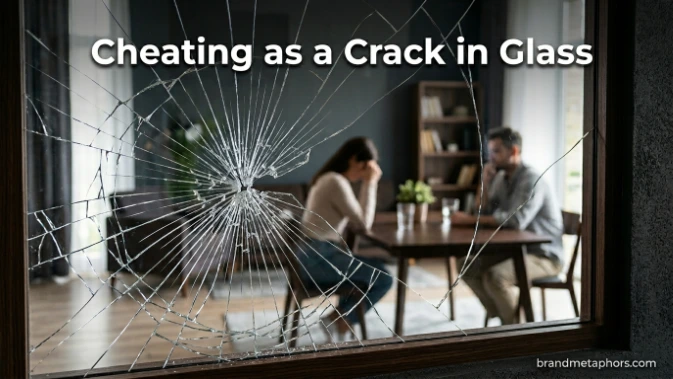
This metaphor compares cheating to a crack in glass—something fragile that once broken, can never fully return to its original form.
It emphasizes:
- Irreversibility
- Fragility of trust
- Visible damage
Even if repaired, the crack remains a reminder.
Example Scenario
After years of loyalty, one mistake fractures everything:
“Their relationship didn’t shatter all at once—it cracked quietly, like glass under pressure, and every word after that echoed through the fracture.”
Alternative Expressions
- “A fracture in the foundation”
- “A tear in the fabric of trust”
- “A split mirror reflecting two truths”
Sensory & Emotional Details
- Sound: a faint snap or tink
- Visual: a thin line spreading outward
- Emotion: disbelief turning into clarity
Mini Story
Imagine a couple sitting at breakfast. The sunlight hits a glass window, revealing a crack neither noticed before. It wasn’t new—it had simply gone unseen. That’s how betrayal often feels: not sudden, but discovered.
Cheating as a Double Life

Meaning and Explanation
This metaphor frames cheating as living two parallel realities—one honest, one hidden.
It highlights:
- Deception
- Compartmentalization
- Emotional distance
The person cheating becomes divided.
Example Sentence
“He walked through life like an actor with two scripts, switching roles depending on who was watching.”
Alternative Ways to Express It
- “Wearing two faces”
- “Dancing between shadows and light”
- “Keeping a secret room in the heart”
Cultural Reference
This metaphor echoes themes found in literature—characters leading dual lives, torn between identity and desire.
Emotional Details
- Anxiety of being discovered
- Thrill mixed with guilt
- Exhaustion from maintaining the illusion
Cheating as Poison in Water
Meaning and Explanation
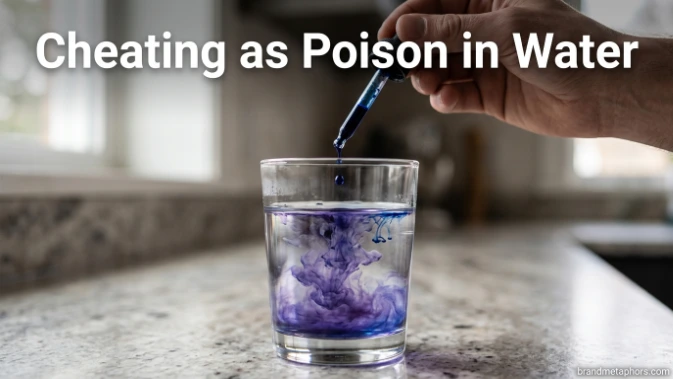
This metaphor suggests that cheating contaminates something pure.
It represents:
- Corruption
- Hidden damage
- Gradual destruction
Even a small amount changes everything.
Example Scenario
“What they had was clear and calm—until one drop of dishonesty turned the whole river bitter.”
Alternative Expressions
- “A stain that spreads”
- “Rot beneath the surface”
- “A silent infection”
Sensory Details
- Taste: bitterness
- Sight: once-clear water turning cloudy
- Emotion: betrayal creeping in slowly
How to Use Cheating Metaphors in Creative Writing
Match Emotion to Image
Choose metaphors that reflect the tone:
- Gentle sadness → fading light
- Intense betrayal → breaking glass
- Quiet deception → shadows
Avoid Overused Phrases
Instead of:
- “Broken heart” Try:
- “A compass spinning without direction”
Stay Consistent
Don’t mix metaphors randomly:
- ❌ “A crack in glass that poisoned the fire”
- ✔ “A crack in glass that spread with every word”
Storytelling with Cheating Metaphors
Metaphors can carry entire narratives.
Example:
“Their love was a house with open windows. Over time, secrets slipped in like cold air. By the time they noticed, winter had already settled inside.”
This tells a story without directly stating betrayal.
Interactive Exercise: Create Your Own Metaphor

Try this:
pace 1: Think of a feeling associated with cheating
- Guilt
- Fear
- Excitement
- Loss
Step 2: Connect it to a physical object or scene
- Storm
- Mirror
- Fire
- Shadow
Step 3: Combine them
Example:
- “Guilt was a storm cloud he carried indoors.”
Now you try:
- “Cheating is like __________ because __________.”
Creative Prompts for Writers
- Write a scene where cheating is revealed without using the word cheat
- Describe betrayal using only nature imagery
- Write from the perspective of the “other side” using metaphor
Using Metaphors for Cheating in Social Media
Short metaphors work beautifully in captions:
- “Trust cracks quietly.”
- “Two lives, one truth missing.”
- “Even clear water can hide poison.”
Tips:
- Keep it concise
- Focus on imagery
- Let readers interpret
Bonus Tips: Make Your Metaphors Stand Out

- Use unexpected comparisons
- Add sensory details (sound, touch, color)
- Keep it emotionally honest
- Read it aloud—does it feel right?
Expanding Your Metaphor Toolkit
Here are a few more ideas:
- Cheating as a shadow growing longer
- Cheating as a stolen key
- Cheating as a script rewritten in secret
- Cheating as a fading photograph
Each brings a slightly different emotional tone.
The Emotional Truth Behind Metaphors
Metaphors don’t just decorate language—they reveal truth.
When someone says:
“It felt like the ground disappeared beneath me,”
they’re not exaggerating. They’re translating emotion into something we can grasp.
Cheating disrupts reality. Metaphors rebuild it in words.
FAQs About Metaphors for Cheating
Why use metaphors instead of direct language?
Metaphors add emotional depth and make writing more engaging and memorable.
Can metaphors be used in academic writing?
Yes, but sparingly. They work best in creative, narrative, or reflective contexts.
How do I avoid cliché metaphors?
Try combining unusual ideas or drawing from personal experiences.
Are metaphors always symbolic?
Mostly yes, but they can also be sensory and descriptive rather than deeply symbolic.
Can metaphors change depending on culture?
Absolutely. Different cultures use different imagery to express similar emotions.
What is a good metaphor for cheating?
A strong metaphor is “cheating is a rigged game.” It clearly shows that one person gains an unfair advantage while others believe the rules are being followed.
What metaphor represents betrayal?
A cracked mirror is a useful metaphor for betrayal because it represents something that once felt whole but has been damaged and changed.
How can I describe cheating without saying “cheating”?
You can describe it through images such as a broken mirror, hidden blade, crooked scoreboard, false map, or rigged game. These comparisons show deception without directly naming it.
Can cheating metaphors be used for academic dishonesty?
Yes. A rigged game, crooked scoreboard, or stolen victory can describe academic cheating because these images focus on unfair advantage and dishonest success.
How do I create my own metaphor for dishonesty?
First, identify the feeling you want to show. Next, choose a familiar object or situation that creates the same feeling. Then explain the connection with a short, clear sentence.
Conclusion
Cheating can be difficult to describe because it involves more than one dishonest act. It can damage trust, create doubt, expose unfairness, and change how people remember a relationship or experience.
The cracked mirror shows how betrayal can fracture trust. The hidden knife captures the shock of secret dishonesty. Meanwhile, the rigged game explains the unfair advantage created by cheating.
Therefore, choose your metaphor based on the feeling you want to express. If you want to show secrecy, choose an image of something hidden. If you want to show unfairness, compare cheating to a game whose rules have been secretly changed.
Ultimately, the strongest metaphor does not merely call someone dishonest—it lets the reader feel what dishonesty has changed.