

Imagine waking up to an alarm, checking your phone, answering messages, rushing through breakfast, and already feeling behind before the day has truly begun. Then the calls start, deadlines pile up, and one task quickly becomes five. Metaphors for Busy can turn that familiar rush into clear, colorful language that readers can feel. Instead of simply saying someone is “very busy,” you can describe their day as a race, a storm, or a machine that never stops. As a result, ordinary sentences become more vivid and memorable. Whether you are writing a story, poem, school assignment, social media caption, or everyday message, the right metaphor can capture stress, energy, pressure, and constant movement in just a few words. Below are creative ways to describe a hectic life while keeping your writing natural and easy to understand.
Why Metaphors for Busy Matter in Everyday Communication
When you say, “I’m busy,” it lands flat. It’s functional, but forgettable. Everyone says it. It carries no texture, no color, no emotion.
But say, “I’m spinning plates right now,” and suddenly there’s movement. Tension. A hint of chaos.
Metaphors:
- Make your language memorable
- Help others feel your experience
- Add personality and creativity
- Improve storytelling and writing quality
In a world overloaded with information, vivid language cuts through noise. It invites attention.
Understanding the Concept: What Is a Metaphor for Busy?

A metaphor is a comparison between two unlike things that highlights a shared quality. When we use metaphors for being busy, we compare our state of overwhelm, activity, or pressure to something more concrete.
For example:
- Busy as a bee → Constant motion and productivity
- Juggling a dozen balls → Managing multiple responsibilities
These comparisons work because they tap into shared imagery and experience.
Metaphors for Busy That Bring Language to Life
Let’s explore three rich, expressive metaphors in depth.
Spinning Plates” – The Art of Controlled Chaos
Meaning and Explanation
This metaphor comes from circus performers who keep multiple plates spinning on sticks simultaneously. If they stop, the plates fall.
It represents managing many tasks at once, where neglecting even one could lead to failure.
Example Scenario
You’re answering emails, attending meetings, managing deadlines, and helping a colleague—all at once.
Sentence: “I’ve been spinning plates all day, trying to keep everything from crashing.”
Alternative Expressions
- “Juggling responsibilities”
- “Balancing too many things”
- “Keeping everything afloat”
Sensory and Emotional Details
You can almost hear the clatter of plates threatening to fall. There’s tension, urgency, and a constant need for attention.
Mini Storytelling Touch
Imagine a performer under bright lights, sweat forming as the plates wobble. That’s what your Tuesday afternoon feels like.
Running Like a Headless Chicken” – Frenzied Busyness

Meaning and Explanation
This metaphor describes chaotic, directionless activity. You’re busy—but not necessarily productive.
Example Scenario
You’ve got a long to-do list but keep jumping between tasks without finishing anything.
Sentence: “I’ve been running around like a headless chicken all morning and still haven’t finished anything.”
Alternative Expressions
- “All over the place”
- “Rushing without focus”
- “Scattered and frantic”
Sensory and Emotional Details
There’s a sense of panic, confusion, and lack of control. Movement without meaning.
Cultural Note
This metaphor has roots in rural imagery but has become widely used in modern speech to describe frantic energy.
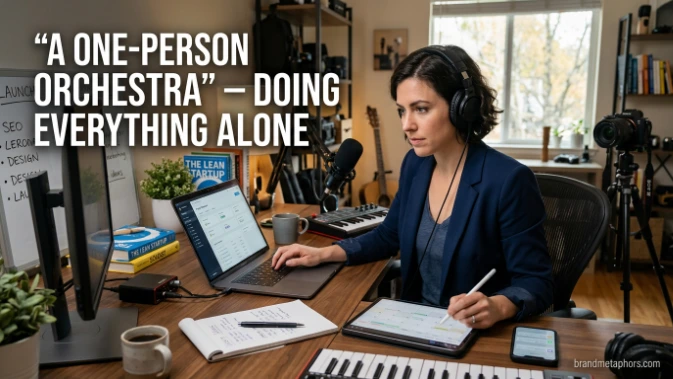
A One-Person Orchestra” – Doing Everything Alone
Meaning and Explanation
This metaphor captures the experience of handling multiple roles or tasks single-handedly—like playing every instrument in an orchestra.
Example Scenario
You’re managing work, family, errands, and personal commitments without help.
Sentence: “I feel like a one-person orchestra, trying to keep every part in sync.”
Alternative Expressions
- “Wearing too many hats”
- “Doing it all myself”
- “Carrying everything on my shoulders”
Sensory and Emotional Details
You can almost hear the overlapping sounds—drums, violin, piano—all played by one person. It’s impressive but exhausting.
Real-Life Reflection
This metaphor resonates deeply with freelancers, parents, and entrepreneurs who often juggle multiple roles alone.
Creative Ways to Use Metaphors for Busy in Writing
Use in Storytelling
Instead of telling readers a character is busy, show it:
“He moved through the day like a man spinning plates, each task demanding his attention before it shattered.”
Use in Social Media
Metaphors make posts relatable and engaging:
“Today felt like being a one-person orchestra with no rehearsal.”
Use in Professional Communication
Even emails can benefit:
“I’m currently juggling several priorities but will respond by tomorrow.”
Interactive Exercise: Find Your Own Metaphor for Busy

Try this simple exercise:
Think About Your Day
Was it:
- Structured?
- Chaotic?
- Overwhelming?
- Productive?
Choose an Image
What does it feel like?
- A storm?
- A race?
- A crowded market?
Create Your Metaphor
Combine the feeling with the image:
“My day was like a traffic jam in my mind—everything moving slowly but honking loudly.”
Prompt Ideas
- “Being busy feels like…”
- “My mind today is like…”
- “Work this week has been like…”
Using Metaphors to Improve Emotional Awareness
Metaphors don’t just communicate—they reveal.
Saying “I’m drowning in work” signals overwhelm. Saying “I’m climbing a mountain” suggests challenge but progress.
By choosing your metaphor, you:
- Understand your emotional state
- Communicate it clearly
- Sometimes even reframe it
Bonus Tips: Making Your Metaphors More Powerful
Be Specific
Instead of “busy like crazy,” say: “Busy like a chef in a kitchen during dinner rush.”
Use Sensory Details
Add sound, motion, or feeling: “My day buzzed like a swarm of bees.”
Avoid Clichés (or Refresh Them)
“Busy as a bee” → “Busy as a bee in a storm, darting without rest.”
Match Tone to Context
Professional writing → subtle metaphors Creative writing → vivid, bold imagery
Metaphors for Busy in Different Contexts
At Work
- “Buried under emails”
- “Drowning in deadlines”
At Home
- “A whirlwind of chores”
- “A never-ending carousel”
In Creative Writing
- “Time snapped at his heels like a relentless dog”
- “Her schedule stretched thin like worn fabric”
Practicing Metaphors in Daily Life

Try using one metaphor per day when describing your schedule.
For example:
- To a friend: “Today felt like juggling knives.”
- In a journal: “My thoughts were a crowded marketplace.”
Over time, this habit:
- Expands your vocabulary
- Sharpens your creativity
- Makes communication more engaging
FAQs About Metaphors for Busy
What is the most common metaphor for being busy?
“Busy as a bee” is one of the most widely used metaphors, symbolizing constant activity and productivity.
Are metaphors appropriate in professional writing?
Yes, when used sparingly and appropriately. They can make communication clearer and more engaging.
How do I create my own metaphor?
Think about how you feel, then compare it to something vivid or familiar that shares the same qualities.
Can metaphors help reduce stress?
Indirectly, yes. They help you understand and express your feelings, which can be calming and clarifying.
Should I avoid clichés?
Not necessarily—just try to refresh them or use them creatively to keep your language interesting.
What is a good metaphor for being very busy?
A “racing train” is a strong metaphor because it suggests speed, constant movement, and little time to stop.
What metaphor describes an overwhelming schedule?
A “whirlwind” or “storm of responsibilities” works well because both images suggest confusion, pressure, and rapid activity.
How can I describe a busy person creatively?
You can compare the person to an engine, racing train, spinning wheel, or machine that never stops. Choose the image based on the feeling you want to show.
What is a simple metaphor for a hectic life?
“A whirlwind” is one of the simplest choices. It quickly communicates movement, disorder, and intensity.
Can these metaphors be used in school writing?
Yes. They can work well in essays, creative writing, descriptions, poetry, and personal narratives. However, choose a metaphor that clearly supports your main idea.
Conclusion
A busy life can be difficult to explain with one simple word. Fortunately, metaphors give that feeling movement, color, and emotion. A racing train can show speed and momentum. A whirlwind can express confusion and pressure. Meanwhile, a machine that never stops can reveal both productivity and exhaustion.
The key is to choose an image that matches the feeling behind the busyness. Furthermore, simple comparisons are often more powerful than complicated ones.
So, the next time “busy” feels too ordinary, look for a stronger picture. Maybe your day is a train. Maybe it is a storm. Or perhaps it is an engine that needs a moment to cool down.
Sometimes, the best way to describe a fast life is not to count the tasks—it is to show how quickly the world is moving around you.