

The Moment You Stop Fighting the Tide
The sea doesn’t argue with the shore. It arrives, again and again, spilling itself across the sand, retreating without protest, returning without resentment. Imagine standing barefoot where the waves meet the land—cool water rushing over your toes, then slipping away. For a moment, you try to hold it, to trap it, to keep the ocean still. But it resists you, not with force, but with nature.
Acceptance feels like that.
he’s not giving up. It’s not losing. It’s the quiet, powerful moment when you stop wrestling with what is and start flowing with it. In a world obsessed with control, achievement, and constant improvement, acceptance is often misunderstood. Yet, it is one of the most freeing, grounding, and transformative states of mind.
This article explores metaphors for acceptance—vivid, relatable images that help you understand, feel, and practice it in your daily life. Along the way, you’ll find examples, mini stories, exercises, and creative prompts to help you embody acceptance—not just think about it.
What Is Acceptance and Why It Matters
Acceptance is the ability to acknowledge reality as it is—without denial, resistance, or excessive judgment. It doesn’t mean you approve of everything. It means you stop wasting energy wishing things were different right now.
Why is this important?
Because resistance often creates more suffering than the situation itself. When you accept, you create space—space to breathe, think, and respond rather than react. Acceptance is the foundation of emotional resilience, mental clarity, and inner peace.
Think of it as the doorway to change. Ironically, when you accept something fully, you are often in the best position to transform it.
Metaphor 1: Acceptance Is Floating on Water

Meaning and Explanation
Imagine lying on your back in a calm lake. The moment you tense up, thrash, or panic, you start to sink. But when you relax—when you trust the water—you float effortlessly.
Acceptance works the same way. The more you resist reality, the heavier it feels. When you release tension and allow things to be, you stay afloat.
Example Scenario
You’ve received unexpected criticism at work. Instead of spiraling into defensiveness, you pause and think, “This is happening. I don’t have to like it, but I can face it.” Suddenly, the weight lifts just a little.
Alternative Expressions
- “Let yourself float instead of fighting the current.”
- “Trust the water to hold you.”
- “Relax into what is.”
Sensory and Emotional Detail
Feel the cool support of the water beneath you. Hear the gentle ripple. Notice how your body softens when you stop struggling.
Mini Story
A young swimmer once feared deep water. Every lesson was a battle. One day, the instructor said, “Do nothing.” Hesitant, the swimmer let go—and discovered the water had been holding them all along.
Metaphor 2: Acceptance Is Opening a Window in a Stuffy Room
Meaning and Explanation
When a room feels suffocating, you don’t argue with the air—you open a window. Acceptance is that window. It allows fresh perspective, clarity, and calm to enter.
Example Sentence
“I can’t change what happened, but I can open the window and let in a new way of seeing it.”
Alternative Ways to Express It
- “Let some air into the situation.”
- “Create space for a new breeze.”
- “Don’t stay trapped in stale thoughts.”
Emotional Layer
Acceptance often brings relief—a subtle but noticeable lightness, like the first breath of fresh air after being indoors too long.
Cultural Reference
In many philosophies, especially Eastern traditions, openness is associated with wisdom. The idea of “beginner’s mind” is essentially opening the window of perception.
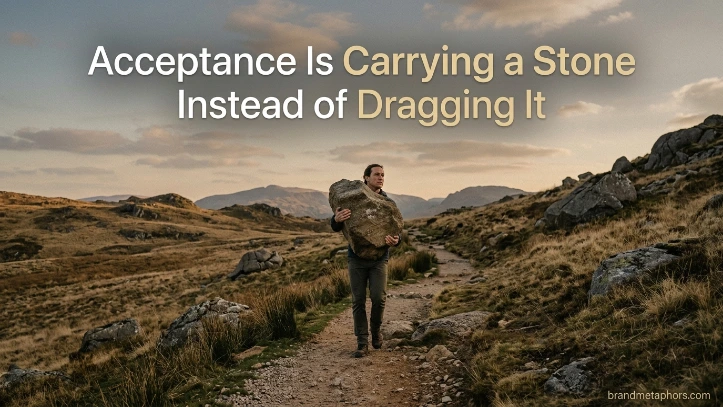
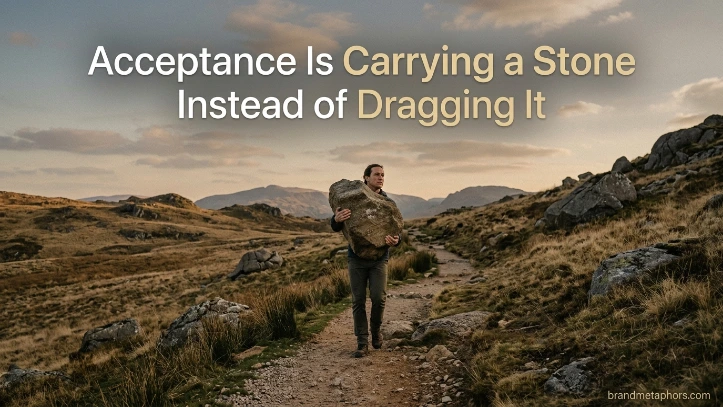
Metaphor 3: Acceptance Is Carrying a Stone Instead of Dragging It
Meaning and Explanation
Picture a heavy stone tied to your leg, dragging behind you as you walk. It slows you down, exhausts you. Now imagine lifting it, holding it in your hands. It’s still heavy—but manageable.
Acceptance doesn’t remove burdens. It changes your relationship to them.
Example Scenario
Grieving a loss, you stop asking “Why me?” and instead say, “This is part of my story now.” The pain doesn’t vanish, but it becomes something you can carry with dignity.
Alternative Expressions
- “Hold your burden with intention.”
- “Carry it, don’t let it drag you.”
- “Own the weight you bear.”
Emotional Detail
There’s strength in this metaphor—a quiet resilience, a sense of grounded courage.
How to Use Metaphors for Acceptance in Daily Life
Metaphors are more than poetic language—they are mental shortcuts. They help you feel a concept instantly.
When you’re overwhelmed, ask yourself:
- “Am I fighting the water?”
- “Can I open a window here?”
- “Am I dragging or carrying this?”
These questions shift your mindset quickly and gently.
Interactive Exercise: Create Your Own Acceptance Metaphor
Try this:
- Think of a challenging situation in your life.
- Ask yourself: What does this feel like physically or visually?
- Turn that into a metaphor.
Prompt Examples:
- “This situation feels like…”
- “If my emotions were a landscape, they would be…”
- “Acceptance, in this moment, would look like…”
Creative Twist: Write a short paragraph or social media post using your metaphor. Keep it vivid and sensory.
Bonus Tips for Writing and Expression
- Use contrast: Show resistance vs. acceptance (storm vs. calm sea).
- Engage senses: Sight, sound, touch make metaphors powerful.
- Keep it simple: The best metaphors are easy to visualize.
- Repeat for emphasis: Reinforce your message across different contexts.
- Apply in captions: Short metaphor-based posts perform well on social media.
Example: “Today, I stopped fighting the tide. And for the first time, I felt the ocean carry me.”
Acceptance in Literature and Real Life
Many great stories revolve around acceptance.
Think of characters who grow not by conquering the world, but by understanding it. In everyday life, acceptance shows up quietly—in forgiveness, in resilience, in the decision to move forward.
A parent accepting a child’s individuality. A person embracing a life path they didn’t plan. Someone learning to live with uncertainty.
These are not small acts. They are profound transformations.
Practical Strategies to Cultivate Acceptance
- Pause before reacting
- Name the reality clearly (“This is happening.”)
- Separate facts from judgments
- Focus on what you can control
- Practice mindfulness or breathing exercises
Acceptance is a skill. The more you practice, the more natural it becomes.
When Acceptance Feels Difficult
Let’s be honest—acceptance isn’t always easy.
Sometimes it feels like surrender. Sometimes it feels unfair. In those moments, remember:
Acceptance is not the end of the story. It’s the beginning of a new chapter—one where you are no longer at war with reality.
we can still hope. You can still act. You can still change things.
But first, you meet them where they are.
Bringing It All Together
Acceptance is not passive. It is deeply active in its own quiet way. It requires awareness, courage, and a willingness to let go of illusions.
Whether you imagine yourself floating on water, opening a window, or carrying a stone, each metaphor offers a doorway into a calmer, more grounded state of being.
Use them. Play with them. Return to them when life feels heavy.
Because sometimes, the simplest shift—from resistance to acceptance—changes everything.
FAQs About Metaphors for Acceptance
1. What is a simple metaphor for acceptance?
A common one is “floating on water”—it shows how letting go of resistance helps you stay supported rather than overwhelmed.
2. Why are metaphors helpful for understanding acceptance?
Metaphors make abstract ideas tangible. They allow you to feel acceptance rather than just think about it.
3. Can acceptance coexist with change?
Yes. Acceptance is acknowledging reality first, which actually puts you in a better position to create meaningful change.
4. How can I practice acceptance daily?
Use quick mental cues like “open the window” or “stop fighting the tide” when you feel resistance building.
5. Are metaphors useful for writing and social media?
Absolutely. Metaphors create vivid, shareable content that resonates emotionally with readers.
Conclusion
Acceptance is not about losing control—it’s about releasing the illusion that you ever had it completely. It’s about meeting life where it stands and choosing your response with clarity and grace.
So the next time you find yourself resisting, pause.
Feel the water beneath you. Open the window. Lift the stone.
And let yourself move forward—not by force, but by flow.