
Introduction
Good writing is more than using correct grammar and spelling. It also involves choosing the right words, using descriptive language, and understanding how language creates meaning. Figurative language, such as metaphors, similes, idioms, and poetic expressions, helps writers paint vivid pictures and communicate ideas in memorable ways.
Whether you are writing a school essay, a creative story, a blog, or a professional email, strong vocabulary makes your writing clearer and more engaging.
English learners often come across words that look almost identical but have very different meanings—or one may not even be a real word. This is exactly the case with Lozenger vs lozenge. Many people accidentally type lozenger when they actually mean lozenge. Understanding the difference helps improve spelling, writing skills, vocabulary enhancement, and confidence in communication.
In this guide, you will learn the meaning of each word, discover which one is correct, see comparison examples, explore sentence examples, avoid common mistakes, and practise using the correct spelling in everyday writing.
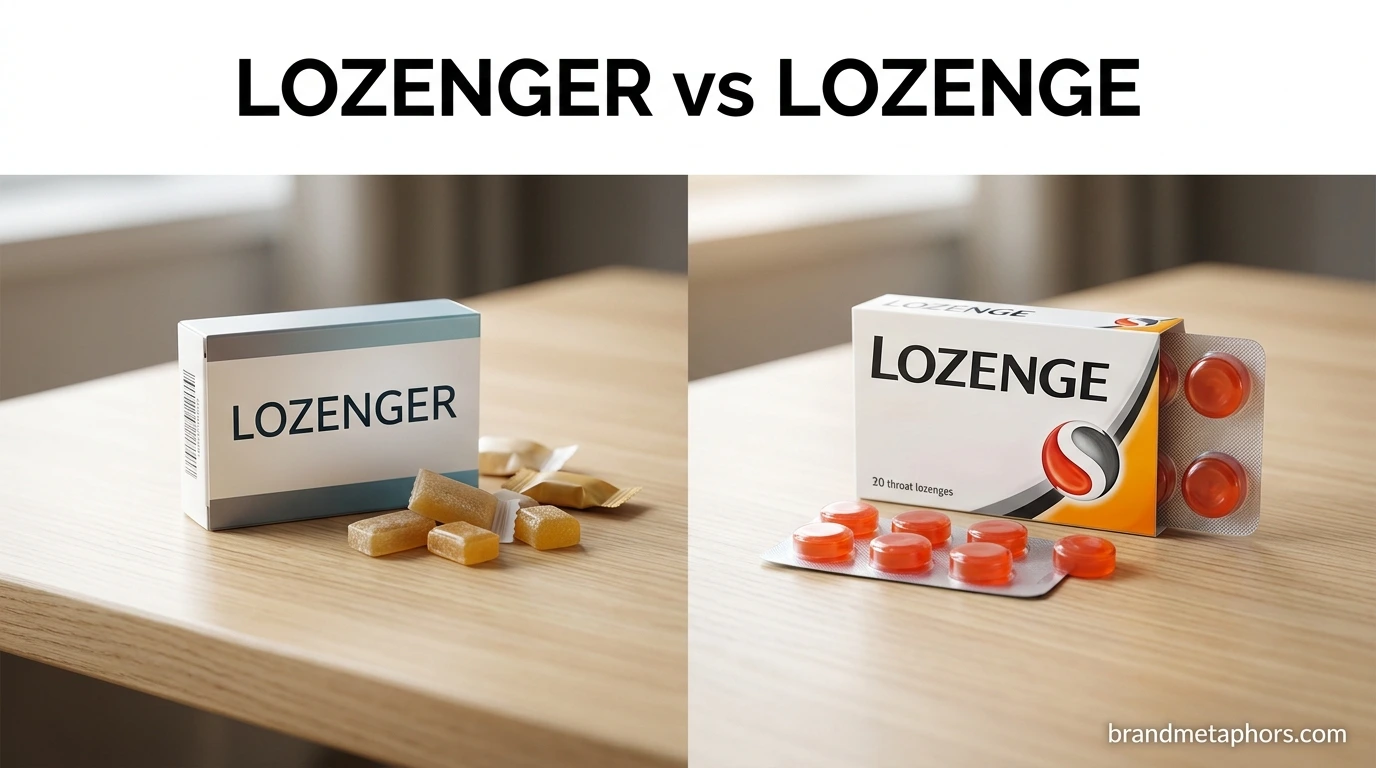
Is There a Difference?
The short answer is simple.
WordIs it Correct?MeaningLozenge✅ YesA small medicinal tablet or a diamond-shaped figureLozenger❌ NoNot a standard English word
The confusion happens because many English words end with -er, leading people to think lozenger follows the same pattern. However, standard English dictionaries do not recognise it as a proper word.
Whenever you need the word, always choose lozenge.
What Does Lozenge Mean?
A lozenge has two common meanings.
1. A Medicinal Tablet
This is the meaning most people know.
A lozenge is a small flavoured tablet that slowly dissolves in the mouth, usually to soothe a sore throat or cough.
Examples include:
- throat lozenge
- cough lozenge
- herbal lozenge
- medicated lozenge
- mint lozenge
Example Sentences
- The doctor suggested a honey lozenge for my sore throat.
- She kept a cough lozenge in her pocket.
- The mint lozenge freshened his breath.
- Always read the instructions before taking a medicinal lozenge.
- The child enjoyed the fruity taste of the vitamin lozenge.
2. A Diamond Shape
In geometry, architecture, and design, a lozenge refers to a diamond-shaped figure with equal sides.
Examples:
- decorative lozenge pattern
- lozenge-shaped window
- medieval shield with a lozenge design
Sentence examples:
- The wallpaper featured a repeating lozenge pattern.
- The artist painted several colourful lozenge shapes.
- The flag contained a blue lozenge in the centre.
Why Do People Write “Lozenger”?
The mistake usually comes from spelling confusion.
Reasons include:
- assuming every noun has an “-er” version
- typing quickly
- hearing the pronunciation incorrectly
- autocorrect errors
- unfamiliarity with the correct spelling
English contains many similar-looking words, making these mistakes common.
For example:
- traveller ✔
- baker ✔
- singer ✔
Because these words end with -er, some writers mistakenly create lozenger, even though English does not.
Pronunciation Guide
Lozenge
Pronunciation:
LOZ-inj
IPA:
/ˈlɒz.ɪndʒ/
Notice that the ending sounds like “inj”, not “jer.”
Breaking it into syllables helps.
Loz-enge
Practice saying:
- cough lozenge
- mint lozenge
- throat lozenge
Quick Comparison Table
FeatureLozengeLozengerCorrect spellingYesNoFound in dictionariesYesNoUsed in medicineYesNoUsed in geometryYesNoAccepted in academic writingYesNoSuitable for examsYesNo
How to Use Lozenge Correctly
The word can function as a noun.
Examples:
Medical
- I bought a packet of throat lozenges.
- Lemon lozenges often soothe irritation.
- The pharmacist recommended sugar-free lozenges.
Geometry
- The design includes several silver lozenges.
- Each window contains a lozenge pattern.
- The floor tiles form repeating lozenges.
Creative Writing
Writers sometimes use the word descriptively.
Examples:
- The moon looked like a silver lozenge hanging in the sky.
- Her necklace contained tiny crystal lozenges.
- The stained glass shimmered with colourful lozenges.
Comparison Examples
Correct
✔ Please take one lozenge every four hours.
❌ Please take one lozenger every four hours.
✔ The wallpaper features diamond-shaped lozenges.
❌ The wallpaper features diamond-shaped lozengers.
✔ She bought herbal lozenges.
❌ She bought herbal lozengers.
Using the Word in Descriptive Language

Although the word mainly refers to medicine or shapes, writers sometimes use it to create vivid descriptions.
Examples:
- The lake reflected a lozenge of sunlight.
- Tiny lozenges of coloured glass sparkled in the church windows.
- The kite resembled a floating lozenge.
These descriptions help readers imagine the scene more clearly.
Figurative Language and Creative Writing
While lozenge is usually literal, creative writers sometimes include it in figurative language.
Metaphor Examples
- Hope became a healing lozenge for his tired heart.
- Kind words were emotional lozenges after a difficult day.
Here, lozenge symbolises comfort or relief.
Simile Examples
- Her pendant shone like a polished lozenge.
- The diamond sparkled like a crystal lozenge.
These simile examples compare one object to another using “like.”
Symbolism
In literature, a lozenge may symbolise:
- healing
- comfort
- care
- recovery
- protection
Literary Devices
Although uncommon, the word can appear with several literary devices.
Imagery
“The silver lozenge glittered beneath the moonlight.”
Readers picture the shining object.
Symbolism
“The herbal lozenge represented hope during illness.”
The object stands for emotional healing.
Metaphor
“Music became a lozenge for her soul.”
The music is compared to medicine.
Simile
“The crystal reflected light like a shining lozenge.”
Personification
“The lonely lozenge waited patiently inside its wrapper.”
Objects receive human qualities.
Sentence Examples for Different Situations
Everyday Conversation
- I need a cough lozenge.
- This mint lozenge tastes great.
- She always carries throat lozenges.
School Writing
- The geometric pattern consisted of blue lozenges.
- The painting displayed several golden lozenges.
Healthcare
- Take one lozenge every six hours.
- Keep lozenges away from young children.
Creative Writing
- A bright lozenge of sunlight crossed the floor.
- The stained glass formed colourful lozenges.
- The necklace held a sparkling lozenge-shaped gem.
Professional Writing
- The package contains twenty-four lozenges.
- The product includes natural herbal ingredients.
Tone and Style Usage
Formal Tone
- The patient should dissolve one lozenge slowly in the mouth.
Neutral Tone
- Try a honey lozenge for your sore throat.
Informal Tone
- Grab a cough lozenge before class.
Creative Tone
- The glowing lozenge floated across the evening sky.
When to Use the Word
Use lozenge when discussing:
- sore throat medicine
- cough relief
- breath fresheners
- herbal tablets
- diamond-shaped designs
- geometric patterns
- jewellery
- decorative art
- creative descriptions
When to Avoid It
Avoid using:
- lozenger
- lozengers
- lozenging
These are not accepted English words.
Also avoid using lozenge if another word is more accurate.
Instead of:
“The square was a lozenge.”
Say:
“The diamond-shaped figure was a lozenge.”
Common Mistakes
Adding “-er”
❌ lozenger
✔ lozenge
Wrong Plural
❌ lozengers
✔ lozenges
Wrong Pronunciation
Some people say:
Loz-en-ger
Correct pronunciation:
LOZ-inj
Confusing Shape and Medicine
Remember:
Both meanings are correct.
Context tells readers which meaning you intend.
Vocabulary Enhancement
Learning related words expands vocabulary.
Medical vocabulary:
- tablet
- pastille
- cough drop
- medicine
- remedy
- soothing tablet
- herbal treatment
Shape vocabulary:
- diamond
- rhombus
- geometric figure
- polygon
- pattern
- design
Creative writing vocabulary:
- sparkle
- shimmer
- relief
- comfort
- healing
- crystal
- glowing
Using these related words improves descriptive language and writing skills.
Idiom Meaning
There is no common English idiom containing lozenge.
However, writers often use medicinal objects symbolically.
Example:
“Her encouragement was a lozenge for my worries.”
Although not an idiom, readers understand it as emotional comfort.
Practice Exercises
Exercise 1
Choose the correct word.
- The doctor recommended a ______.
A. lozenger
B. lozenge
Answer:
✅ lozenge
- The wallpaper displayed colourful ______.
A. lozenges
B. lozengers
Answer:
✅ lozenges
- She carried a mint ______.
A. lozenge
B. lozenger
Answer:
✅ lozenge
Exercise 2
Correct the sentence.
“The pharmacist gave me a lozenger.”
Correct answer:
“The pharmacist gave me a lozenge.”
Exercise 3
Write your own sentence using:
- throat lozenge
- lozenge-shaped window
- herbal lozenge
Tips for Remembering the Correct Spelling

Here are easy tricks:
- Think of lozenge ending with -ge.
- Remember that dictionaries only list lozenge.
- Read medicine labels carefully.
- Practise writing the word several times.
- Associate it with “cough lozenge.”
Memory trick:
“Medicine ends with GE.”
Why Correct Spelling Matters
Correct spelling improves:
- exam scores
- academic writing
- professional communication
- reader trust
- vocabulary growth
- writing confidence
Using recognised words also helps search engines, spell checkers, and readers understand your writing accurately.
Frequently Asked Questions
1. Is “lozenger” a real English word?
No. Standard English dictionaries do not recognise lozenger. The correct word is lozenge.
2. What is a lozenge used for?
It usually refers to a medicinal tablet that dissolves slowly in the mouth or a diamond-shaped geometric figure.
3. What is the plural of lozenge?
The plural form is lozenges.
Example:
“The shop sells many herbal lozenges.”
4. Can I use lozenge in creative writing?
Yes. Writers sometimes use it literally or as a metaphor for comfort, healing, or diamond-shaped objects.
5. How can I remember the correct spelling?
Remember that the word ends in -ge, not -ger. Reading medicine packages and practising the spelling will help reinforce the correct form.
Conclusion
Understanding the difference between lozenge and the misspelt form lozenger is simple once you know that only lozenge is recognised in standard English. Whether you are talking about a cough tablet, a geometric shape, or using the word creatively in descriptive writing, choosing the correct spelling strengthens your communication and builds confidence.
For students, writers, and English learners, mastering small spelling differences is an important step towards better writing skills and vocabulary enhancement. By practising sentence examples, exploring figurative language, recognising common mistakes, and using comparison tables, you can avoid errors and write with greater accuracy.
Remember: whenever you need the word, choose lozenge—the correct spelling accepted in dictionaries, classrooms, professional writing, and everyday English.