
Introduction
Good writing is more than using correct grammar. It is about choosing the right words to express your ideas clearly and creatively. Whether you are writing an essay, a story, a poem, or a professional email, understanding word meanings helps you communicate with confidence. Figurative language, descriptive language, literary devices, similes, metaphors, and idioms make writing more interesting, while accurate vocabulary ensures your message is understood exactly as you intend.
Many English learners and even native speakers confuse similar-looking words. Some words sound alike but have different meanings, while others have overlapping uses that create uncertainty. Learning these differences strengthens writing skills, improves vocabulary enhancement, and helps avoid embarrassing mistakes.
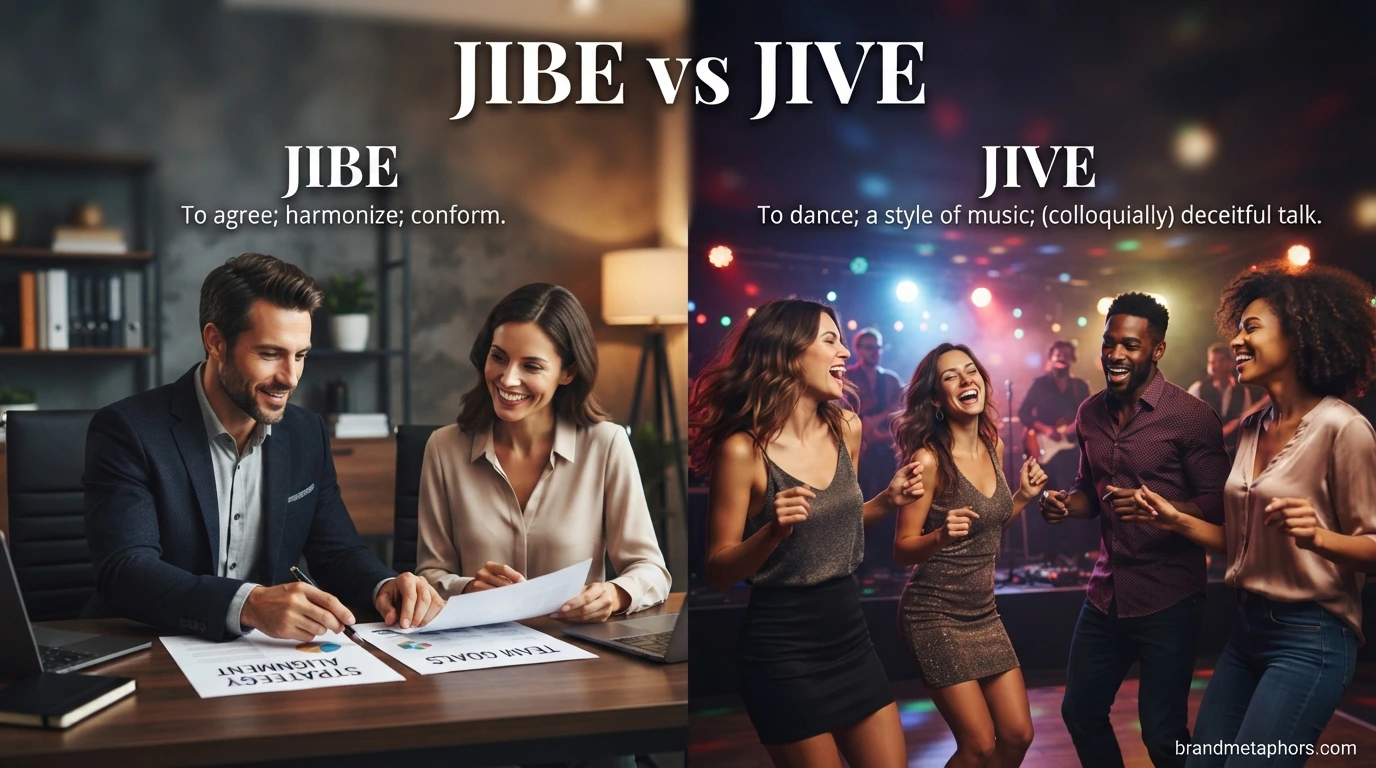
Among the most commonly confused pairs are jibe and jive. Although they are pronounced similarly in many accents, they have completely different meanings and origins. One relates to agreement or sarcastic remarks, while the other is connected to dance, music, slang, or deceptive talk.
This guide explains each word in simple language, provides comparison examples, sentence examples, common mistakes, exercises, figurative uses, and practical writing tips to help students, writers, and English learners master these two confusing words.
What Does “Jibe” Mean?
The word jibe has two common meanings.
Meaning 1: To Agree or Match
This is the most common modern use.
It means something fits, agrees, matches, or is consistent with something else.
Examples
- Her explanation doesn’t jibe with the evidence.
- The witness’s story jibes with the police report.
- His actions don’t jibe with his promises.
- These numbers jibe perfectly.
- The research findings jibe with previous studies.
This meaning is common in academic writing, journalism, and formal English.
Meaning 2: A Sarcastic or Mocking Remark
A jibe can also mean a teasing or insulting comment.
Examples:
- He ignored the cruel jibes.
- The audience laughed at her playful jibe.
- His jibe hurt her feelings.
This meaning is less common than the “agree” meaning but still appears in literature and newspapers.
What Does “Jive” Mean?
The word jive has several different meanings depending on context.
Meaning 1: A Style of Dance
Jive is a lively dance that became popular in the twentieth century.
Examples:
- They performed a fast jive.
- She loves dancing the jive.
- The dancers practised jive every weekend.
Meaning 2: Swing Music
Historically, jive referred to swing or jazz culture.
Example:
- The band played energetic jive music.
Meaning 3: Slang or Nonsense
In informal American English, jive can refer to foolish talk, exaggerated speech, or dishonest language.
Examples:
- Don’t give me that jive.
- I don’t believe his jive.
- That’s just jive.
This use is informal and should usually be avoided in formal writing.
Quick Comparison Table
FeatureJibeJiveMain meaningAgree or matchDance or slangPart of speechVerb and nounNoun and verbFormal writingVery commonRareInformal speechSometimesCommonRelated to agreementYesNoRelated to danceNoYesRelated to sarcasmYesNoRelated to musicNoYes
Origin and History of Both Words
Understanding where words come from makes them easier to remember.
Jibe
The exact origin is uncertain, but the word has been used for hundreds of years. It became common in English to describe agreement or compatibility.
Examples include:
- The facts jibe.
- The reports don’t jibe.
- Their opinions jibe.
Jive
The word developed in African American communities during the early twentieth century. It became connected with jazz music, swing dancing, and colourful slang.
Later, it also came to mean exaggerated talk or nonsense.
Although the words sound similar, they developed from completely different histories.
When Should You Use “Jibe”?
Choose jibe whenever you want to talk about agreement, consistency, or matching information.
Academic Writing
- The conclusion jibes with the research.
- The results jibe with earlier experiments.
Business Writing
- The figures do not jibe.
- The proposal jibes with company goals.
Everyday Conversation
- That doesn’t jibe.
- Your story doesn’t jibe with yesterday’s version.
Journalism
Reporters often use this word when discussing evidence.
Example:
- The witness statement did not jibe with the security footage.
When Should You Use “Jive”?

Use jive only when referring to dance, music, or informal slang.
Dance
- They entered a jive competition.
- We learned the jive in dance class.
Music
- The band specialises in jive music.
- Everyone enjoyed the lively performance.
Informal Slang
- Stop talking jive.
- He’s giving us jive.
Remember that this slang is mainly American English and sounds informal.
Side-by-Side Sentence Examples
Seeing both words together makes the difference much clearer.
Correct SentenceExplanationHer explanation doesn’t jibe with the facts.AgreementThe dancers performed a beautiful jive.DanceHis report jibes with the evidence.MatchingThe band played lively jive music.MusicTheir stories don’t jibe.ConsistencyDon’t believe all that jive.Slang
More examples:
Jibe
- The evidence jibes perfectly.
- Everything seems to jibe.
- Our opinions jibe on this issue.
- Nothing about his explanation jibes.
- Her timeline doesn’t jibe.
Jive
- We danced the jive.
- The club hosted a jive competition.
- His speech was full of jive.
- They listened to jive music.
- She enjoys learning vintage dances like the jive.
Figurative Language and Creative Writing Applications
Strong writing often uses figurative language to create memorable images and emotions. Although these words themselves are not figurative, they can appear in descriptive or creative writing.
Metaphor Examples
- Their ideas finally danced together like perfect partners.
- His promises refused to fit into reality.
- Truth and lies fought like opposite colours.
Simile Examples
- Their opinions matched like puzzle pieces.
- The music bounced like sunshine.
- Her words flowed like smooth jazz.
Descriptive Language
Instead of writing:
“The ideas matched.”
You could write:
“The ideas fit together like carefully crafted puzzle pieces.”
Instead of:
“The dance was exciting.”
You could write:
“The dancers flew across the floor with endless energy.”
Literary Devices
Writers often combine:
- Metaphors
- Similes
- Imagery
- Personification
- Symbolism
- Alliteration
These literary devices create more vivid storytelling.
Example:
“The melody wrapped around the room like warm light.”
Idioms and Related Expressions
English contains many expressions related to agreement and consistency.
In Agreement
- On the same page
- See eye to eye
- In harmony
- In sync
- Match up
- Fit together
Examples:
- Their opinions were on the same page.
- Everything matched up nicely.
- We finally saw eye to eye.
Related Dance Expressions
- Cut a rug
- Dance the night away
- Find your rhythm
- Move to the beat
Example:
“They danced the night away.”
These idioms add colour to creative writing.
Common Mistakes and How to Avoid Them
Many learners confuse these words because they sound similar.
Mistake 1
❌ The evidence doesn’t jive.
✅ The evidence doesn’t jibe.
Reason:
Evidence agrees or disagrees—it does not dance.
Mistake 2
❌ We learned the jibe.
✅ We learned the jive.
Reason:
Jive is the dance.
Mistake 3
❌ Their stories jived.
✅ Their stories jibed.
Reason:
Stories agree.
Memory Trick
Remember:
B in jibe = Both things match.
V in jive = Vibrant dance.
Simple memory tricks help prevent mistakes.
Tone, Style, and Register

Choosing the correct word depends on tone.
SituationBetter ChoiceSchool essayJibeResearch paperJibeBusiness emailJibeDance articleJiveMusic reviewJiveInformal American conversationJive (slang)
Formal writing usually requires jibe.
The slang use of jive should generally stay in casual conversation.
When to Use and When to Avoid
Use Jibe When
- Comparing facts
- Discussing evidence
- Writing reports
- Explaining research
- Talking about consistency
Avoid Jibe When
- Talking about dancing
- Discussing jazz styles
- Referring to music genres
Use Jive When
- Describing dance
- Discussing swing music
- Using informal slang
Avoid Jive When
- Academic writing
- Scientific reports
- Business communication
- Comparing facts
Practice Exercises
Exercise 1
Choose the correct word.
- The reports don’t _____.
- They danced the _____.
- His explanation doesn’t _____ with the evidence.
- The band played lively _____ music.
- Don’t believe that _____.
Answers
- jibe
- jive
- jibe
- jive
- jive
Exercise 2
Correct the mistakes.
- Their stories don’t jive.
- We practised the jibe.
- The facts jived perfectly.
Answers
- Their stories don’t jibe.
- We practised the jive.
- The facts jibed perfectly.
Exercise 3
Write Your Own Sentences
Create:
- Two sentences using the word referring to agreement.
- Two sentences about dancing.
- One sentence using descriptive language.
- One sentence with a simile.
- One sentence using a metaphor.
This exercise builds confidence and improves creative writing.
Vocabulary Enhancement Tips
Expanding your vocabulary helps you become a stronger writer and speaker.
Earth related to agreement:
- Match
- Agree
- Align
- Correspond
- Fit
- Coincide
- Harmonise
- Conform
Words related to dance:
- Swing
- Twist
- Waltz
- Salsa
- Tango
- Foxtrot
- Boogie
- Shuffle
Words related to descriptive language:
- Vibrant
- Graceful
- Energetic
- Rhythmic
- Consistent
- Harmonious
- Colourful
- Expressive
Learning groups of related words makes vocabulary easier to remember.
Why Learning Word Differences Improves Writing
Small vocabulary mistakes can change the meaning of a sentence.
Correct word choice helps readers:
- Understand your ideas quickly.
- Trust your writing.
- Enjoy your stories.
- Appreciate your creativity.
- Learn from your explanations.
Whether you are writing essays, creative stories, poems, speeches, or emails, selecting precise words improves clarity and confidence.
Mastering commonly confused words is one of the easiest ways to strengthen communication skills.
Frequently Asked Questions
1. Which word means “to agree”?
Jibe means to agree, match, or be consistent with something.
2. Which word refers to a dance?
Jive is a lively dance and also refers to a style of music.
3. Can “jive” mean nonsense?
Yes. In informal American English, it can refer to foolish, exaggerated, or dishonest talk.
4. Is “jibe” formal?
Yes. It is widely accepted in formal, academic, business, and professional writing when discussing agreement or consistency.
5. How can I remember the difference?
Think of jibe as relating to ideas that fit together, while jive reminds you of vibrant dancing and lively music.
Conclusion
Although jibe and jive sound alike, they serve very different purposes in English. One is used to describe agreement, consistency, or a sarcastic remark, while the other refers to a lively dance, swing music, or informal slang. Understanding this distinction helps students, writers, and English learners avoid common mistakes and communicate more accurately.
The best way to master these words is through regular reading, writing, and practice. Use comparison examples, sentence exercises, descriptive language, figurative language, literary devices, similes, metaphors, and idioms to strengthen your vocabulary and make your writing more engaging. As your understanding grows, you’ll choose the right word naturally, improving both your writing skills and your confidence in English.