
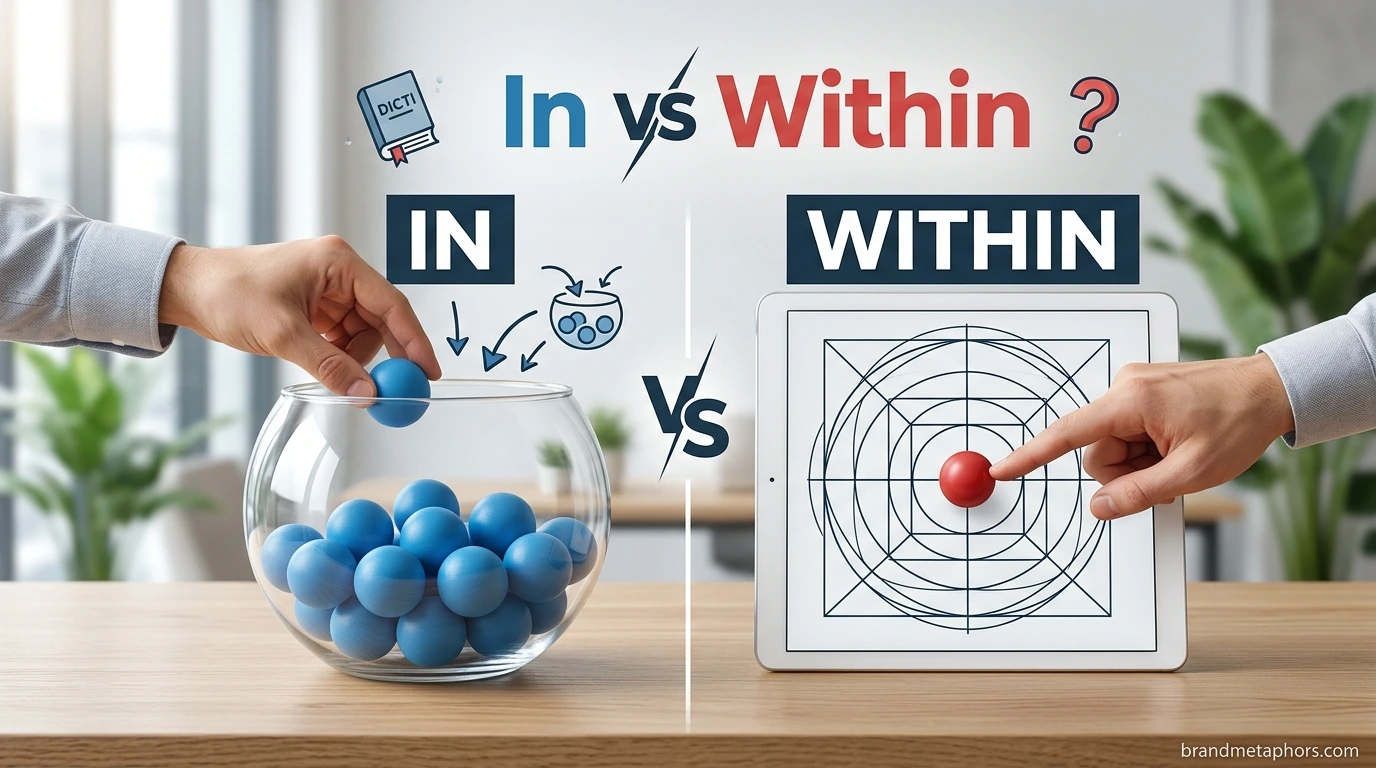
Introduction: Why Figurative Language and Precise Word Choice Matter
Strong writing depends on choosing the right words for the right situation. Whether you are writing an academic essay, a business email, a creative story, or a social media post, your vocabulary shapes how readers understand your ideas. One of the most common areas of confusion for students, writers, and English learners is choosing between in and within.
Although these two prepositions often appear similar, they are not always interchangeable. Each has unique meanings, tones, and grammatical uses. Understanding their differences helps improve writing skills, vocabulary enhancement, descriptive language, and communication.
Learning this distinction also strengthens your ability to recognize figurative language, write more naturally, and create smoother sentences. Writers frequently choose one over the other depending on the level of formality, emphasis, or style they want to achieve. In poetry, creative writing, and literature, these subtle choices can influence imagery, rhythm, and emotional impact.
This guide explains every important difference between these commonly confused words through detailed explanations, comparison examples, sentence examples, literary devices, idiom meaning, metaphor examples, simile examples, exercises, and practical writing tips.
What Does “In” Mean?
The preposition in is one of the most frequently used words in English. It generally indicates location, position, time, inclusion, or condition.
It usually answers questions like:
- Where?
- When?
- Inside what?
- During which period?
Basic Meaning
“In” simply refers to something being inside a place, object, situation, or period of time.
Common Uses of “In”
UsageExampleLocationThe books are in the library.TimeWe met in July.ConditionShe is in trouble.GroupHe is in our class.StateThe machine is in operation.
Because it is simple and versatile, in appears constantly in both spoken and written English.
Everyday Sentence Examples
- The keys are in my pocket.
- We live in Canada.
- She arrived in the morning.
- The children played in the garden.
- There is milk in the refrigerator.
- He specializes in biology.
- The answer is in the textbook.
- She believes in hard work.
- I wrote it in pencil.
- Everyone stood in line.
Notice that in sounds natural in ordinary conversations because it is direct and uncomplicated.
What Does “Within” Mean?
Within also refers to being inside something, but it usually places more emphasis on limits, boundaries, space, time, or internal existence.
Compared to “in,” it often sounds more formal, precise, and literary.
Basic Meaning
Within means:
- Inside the boundaries of
- Not beyond
- During a specified period
- Internally
- Existing inside something physically or emotionally
Common Uses
UsageExamplePhysical boundaryStay within the fence.Time limitFinish within two days.Emotional stateStrength lies within you.Organizational boundaryChanges within the company.Legal limitOperate within the law.
Unlike “in,” within emphasizes the idea of limits or boundaries rather than simple location.
Sentence Examples
- Please remain within the marked area.
- Complete the assignment within three days.
- Happiness comes from within.
- The solution exists within the document.
- Growth begins within ourselves.
- Several departments within the organization cooperated.
- The answer lies within these pages.
- The damage remained within acceptable limits.
- The changes occurred within the community.
- Keep your comments within the topic.
Key Differences Between “In” and “Within”
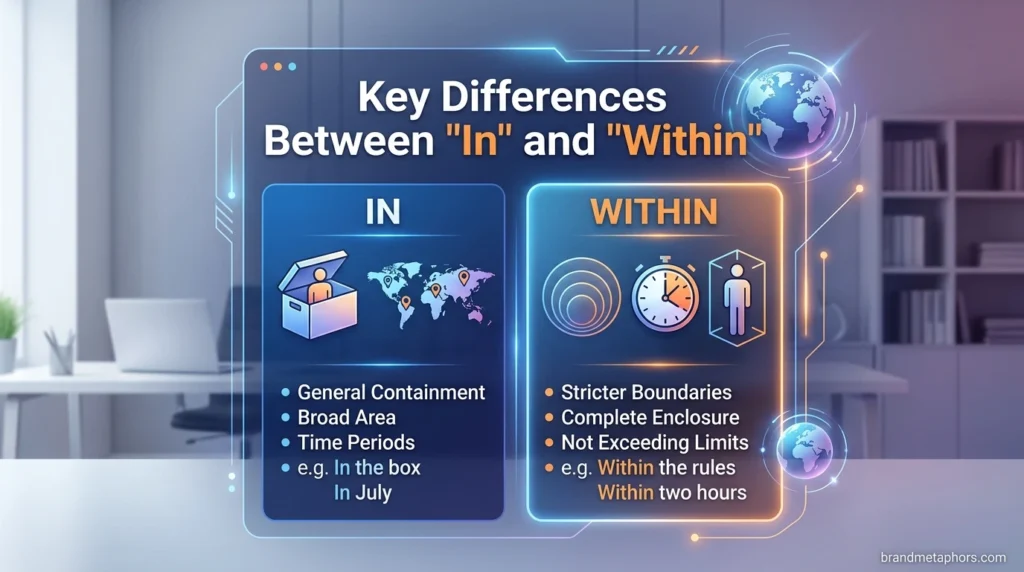
Although these words often overlap, their meanings are not identical.
Quick Comparison Table
FeatureInWithinEveryday speechVery commonLess commonFormal writingYesVery commonIndicates simple locationYesSometimesEmphasizes boundariesRarelyYesIndicates time limitsSometimesFrequentlyLiterary toneModerateStrongPrecisionGeneralMore precise
Simple Comparison Examples
InWithinShe is in the room.She stayed within the room’s boundaries.Finish in two days.Finish within two days.He lives in the city.Changes occurred within the city limits.Water is in the bottle.The pressure stayed within safe limits.
Notice that within often adds the idea of restriction or limitation.
When to Use “In”
Understanding when to choose in makes your writing more natural.
1. General Location
Use in for ordinary places.
Examples:
- We are in school.
- She lives in London.
- The files are in the cabinet.
2. Months, Years, Seasons
Examples:
- In December
- In 2025
- In winter
- In the twentieth century
4. Groups
Examples:
- In our family
- In the committee
- In the class
- In the audience
5. Transportation
Examples:
- In a car
- In a taxi
- In an elevator
Example Paragraph
Sarah found an old photograph in her grandmother’s attic. The picture showed her family in happier times. Everyone in the image smiled naturally, reminding her of the importance of preserving memories.
When to Use “Within”

Choose within whenever you want to emphasize boundaries, limitations, or internal existence.
1. Time Limits
Examples:
- Respond within 24 hours.
- Complete the form within one week.
- Finish within the deadline.
2. Physical Boundaries
Examples:
- Stay within the park.
- Keep within the lines.
- Work within your assigned area.
3. Rules and Limits
Examples:
- Act within the law.
- Stay within budget.
- Operate within company policy.
4. Internal Qualities
Examples:
- Courage comes from within.
- The answer lies within.
- Peace begins within ourselves.
Example Paragraph
The organization completed every project within budget while encouraging creativity within each department. Employees discovered new confidence from within, leading to remarkable improvements throughout the company.
Using “In” and “Within” in Figurative Language
Figurative language helps writers communicate emotions, imagination, and abstract ideas more effectively. Instead of stating facts literally, figurative expressions create vivid mental images and emotional connections with readers.
Both in and within frequently appear in figurative language because they can represent emotional, psychological, or symbolic spaces rather than physical ones.
Figurative Examples with “In”
- She is in deep thought.
- We are in the middle of change.
- He is in a difficult situation.
- They remain in hope despite the challenges.
- She found joy in simple moments.
Here, in expresses emotional or abstract states instead of physical locations.
Figurative Examples with “Within”
- Great strength lives within you.
- The answer lies within your heart.
- Fear grows within us.
- Kindness begins within every person.
- Hope remains within reach.
In these examples, within creates a stronger sense of inner emotion, hidden potential, or personal reflection, making it especially effective in inspirational and literary writing.