
Introduction
Good writing is not only about grammar and spelling. It is also about choosing the right words and expressions to match the purpose, audience, and tone of your message. Whether you are writing essays, stories, poems, emails, or creative content, understanding language choices can improve your communication skills.
Writers often use descriptive language, figurative language, literary devices, and different sentence structures to make their writing more engaging. One common question English learners ask is whether they should use “do not” or “don’t.” While both forms have the same meaning, they create different tones and are used in different situations.
Learning the difference can strengthen writing skills, improve vocabulary enhancement, and help you communicate more effectively in both formal and informal settings. This guide explains everything you need to know, including meanings, examples, comparisons, common mistakes, exercises, and practical writing tips.
What Are “Do Not” and “Don’t”?
Both expressions are negative forms of the verb do.
- Do not is the full form.
- Don’t is the contracted form.
Basic Meaning
Both mean:
To avoid doing something or to express a negative action.
Examples
- Do not open the door.
- Don’t open the door.
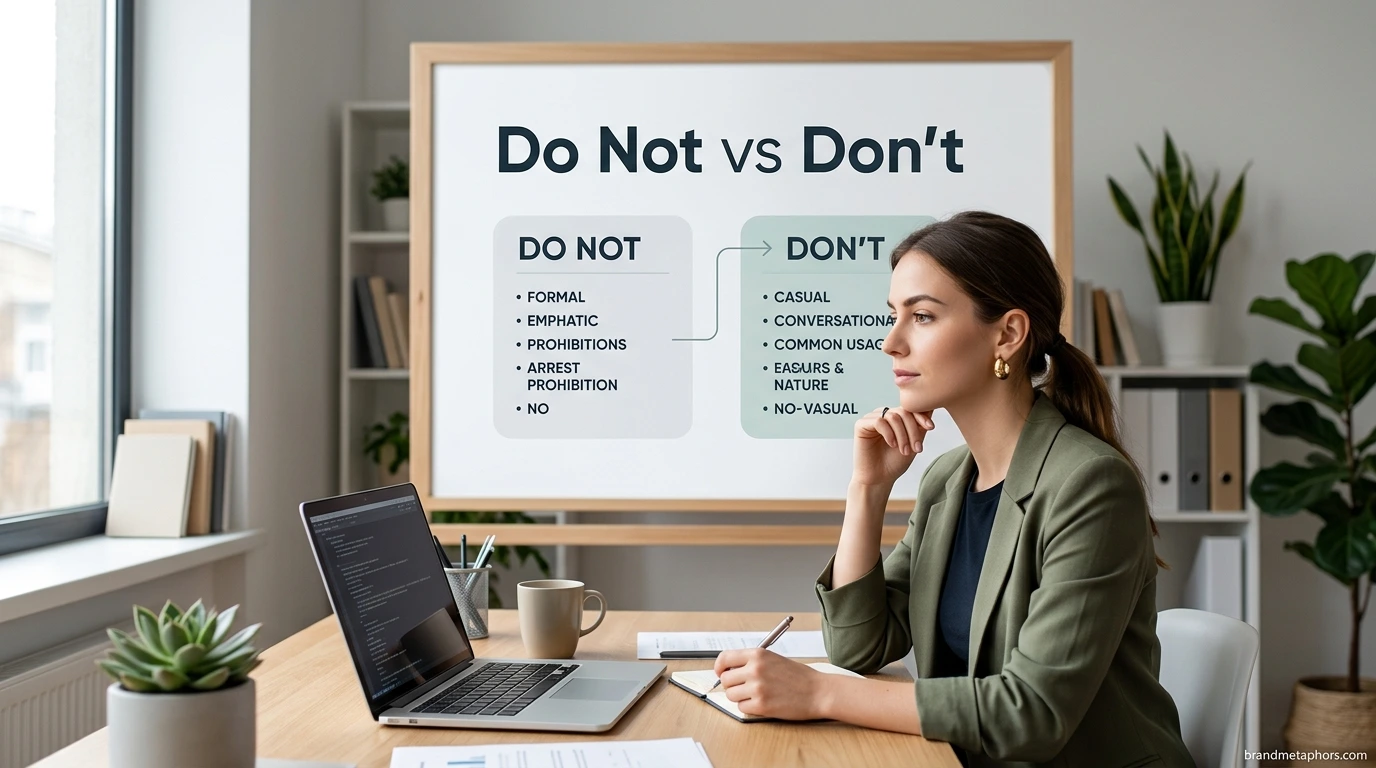
The meaning remains exactly the same. The difference lies mainly in style, tone, and formality.
Quick Comparison Table
FeatureDo NotDon’tFormFull formContractionMeaningNegative command or statementNegative command or statementFormalityMore formalMore informalAcademic WritingPreferredUsually avoidedCasual ConversationLess commonVery commonProfessional DocumentsOften usedSometimes avoidedText MessagesRareVery commonEmphasisStrongerSofter
Understanding Contractions in English
A contraction is a shortened form of two words combined with an apostrophe.
Examples of Contractions
Full FormContractionDo notDon’tCannotCan’tWill notWon’tI amI’mThey areThey’reIs notIsn’t
Contractions make speech and writing sound more natural and conversational.
Example
Formal:
- Do not forget your assignment.
Informal:
- Don’t forget your assignment.
When to Use “Do Not”

The full form is best when you want a serious, formal, or professional tone.
Academic Writing
Students often use the full form in essays and research papers.
Examples:
- Do not copy information without citing sources.
- Students should do not? (Incorrect)
- Students should not plagiarize. (Correct)
Official Instructions
Examples:
- Do not enter this area.
- Do not touch the equipment.
- Do not park here.
Legal and Professional Documents
Examples:
- Employees must do not disclose confidential information.
- Employees must not disclose confidential information.
- Do not distribute this document without permission.
For Strong Emphasis
The full form often sounds more powerful.
Example:
- Do not ignore the warning signs.
When to Use “Don’t”
The contraction is common in everyday communication.
Casual Conversations
Examples:
- Don’t worry.
- Don’t be late.
- Don’t forget your keys.
Friendly Emails
Examples:
- Don’t hesitate to contact me.
- Don’t forget our meeting tomorrow.
Social Media Posts
Examples:
- Don’t stop learning.
- Don’t give up on your goals.
Creative Writing
Authors often use contractions to create natural dialogue.
Example:
“Don’t leave yet,” Sarah said.
The sentence sounds realistic because people commonly speak this way.
Tone Differences Between “Do Not” and “Don’t”
Tone refers to the attitude or feeling behind words.
Formal Tone
Example:
- Do not use mobile phones during the examination.
This sounds professional and authoritative.
Conversational Tone
Example:
- Don’t use your phone during the test.
This sounds friendlier and more natural.
Comparison Table
ToneExampleFormalDo not interrupt the speaker.InformalDon’t interrupt the speaker.ProfessionalDo not share your password.FriendlyDon’t share your password.AcademicDo not rely on unreliable sources.CasualDon’t trust everything online.
Sentence Examples for Different Situations
School Examples
- Do not write on the desk.
- Don’t forget your homework.
- Do not cheat during exams.
- Don’t arrive late for class.
Workplace Examples
- Do not disclose confidential information.
- Don’t miss the deadline.
- Do not use company resources improperly.
- Don’t ignore customer feedback.
Daily Life Examples
- Don’t forget your umbrella.
- Do not leave the stove unattended.
- Don’t drive while distracted.
- Do not litter in public places.
Family Examples
- Don’t stay up too late.
- Do not speak rudely to others.
- Don’t waste food.
- Do not leave the gate open.
Using “Do Not” and “Don’t” in Creative Writing
Creative writing aims to engage readers through storytelling, descriptive language, and literary devices.
Character Dialogue
Most people speak using contractions.
Example:
“Don’t go into the forest alone,” warned the guide.
This sounds natural.
Narration
Narrators may use either form depending on style.
Example:
The travelers knew they should not continue.
Or:
The travelers knew they must do not? No. They knew they must not continue.
Building Character Voice
Different characters may speak differently.
Formal character:
“Do not question my authority.”
Casual character:
“Don’t tell me what to do.”
This helps create unique personalities.
Connection with Figurative Language and Literary Devices

While “do not” and “don’t” are grammatical forms rather than figurative language, writers often combine them with literary devices to make writing more expressive.
Metaphor Examples
- Don’t let fear become a prison.
- Do not allow doubt to steal your future.
Simile Examples
- Don’t cling to failure like a shadow.
- Do not spread through life like a drifting leaf.
Personification Examples
- Don’t let the darkness win.
- Do not allow time to slip away unnoticed.
Poetic Expression
Poets choose either form based on rhythm and tone.
Example:
Don’t silence the dreams that live inside you.
The contraction creates smoother flow.
Common Mistakes Learners Make
Mistake 1: Using Double Negatives
Incorrect:
- Don’t do nothing.
Correct:
- Don’t do anything.
- Do nothing.
Mistake 2: Using Formal and Informal Styles Inconsistently
Example:
- Do not forget the report, and don’t fail to submit it.
While not wrong, consistency is often better.
Formal:
- Do not forget the report, and do not fail to submit it.
Informal:
- Don’t forget the report, and don’t fail to submit it.
Mistake 3: Incorrect Grammar
Incorrect:
- You do not likes coffee.
Correct:
- You do not like coffee.
Mistake 4: Apostrophe Errors
Incorrect:
- Dont forget.
Correct:
- Don’t forget.
Always include the apostrophe.
How Writers Choose Between Them
Professional writers consider several factors.
Audience
Ask:
Who will read the content?
Formal audience:
- Do not
General audience:
- Don’t
Purpose
Academic purpose:
- Do not
Entertainment purpose:
- Don’t
Brand Voice
Professional organizations often prefer:
- Do not
Friendly brands often prefer:
- Don’t
Readability
Contractions usually improve readability because they sound more natural.
Example:
- Don’t worry about making mistakes while learning.
This feels more conversational.
Practice Exercises
Exercise 1: Choose the Best Option
- ______ forget to submit your assignment.
- ______ enter without permission.
- ______ worry about small mistakes.
- ______ touch the wet paint.
Answers:
- Don’t
- Do not
- Don’t
- Do not
Exercise 2: Rewrite Using Contractions
- Do not be afraid.
- Do not give up.
- Do not forget your books.
Answers:
- Don’t be afraid.
- Don’t give up.
- Don’t forget your books.
Exercise 3: Rewrite Using Full Forms
- Don’t run in the hallway.
- Don’t waste your time.
- Don’t ignore the instructions.
Answers:
- Do not run in the hallway.
- Do not waste your time.
- Do not ignore the instructions.
Tips for Students, Writers, and English Learners
Students
- Use “do not” in formal essays when required.
- Follow your teacher’s style guidelines.
- Maintain consistency throughout your writing.
Writers
- Use contractions in dialogue.
- Consider character personality and tone.
- Use full forms when emphasizing important points.
English Learners
- Learn both forms.
- Practice switching between formal and informal styles.
- Pay attention to context.
Vocabulary Enhancement
Read:
- Books
- Newspapers
- Blogs
- Academic articles
Notice when writers use contractions and when they avoid them.
Advanced Comparison Examples

Example 1
Formal:
- Do not make assumptions without evidence.
Informal:
- Don’t make assumptions without proof.
Example 2
Formal:
- Do not disturb the presentation.
Informal:
- Don’t interrupt the presentation.
Example 3
Formal:
- Do not exceed the speed limit.
Informal:
- Don’t drive too fast.
Example 4
Formal:
- Do not forget to review the material.
Informal:
- Don’t forget to study.
Frequently Asked Questions (FAQs)
1. Is “don’t” grammatically correct?
Yes. It is a standard English contraction of “do not” and is completely correct in informal writing and speech.
2. Which is more formal: “do not” or “don’t”?
“Do not” is more formal and is preferred in academic, legal, and professional writing.
3. Can I use “don’t” in essays?
Some teachers allow it, but many academic styles prefer the full form “do not.”
4. Do they have different meanings?
No. Both expressions have the same meaning. The difference is mainly tone and formality.
5. Which sounds more natural in conversation?
“Don’t” sounds more natural because native speakers frequently use contractions in everyday speech.
Conclusion
Understanding the difference between “do not” and “don’t” is an important step toward stronger English communication. Although both expressions have the same meaning, they serve different purposes depending on tone, audience, and context. The full form is typically used in formal, academic, and professional situations, while the contraction is preferred in everyday conversations and creative writing.
By learning when to use each form, students can improve academic performance, writers can create more natural dialogue, and English learners can communicate with greater confidence. Practice using both styles, pay attention to context, and focus on consistency. Over time, choosing between these two forms will become a natural part of your writing and speaking skills.