
Meta Title
Day Off vs Off Day: Meaning, Differences, Examples, and Correct English Usage
Meta Description
Learn the difference between day off vs off day with meanings, grammar rules, examples, comparison tables, common mistakes, exercises, FAQs, and writing tips for students and English learners.
Day Off vs Off Day
Introduction
Figurative language makes writing more expressive, memorable, and engaging. Whether you’re writing essays, stories, speeches, emails, or creative pieces, literary devices such as metaphors, similes, personification, and idioms help readers visualize ideas and connect emotionally with your words. However, before mastering creative writing, it’s equally important to understand everyday English expressions correctly.
One common source of confusion is the phrase day off vs off day. Although these expressions look nearly identical, they have very different meanings and are used in different situations. Many English learners mistakenly use one in place of the other, leading to awkward or incorrect sentences.
This guide explains the meanings, grammar, usage, examples, writing tips, comparison tables, common mistakes, exercises, and frequently asked questions. Along the way, you’ll also see how descriptive language, figurative language, and other literary devices enrich communication.
What Does “Day Off” Mean?
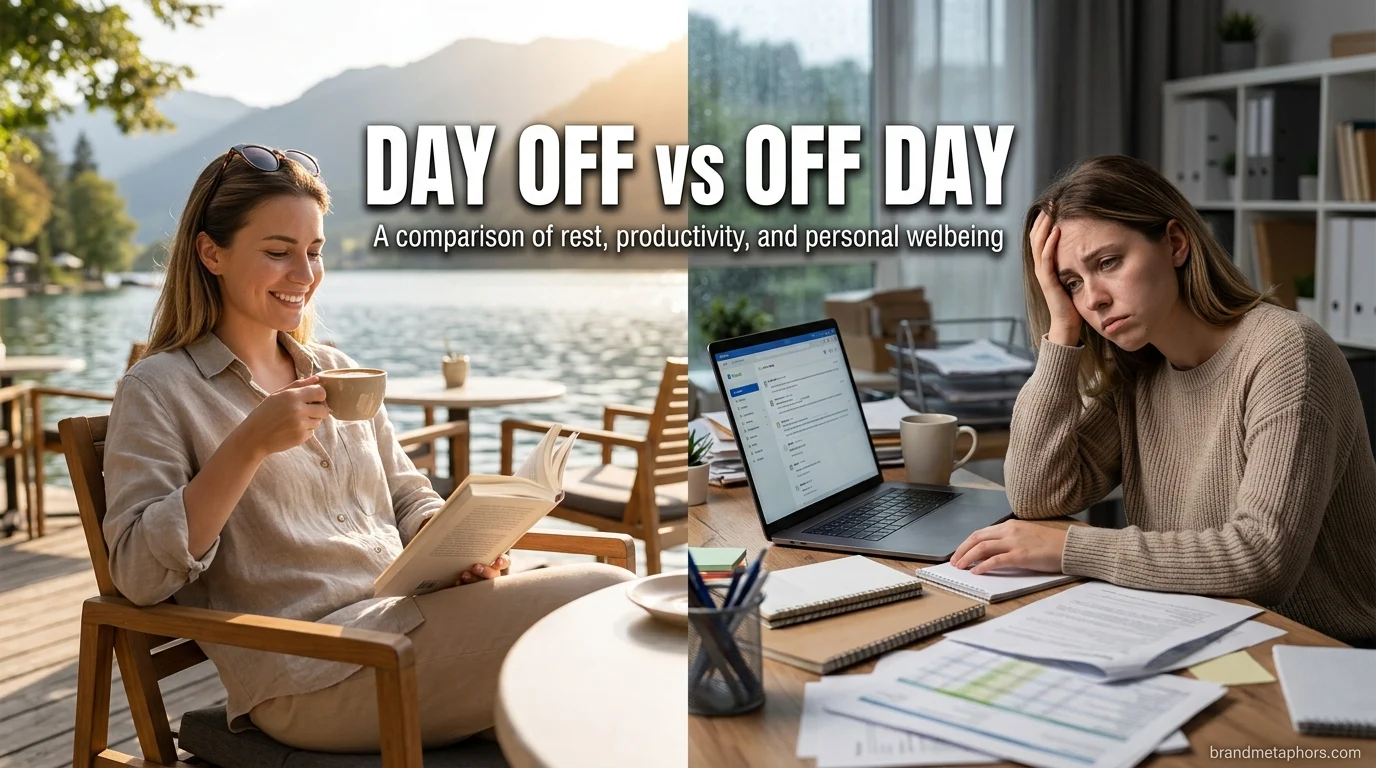
A day off is a scheduled period when someone does not have to work, attend school, or perform their regular responsibilities.
It refers to free time for relaxation, travel, hobbies, family activities, or personal errands.
Simple Definition
A day off means:
- A holiday from work
- A break from school
- A planned rest day
- Time away from regular duties
Examples
- I have a day off tomorrow.
- She spent her day off reading novels.
- We went hiking on my day off.
- His day off was filled with family activities.
- They usually clean the house on their day off.
What Does “Off Day” Mean?
An off day describes a time when someone performs below their usual standard.
It often refers to:
- Feeling tired
- Making unusual mistakes
- Being less productive
- Lacking concentration
- Performing poorly in sports, work, or school
Simple Definition
An off day means:
- A bad day
- A day of poor performance
- Feeling mentally or physically below normal
Examples
- I had an off day at work.
- The tennis player admitted she was having an off day.
- Everyone has an off day occasionally.
- Even experienced writers experience an off day.
- My presentation wasn’t great because I was having an off day.
Quick Comparison Table
FeatureDay OffOff DayMeaningTime away from work or schoolA day of poor performanceEmotionUsually positiveUsually negativeRefers ToFree timePerformance or moodPlanned?Usually yesUsually noExampleI’m taking a day off tomorrow.I’m having an off day today.
Grammar and Sentence Structure
Although the words are identical, their order changes the meaning completely.
Day Off
Structure:
Have + a day off
Examples:
- I have a day off today.
- She took a day off.
- We enjoyed our day off.
Off Day
Structure:
Have + an off day
Examples:
- I’m having an off day.
- He had an off day yesterday.
- Everyone experiences an off day sometimes.
Notice the article “an” before “off day” because the word begins with a vowel sound.
When to Use “Day Off”

Use this phrase when talking about free time from responsibilities.
Appropriate situations include:
- Vacation
- Weekend breaks
- Holidays
- Mental health days
- Annual leave
- School holidays
- Rest after busy schedules
Examples
- I’m taking a day off next Friday.
- She uses her day off to volunteer.
- We planned a picnic on our day off.
- My father finally has a day off this weekend.
- Students often relax during a day off from school.
When to Use “Off Day”
Use this expression when discussing performance rather than schedules.
Common situations include:
Sports
- The goalkeeper had an off day.
- The team struggled because everyone had an off day.
School
- I failed the quiz because I had an off day.
- She usually gets excellent grades, but today was an off day.
Workplace
- My concentration was poor.
- The manager understood I was having an off day.
Creative Writing
Even professional writers experience an off day when ideas don’t flow naturally.
Side-by-Side Sentence Comparisons
Correct SentenceMeaningI’m taking a day off tomorrow.I won’t work tomorrow.I’m having an off day today.I’m not performing well today.She enjoyed her day off.She relaxed.She had an off day at work.She performed poorly.They planned a trip on their day off.Free time was used for travel.The singer had an off day during the concert.Performance wasn’t at the usual level.
Using These Expressions in Different Tones
Tone affects how these expressions sound.
Casual
- Today’s my day off.
- I’m having an off day.
Professional
- I’ll be taking a day off on Monday.
- I apologize; I’m having a bit of an off day.
Academic
- Employees value regular days off for maintaining work-life balance.
- Occasional off days are normal and do not define long-term performance.
Friendly
- Enjoy your day off!
- Don’t worry—everyone has an off day.
Figurative Language and Creative Writing Connections
Understanding literal meanings helps writers confidently explore figurative language.
Although these phrases are usually literal, they can appear alongside literary devices.
Metaphor Example
“My off day became a mountain I had to climb.”
Meaning:
The difficult day felt overwhelming.
Simile Example
“My mind was as cloudy as a rainy afternoon during my off day.”
Personification
“The day refused to cooperate.”
Hyperbole
“My off day lasted a thousand years.”
Imagery
“My day off smelled of fresh coffee, warm sunshine, and blooming flowers.”
These examples improve descriptive language and make writing more engaging.
Sentence Examples for Everyday Communication
Day Off Examples
- I’m spending my day off with family.
- She loves reading on her day off.
- We watched movies all day.
- His day off was peaceful.
- They traveled to the beach.
Off Day Examples
- I forgot everyone’s names because I was having an off day.
- My typing speed was unusually slow.
- The chef admitted it was an off day.
- Even excellent athletes have off days.
- The teacher understood my poor performance.
Common Mistakes
Mistake 1
❌ I had a day off at work because I performed badly.
✔ I had an off day at work.
Mistake 2
❌ I’m taking an off day tomorrow.
✔ I’m taking a day off tomorrow.
Mistake 3
❌ She enjoyed her off day at the beach.
✔ She enjoyed her day off at the beach.
Mistake 4
❌ My boss gave me an off day.
✔ My boss gave me a day off.
Mistake 5
❌ Everyone needs an off day every week.
✔ Everyone needs a day off every week.
Vocabulary Enhancement

Related words and phrases help improve writing skills.
Synonyms for Day Off
- Break
- Leave
- Holiday
- Vacation day
- Rest day
- Time off
- Personal day
- Free day
Related Words for Off Day
- Bad day
- Difficult day
- Poor performance
- Unproductive day
- Slump
- Rough day
- Low-energy day
Using varied vocabulary creates stronger academic and creative writing.
Writing Tips for Students
To communicate naturally:
- Think about whether you’re talking about schedules or performance.
- Use descriptive language to explain feelings.
- Add figurative language in narratives.
- Choose precise vocabulary.
- Read your sentence aloud.
- Replace repeated words with appropriate synonyms.
- Practice writing short dialogues.
- Learn expressions in context rather than memorizing definitions.
Practice Exercises
Exercise 1
Choose the correct phrase.
- I’m taking a ______ tomorrow.
- The basketball player had an ______ yesterday.
- She spent her ______ gardening.
- Everyone experiences an ______ sometimes.
- My manager approved my ______.
Answers
- day off
- off day
- day off
- off day
- day off
Exercise 2
Rewrite correctly.
- I had an off day from work.
- She enjoyed her off day.
- My teacher gave me an off day.
Suggested Answers
- I had a day off from work.
- She enjoyed her day off.
- My teacher gave me a day off.
Quick Reference Table
SituationCorrect ExpressionVacationDay offWeekend breakDay offPoor work performanceOff dayBad sports performanceOff dayHolidayDay offFeeling mentally unfocusedOff dayRelaxing at homeDay offTemporary lack of productivityOff day
Frequently Asked Questions
1. Are “day off” and “off day” interchangeable?
No. A day off refers to free time from work or school, while an off day refers to poor performance or feeling below your usual standard.
2. Which expression is more common?
Both are common, but they are used in different contexts. Native speakers regularly use each phrase appropriately.
3. Can I say “I’m taking an off day”?
No. The natural expression is I’m taking a day off.
4. Is “off day” always negative?
Generally, yes. It usually suggests temporary poor performance, low energy, or difficulty concentrating rather than permanent inability.
5. How can I remember the difference?
Think of day off as a scheduled break from responsibilities, while off day describes a day when your performance, focus, or mood is below your usual level.
Conclusion
Learning the difference between these two similar-looking expressions improves both spoken and written English. A day off refers to planned time away from work, school, or regular responsibilities, allowing you to rest, recharge, or enjoy personal activities. An off day, on the other hand, describes a temporary period of reduced performance, low energy, or difficulty concentrating.
Mastering these distinctions helps students, writers, and English learners communicate more accurately and confidently. Combining precise word choice with descriptive language, figurative language, comparison techniques, literary devices, sentence variety, and vocabulary enhancement creates writing that is both clear and engaging. By practicing these expressions in real-life situations, avoiding common mistakes, and completing regular exercises, you’ll strengthen your writing skills and sound more natural in everyday English conversations.