
Introduction
Words are powerful tools. The more clearly you understand them, the better you can read, write, speak, and express your ideas. Learning the right word also improves your creative writing because it helps you choose vocabulary that matches your message. Whether you are writing stories, poems, essays, speeches, or songs, strong word choice makes your writing more interesting and easier to understand.
Figurative language, descriptive language, literary devices, simile examples, metaphor examples, and poetic expression all depend on choosing accurate words. Even words that seem similar can have different meanings and uses. This is why understanding vocabulary differences is an important writing skill for students, writers, and English learners.
One pair that often causes confusion is choir vs chorus. These words are closely related to music, singing, theater, and literature, but they are not always interchangeable. In some situations they mean different things, while in others they overlap.
This guide explains the meanings, differences, examples, common mistakes, grammar tips, figurative uses, and practical exercises to help you confidently choose the correct word.
What Does “Choir” Mean?
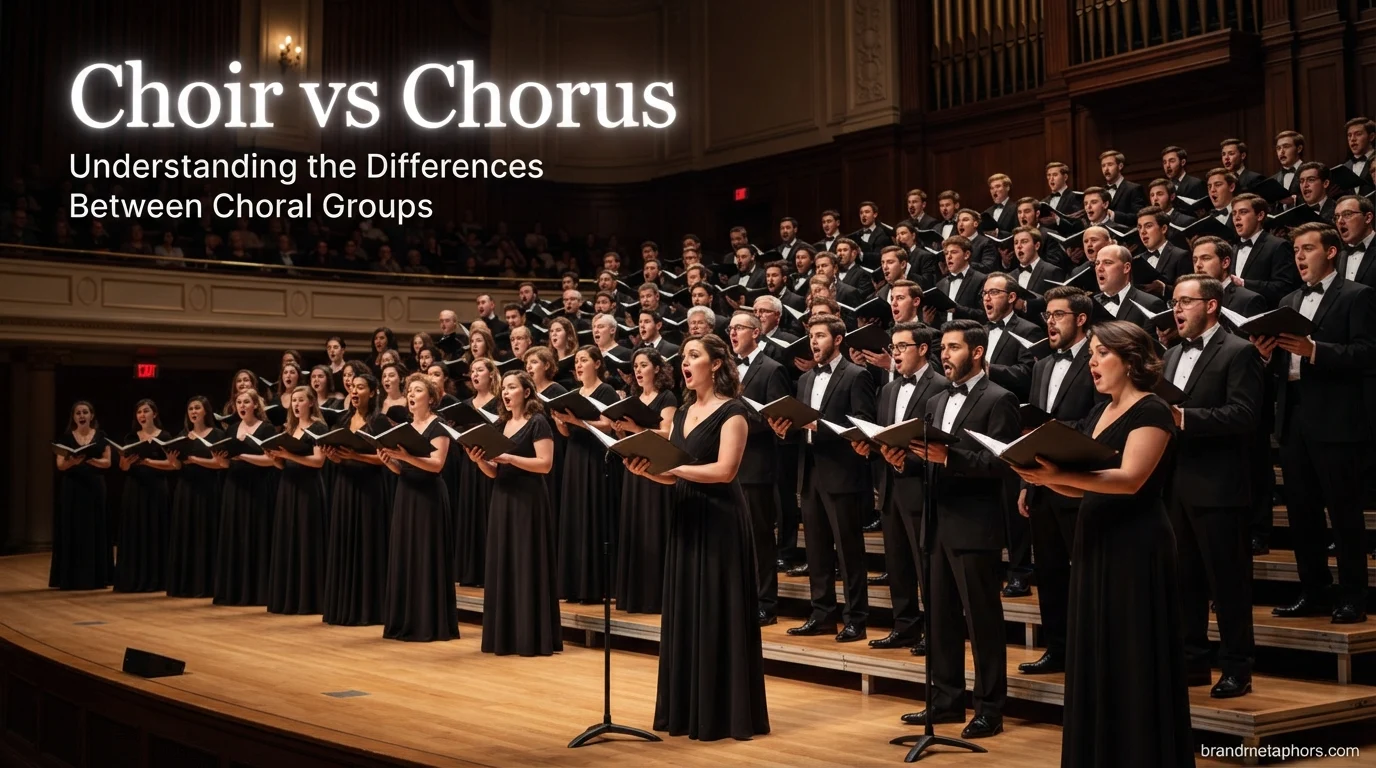
A choir is an organized group of people who sing together. Choirs usually perform in churches, schools, concerts, or community events. Members often sing different vocal parts such as soprano, alto, tenor, and bass.
A choir may perform with or without musical instruments. It usually practices regularly under the direction of a conductor or choir director.
Simple definition
A choir is a group of singers who perform together.
Examples
- The school choir performed at the graduation ceremony.
- Our church choir practices every Wednesday evening.
- She has been a member of the youth choir for three years.
- The children’s choir sang beautifully during the festival.
- We enjoyed listening to the university choir.
Common features of a choir
- Organized singers
- Multiple voice parts
- Regular rehearsals
- Led by a conductor
- Performs in concerts, churches, or schools
What Does “Chorus” Mean?
The word chorus has several meanings depending on the context.
Meaning 1: A repeated part of a song
This is the most common meaning in modern music.
Example:
- Everyone sang the chorus together.
- The chorus is the catchiest part of the song.
Meaning 2: A group of singers
Sometimes chorus refers to a large group of singers, especially in musical theater or opera.
Example:
- The chorus entered the stage after the solo performance.
- The opera chorus sounded magnificent.
Meaning 3: A group speaking together
In ancient Greek drama, the chorus commented on the story and helped explain events.
Example:
- The chorus warned the hero about his choices.
Meaning 4: Many voices together
Sometimes chorus describes many people speaking or reacting at once.
Example:
- A chorus of cheers filled the stadium.
- A chorus of laughter echoed through the room.
Quick Comparison Table
FeatureChoirChorusMain meaningGroup of singersRepeated part of a song or group of singersUsed in churchesYesSometimesUsed in pop songsNoYesUsed in musical theaterSometimesVery commonCan describe repeated lyricsNoYesCan describe many voices togetherRarelyYesCommon in literatureLess commonVery common
The Main Differences
Although these words are related, they are not always interchangeable.
Choir
Think about people.
Examples:
- school choir
- church choir
- children’s choir
- gospel choir
- university choir
The focus is on the singers.
Chorus
Think about songs, theater, or repeated voices.
Examples:
- sing the chorus
- repeat the chorus
- opera chorus
- chorus line
- chorus of applause
The focus may be on repeated lyrics or a large group.
Easy memory trick
Choir = Singers
Chorus = Song section or many voices
This simple trick helps students remember the difference.
Different Types of Choirs
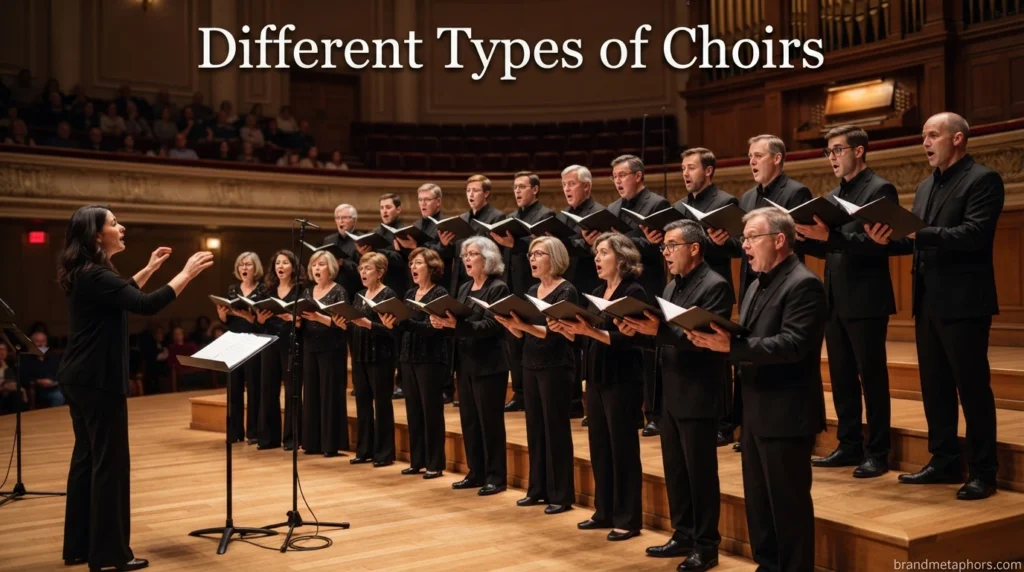
Understanding different choir types builds vocabulary and improves descriptive language.
School choir
Students perform at school events.
Example:
The school choir won first prize.
Church choir
Performs during religious services.
Example:
The church choir sang traditional hymns.
Community choir
Open to local residents.
Example:
Our community choir welcomes new members.
Children’s choir
Made up of young singers.
Example:
The children’s choir performed holiday songs.
Chamber choir
A smaller, highly trained vocal group.
Example:
The chamber choir performed classical music.
Gospel choir
Specializes in gospel music.
Example:
The gospel choir filled the hall with joyful music.
Different Uses of Chorus
Because chorus has several meanings, understanding each one improves writing skills.
Song chorus
The repeated section listeners remember.
Example:
The chorus stayed in my head all day.
Theater chorus
Supports the main performers.
Example:
The chorus danced across the stage.
Greek chorus
Explains events in classical plays.
Example:
The chorus advised the audience.
Chorus of voices
Many people reacting together.
Examples:
At chorus of agreement filled the room.
A chorus of complaints followed the announcement.
A chorus of birds welcomed the sunrise.
Choir and Chorus in Literature and Figurative Language
Although both words belong to music, writers often use them creatively.
Figurative language helps readers imagine sounds, emotions, and movement.
Metaphor examples
- The city became a choir of dreams.
- Her thoughts formed a chorus of hope.
- The forest was a choir of whispering trees.
- Memory sang in a quiet chorus.
- His heart joined the choir of brave souls.
Simile examples
- The students sang like a choir.
- The wind sounded like a distant chorus.
- Her voice blended like a choir at sunset.
- The children laughed like a joyful chorus.
- The audience responded like one great choir.
Descriptive language examples
Instead of writing:
The birds sang.
Write:
The birds formed a cheerful chorus that welcomed the morning.
Instead of writing:
Many people shouted.
Write:
A chorus of excited voices filled the stadium.
These expressions create stronger imagery.
Sentence Examples for Everyday English
Using choir
- My sister joined the school choir.
- Their choir practices twice a week.
- The choir sang Christmas songs.
- Everyone applauded the choir.
- Our choir performed at the city festival.
- The choir director smiled proudly.
- The choir wore matching uniforms.
- She loves singing in the choir.
Using chorus
- The chorus is easy to remember.
- Everyone sang the chorus together.
- The chorus repeated after every verse.
- The audience knew every chorus.
- A chorus of laughter followed the joke.
- We heard a chorus of birds.
- The chorus entered from backstage.
- The chorus finished the performance.
Tone, Style, and Writing Usage
Choosing the right word depends on your writing style.
Formal writing
Choir works well when discussing organized singers.
Example:
The university choir performed classical music.
Music writing
Chorus usually refers to repeated song lyrics.
Example:
The chorus is more memorable than the verses.
Creative writing
Both words can create beautiful imagery.
Examples:
A chorus of rain tapped on the roof.
The mountains became a silent choir beneath the stars.
Poetry
Both words appear in poetic expression because they create rhythm and sound.
Example:
The ocean raised its endless chorus.
When to Use Each Word

Use “choir” when talking about
- Church singers
- School singers
- Vocal groups
- Choir rehearsals
- Choir directors
- Choir concerts
Use “chorus” when talking about
- Song lyrics
- Musical theater
- Opera
- Repeated sections
- Many voices together
- Greek drama
When to Avoid Using Them
Avoid using choir when talking about repeated lyrics.
❌ The choir of the song is catchy.
✔ The chorus of the song is catchy.
Avoid using chorus when referring to a church singing group.
❌ The church chorus performed beautifully.
✔ The church choir performed beautifully.
Remember that in theater, opera, or musical productions, “chorus” may correctly refer to the singing ensemble.
Common Mistakes Students Make
Mistake 1
Using choir instead of chorus for song lyrics.
Incorrect:
The choir starts after the first verse.
Correct:
The chorus starts after the first verse.
Mistake 2
Using chorus for school singing groups.
Incorrect:
Our school chorus won the competition.
Better (in most varieties of English):
Our school choir won the competition.
Mistake 3
Thinking they always mean exactly the same thing.
They overlap in some musical settings but are not identical.
Mistake 4
Ignoring context.
Always ask:
- Am I talking about singers?
- Am I talking about song lyrics?
- Am I describing many voices?
The answer tells you which word fits.
Vocabulary Enhancement
Learning related words helps improve English vocabulary.
WordMeaningVocalistA singerEnsemblePerforming groupHarmonyNotes sounding togetherMelodyMain tuneVerseMain section before or after the chorusRefrainRepeated words or linesConductorPerson leading musiciansHymnReligious songSymphonyLarge musical compositionPerformancePublic presentation
Knowing these words strengthens reading and writing.
Comparison Examples
SituationCorrect WordSchool singersChoirChurch singersChoirChristmas singersChoirRepeated lyricsChorusPop song sectionChorusOpera singers togetherChorusMany voices speakingChorusBirds singing togetherChorus (figurative)
Practice Exercises
Exercise 1
Choose the correct word.
- Our ______ practiced every Friday.
Answer: choir
- The ______ is repeated three times.
Answer: chorus
- Everyone joined the final ______ of the song.
Reply: chorus
- The children’s ______ performed at the festival.
Answer: choir
- We heard a ______ of cheers after the goal.
Answer: chorus
Exercise 2
Fill in the blanks.
- The church ______ welcomed visitors.
- The song’s ______ is easy to sing.
- A ______ of birds greeted the sunrise.
- The school ______ won first place.
- The audience repeated the ______.
Answers:
- choir
- chorus
- chorus
- choir
- chorus
Exercise 3
Rewrite these sentences.
Simple:
People sang loudly.
Better:
The choir sang with powerful harmony.
Simple:
Everyone shouted.
Better:
A chorus of excited voices filled the stadium.
Writing Tips for Students

To improve writing skills:
- Think about the meaning before choosing a word.
- Read sentences aloud.
- Learn vocabulary in context.
- Practice descriptive language.
- Use figurative language carefully.
- Add similes and metaphors naturally.
- Keep your audience in mind.
- Choose words that create clear images.
These habits improve essays, stories, poems, speeches, and creative writing.
Frequently Asked Questions
1. Is a choir the same as a chorus?
Not exactly. A choir usually means an organized singing group, while a chorus can mean the repeated part of a song, a singing group in theater, or many voices together.
2. Which word is used in pop music?
Chorus is used for the repeated part of a pop song.
3. Can chorus mean a group of singers?
Yes. In opera, musicals, and theater, a chorus may refer to a group of singers or performers.
4. Why do writers use “chorus” figuratively?
It creates vivid images of many sounds, voices, or repeated actions, making writing more expressive.
5. How can I remember the difference?
Think of this simple rule:
- Choir = singers
- Chorus = repeated song section or many voices
Conclusion
Understanding the difference between choir and chorus helps you communicate more clearly in music, literature, and everyday English. A choir is usually an organized group of singers who perform together in places like schools, churches, and concert halls. A chorus, on the other hand, most often refers to the repeated section of a song, though it can also describe a theatrical singing group or many voices speaking or reacting together.
Learning these differences improves vocabulary enhancement, writing skills, and confidence in English. It also helps you appreciate figurative language, literary devices, poetic expression, descriptive language, simile examples, and metaphor examples more deeply.
By paying attention to context, practicing with sentence examples, and avoiding common mistakes, students and writers can choose the correct word every time. As your vocabulary grows, your reading, speaking, and creative writing become clearer, richer, and more engaging.