
Introduction
Good writing is not only about using correct grammar. It is also about choosing the right words and expressing ideas clearly. Figurative language, descriptive language, metaphors, similes, and other literary devices make writing more interesting and memorable. They help readers imagine scenes, understand complex ideas, and enjoy reading. Whether you are writing an essay, a story, a poem, or a school assignment, learning the meanings of words and understanding similar terms can greatly improve your communication skills.
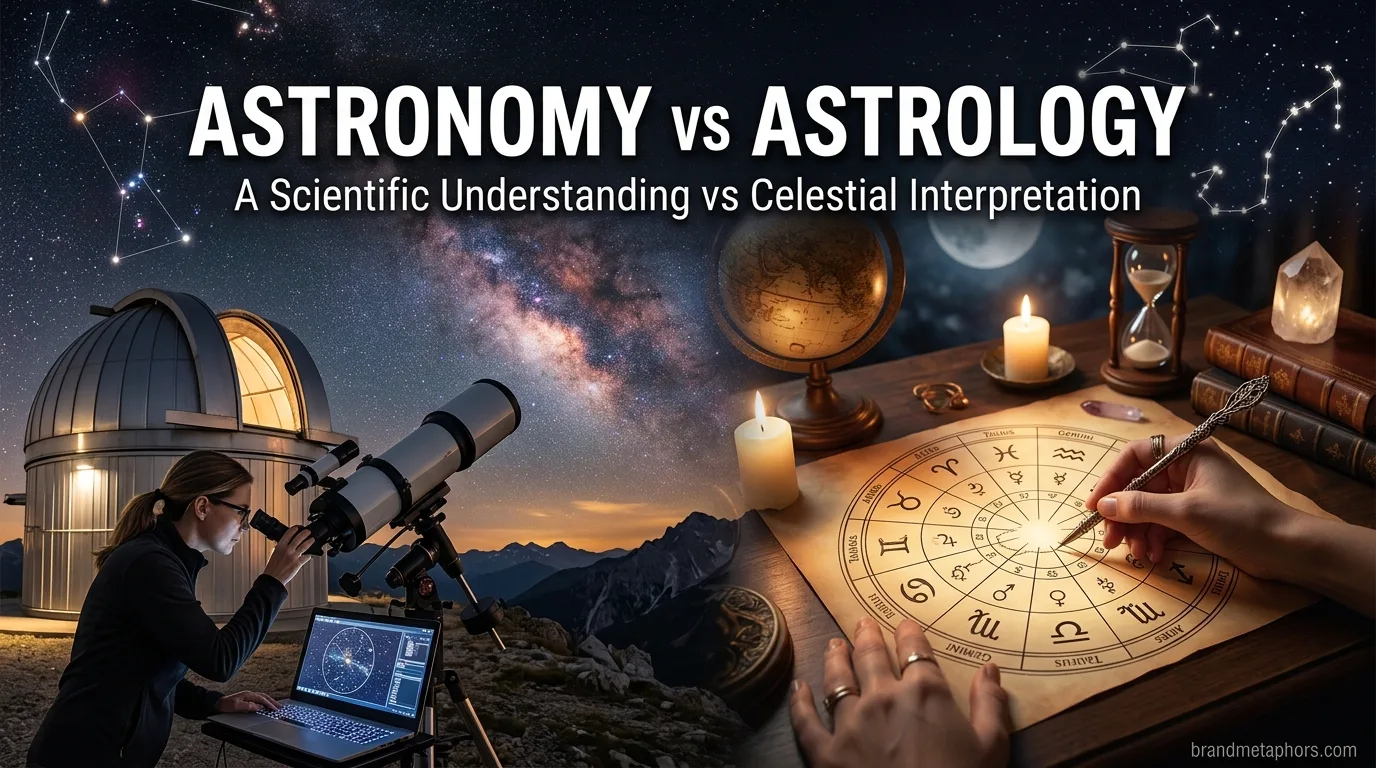
Many English learners confuse astronomy and astrology because both deal with stars, planets, and the sky. The words sound alike, but they describe completely different subjects. One is a scientific study based on evidence, while the other is a belief system that connects celestial bodies with human personalities and future events.
This guide explains the differences in simple language with definitions, comparison tables, sentence examples, figurative language examples, creative writing tips, common mistakes, practice exercises, and FAQs. By the end, you will confidently know when and how to use each word correctly.
What Is Astronomy?
Astronomy is the scientific study of everything beyond Earth’s atmosphere. It explores stars, planets, galaxies, black holes, moons, comets, asteroids, and the universe itself.
Astronomers use telescopes, satellites, computers, mathematics, and scientific experiments to understand how space works.
Main Topics in Astronomy
- Stars
- Planets
- Galaxies
- Solar System
- Black holes
- Nebulae
- Space exploration
- Cosmology
Key Features
- Based on scientific evidence
- Uses observation and experiments
- Constantly updated through discoveries
- Supported by mathematics and physics
Example Sentences
- She wants to study astronomy at university.
- Astronomy helps scientists understand the universe.
- The telescope is an important tool in astronomy.
- Many children become interested in astronomy after seeing the night sky.
What Is Astrology?
Astrology is the belief that the positions of the Sun, Moon, planets, and stars influence people’s personalities, relationships, and future.
Astrologers create horoscopes using birth dates and planetary positions.
Unlike astronomy, astrology is not considered a science because its claims have not been supported by reliable scientific evidence.
Main Topics in Astrology
- Zodiac signs
- Birth charts
- Horoscopes
- Planetary influences
- Personality predictions
- Compatibility readings
Example Sentences
- She reads her astrology horoscope every morning.
- Many people enjoy astrology for entertainment.
- He believes astrology explains personality traits.
- Their discussion focused on zodiac compatibility.
Quick Comparison Table
FeatureAstronomyAstrologyTypeScienceBelief systemStudiesSpace and the universeHuman life and celestial influenceEvidenceScientific researchPersonal belief and traditionUsesResearch, education, explorationHoroscopes, personality readingsProfessionalsAstronomersAstrologersMethodsObservation and experimentsBirth charts and zodiac signsAccuracyTested with evidenceNot scientifically proven
History of Both Subjects
Although they are very different today, both fields were once closely connected.
Ancient Civilisations
Thousands of years ago, people watched the skies to:
- Predict seasons
- Plan farming
- Navigate oceans
- Create calendars
- Understand natural events
Ancient societies often mixed scientific observations with spiritual beliefs.
Development of Astronomy
As scientific methods improved, astronomy became an independent science based on observation, mathematics, and physics.
Development of Astrology
Astrology remained a cultural and spiritual practice. Today many people enjoy it as entertainment or personal guidance rather than science.
Major Differences Explained
Purpose
Astronomy aims to understand the universe.
Astrology aims to interpret how celestial bodies may influence human lives.
Evidence
Astronomy depends on:
- Experiments
- Observation
- Mathematics
- Scientific testing
Astrology depends on:
- Traditions
- Zodiac systems
- Personal interpretation
- Symbolic meanings
Career Paths
Astronomy careers include:
- Space scientist
- Researcher
- Professor
- Observatory technician
- Aerospace specialist
Astrology careers include:
- Horoscope writer
- Birth chart reader
- Spiritual consultant
Comparison Examples in Everyday English

Understanding differences becomes easier through comparisons.
Example 1
❌ She studies astrology to become a space scientist.
✅ She studies astronomy to become a space scientist.
Example 2
❌ NASA researches astrology.
✅ NASA researches astronomy.
Example 3
My aunt enjoys astrology because she likes reading horoscopes.
Example 4
Astronomy explains how stars are born.
Example 5
Astrology says your zodiac sign may influence your personality.
Sentence Examples for Better Vocabulary
Astronomy
- Astronomy requires careful observation.
- The astronomy club visited an observatory.
- Astronomy combines science with mathematics.
- Modern astronomy uses powerful telescopes.
- Astronomy has revealed thousands of distant planets.
Astrology
- Astrology remains popular around the world.
- My friend enjoys astrology magazines.
- Astrology often appears in newspapers.
- She compared everyone’s zodiac signs.
- Astrology is sometimes discussed for fun.
Figurative Language and Creative Writing Examples
Although astronomy is scientific, both words appear in creative writing.
Metaphor Examples
- Her dreams were galaxies waiting to be explored.
- His curiosity became a telescope reaching into endless possibilities.
- Their friendship was a constellation lighting dark nights.
Simile Examples
- She shined like the brightest star.
- His thoughts travelled like planets around the sun.
- The classroom became as exciting as a journey through space.
Personification
- The stars whispered ancient stories.
- The moon smiled over the quiet town.
- The planets danced through the night.
Hyperbole
- There were millions of stars inside her imagination.
Imagery
The silver moon floated above quiet mountains while thousands of sparkling stars covered the sky.
Literary Devices Using Space Imagery
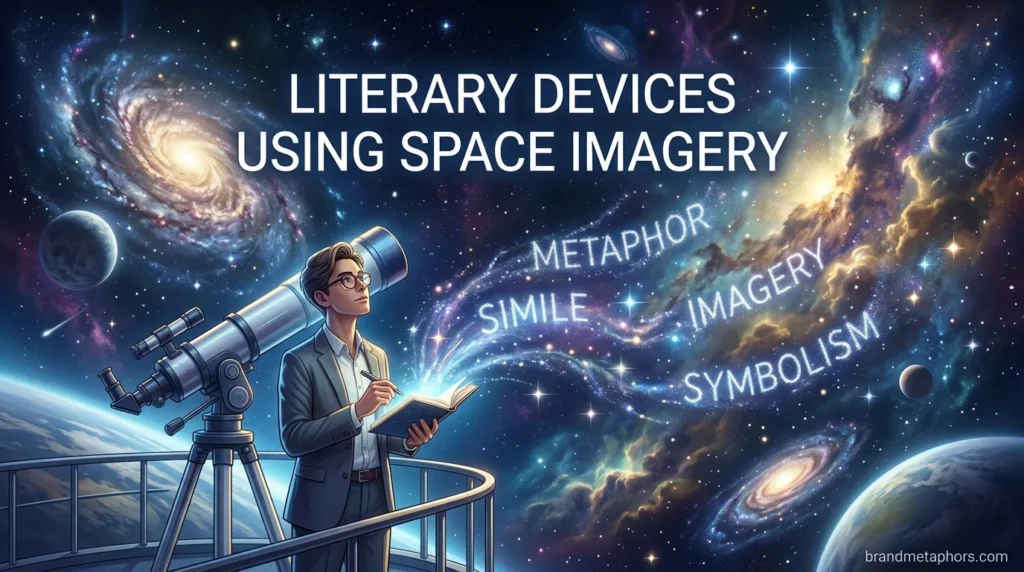
Space vocabulary creates beautiful descriptions in literature.
Symbolism
Stars often symbolise:
- Hope
- Guidance
- Dreams
- Destiny
The moon often symbolises:
- Mystery
- Change
- Peace
The sun often symbolises:
- Life
- Energy
- Success
Alliteration
- Silent stars shimmered softly.
- Brilliant blue planets beamed brightly.
Imagery
The dark sky glittered with countless diamonds of light.
Idioms Related to Stars and the Sky
These idioms use space imagery but have figurative meanings.
IdiomMeaningExampleReach for the starsAim highAlways reach for the stars.Written in the starsMeant to happenTheir friendship seemed written in the stars.Thank your lucky starsFeel gratefulThank your lucky stars you arrived safely.Star performerExcellent personAli was the star performer today.Over the moonVery happyShe was over the moon after winning.
These expressions are figurative and should not be confused with scientific astronomy.
Tone Usage in Different Writing Styles
Academic Writing
Use astronomy when discussing science.
Example:
Astronomy has expanded our understanding of the universe.
Creative Writing
Both words can appear depending on the story.
Example:
The old fortune teller believed astrology could predict the future.
News Writing
Scientific discoveries require astronomy.
Example:
Astronomers discovered a new exoplanet.
Informal Conversation
People often mention astrology when discussing zodiac signs.
Example:
What’s your zodiac sign? Do you enjoy astrology?
When to Use Each Word
Use Astronomy When
- Talking about science
- Studying space
- Discussing planets
- Learning physics
- Reading scientific articles
Use Astrology When
- Talking about horoscopes
- Discussing zodiac signs
- Reading birth charts
- Exploring traditional beliefs
- Having casual conversations about personality
When to Avoid Confusing Them

Avoid using astrology when discussing:
- Space missions
- NASA
- Scientific discoveries
- Telescopes
- Physics
Avoid using astronomy when discussing:
- Horoscopes
- Zodiac compatibility
- Birth charts
- Fortune telling
Common Mistakes
Mistake 1
❌ Astronomy predicts your future.
✅ Astrology claims to predict personality or future events.
Mistake 2
❌ Astronomers write horoscopes.
✅ Astrologers write horoscopes.
Mistake 3
❌ Astrology is taught as a science in physics classes.
✅ Astronomy is studied as a science.
Mistake 4
❌ The telescope helped improve astrology.
✅ The telescope helped improve astronomy.
Vocabulary Enhancement
Learning related words improves English writing.
WordMeaningUniverseEverything in spaceGalaxyHuge collection of starsPlanetLarge object orbiting a starOrbitPath around another objectTelescopeInstrument for viewing distant objectsHoroscopeDaily zodiac predictionZodiacGroup of twelve star signsConstellationPattern of starsObservatoryBuilding used for astronomyCelestialRelated to the sky
Writing Skills Practice
Choose the Correct Word
- Scientists discovered a new galaxy through ______.
Answer: astronomy
- My grandmother enjoys reading her daily ______.
Answer: astrology horoscope
- Space exploration depends on ______.
Reply: astronomy
- Zodiac signs belong to ______.
Answer: astrology
- Black holes are studied in ______.
Answer: astronomy
Fill in the Blanks
- The scientist used a telescope to study ______.
Answer: astronomy
- She checked her zodiac sign using ______.
Answer: astrology
- The universe contains billions of ______.
Reply: galaxies
- The ______ predicted a lucky week.
Answer: astrologer
- The ______ discovered a distant planet.
Answer: astronomer
Mini Quiz
Choose the correct answer.
1. Which one is science?
A. Astrology
B. Astronomy
Answer: B
2. Which uses zodiac signs?
A. Astronomy
B. Astrology
Answer: B
3. Which uses telescopes?
A. Astronomy
B. Astrology
Answer: A
4. Which studies black holes?
A. Astrology
B. Astronomy
Answer: A
5. Which includes horoscopes?
A. Astronomy
B. Astrology
Answer: B
Practical Tips for Remembering the Difference

A simple memory trick can help.
Astronomy = Science
Think of:
- Astronauts
- Space
- Science
- Satellites
All begin with ideas related to scientific exploration.
Astrology = Zodiac
Think of:
- Zodiac
- Horoscopes
- Birth charts
- Personality readings
Another helpful clue:
- Astronomers use telescopes.
- Astrologers use birth charts.
Frequently Asked Questions
1. Is astronomy a science?
Yes. It is a recognised branch of science that studies the universe using observation, mathematics, and experiments.
2. Is astrology scientifically proven?
No. Astrology is considered a belief system and has not been supported by reliable scientific evidence.
3. Why do the words sound similar?
Both words come from ancient Greek roots related to stars, which is why they have similar spellings but different meanings.
4. Can someone enjoy astrology without believing it?
Yes. Many people read horoscopes or discuss zodiac signs simply for fun or entertainment.
5. Which word should I use in school assignments?
Use astronomy for science topics and astrology only when discussing horoscopes, cultural beliefs, or the history of ideas.
Conclusion
Although their names look similar, astronomy and astrology are entirely different. Astronomy is a scientific discipline that explores stars, planets, galaxies, and the universe through observation and evidence. Astrology is a traditional belief system that connects celestial bodies with personality traits and life events through zodiac signs and horoscopes.
Knowing the difference helps students write accurately, improves vocabulary, and prevents common mistakes in essays and conversations.
Understanding related figurative language, literary devices, idioms, metaphors, similes, and descriptive expressions also strengthens creative writing and communication skills. Whether you are studying English, preparing for exams, or developing better writing habits, mastering these two commonly confused words will make your language clearer, more confident, and more effective.