
Introduction
Good writing is more than putting words together. It uses figurative language, descriptive vocabulary, and creative expression to help readers imagine ideas clearly. Whether you’re writing a school essay, a poem, a story, or an article, choosing the right word makes your message stronger. Even words that look almost identical can have very different meanings and backgrounds.
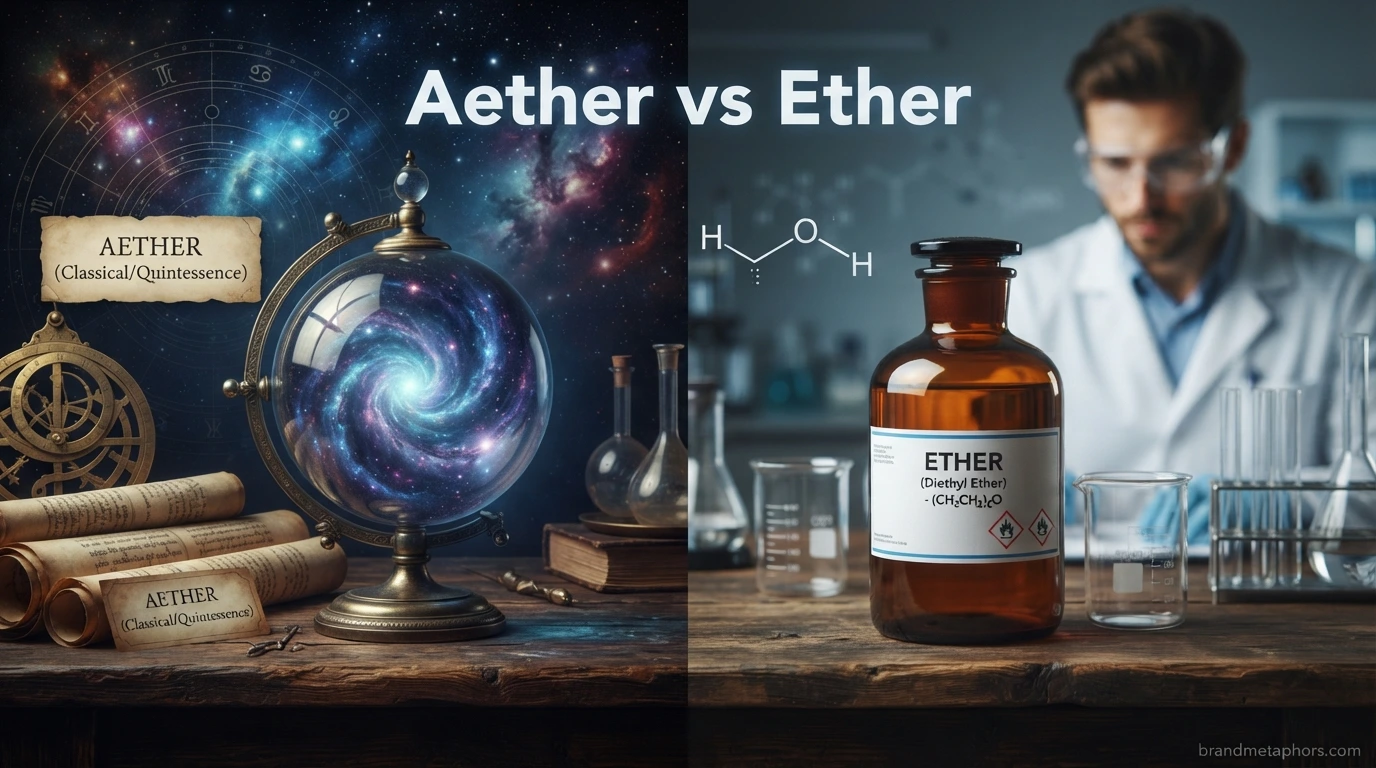
One pair that often confuses students, writers, and English learners is aether vs ether. At first glance, they appear to be simple spelling variations, but they are not always interchangeable. One has deep roots in mythology, philosophy, and classical literature, while the other is more common in modern science, chemistry, medicine, and technology.
Understanding these differences improves your vocabulary, prevents writing mistakes, and helps you choose the most suitable word for different situations. This guide explains each term in simple language, provides examples, comparison tables, writing tips, literary uses, and practical exercises to help you remember the distinction.
What Do Aether and Ether Mean?
Although they share the same pronunciation, these words developed different meanings over time.
FeatureAetherEtherPronunciationEE-thurEE-thurOriginAncient GreekModern English spellingMain UseMythology, philosophy, literary writingChemistry, medicine, computing, networkingStyleFormal, poetic, historicalScientific, everyday technical writing
Simply put:
- Aether usually refers to the mythical upper sky, heavenly atmosphere, or a poetic invisible substance filling the universe.
- Ether usually refers to a chemical compound, an old medical anaesthetic, or modern technology such as Ethereum’s Ether cryptocurrency.
Although dictionaries often list ether as the modern spelling of the old scientific “luminiferous ether,” aether is preferred when discussing classical or historical ideas.
The History Behind Both Words
Understanding history makes the difference much easier to remember.
Ancient Greece
The word aether comes from the Greek word aithēr, meaning the bright upper air or pure heavenly atmosphere.
Ancient philosophers believed Earth contained four elements:
- Earth
- Water
- Fire
- Air
But the heavens were believed to contain a fifth element called aether.
This mysterious substance was thought to fill space beyond the clouds where the stars and gods existed.
Medieval and Renaissance Thinking
Scientists and philosophers later borrowed this idea. They believed light travelled through an invisible material called the luminiferous ether.
Modern physics eventually proved this theory incorrect, but the term remained important in scientific history.
Modern English
Today, ether became the standard spelling for chemistry and medicine, while aether survived mostly in literature, mythology, fantasy, and historical discussions.
Aether in Mythology, Literature, and Creative Writing
In literature, aether creates beautiful imagery.
It often represents:
- Heaven
- Divine light
- Pure air
- Spiritual energy
- Infinite space
- Celestial beauty
Because of these meanings, poets and fantasy writers frequently choose aether instead of ether.
Example sentences
- The phoenix disappeared into the glowing aether.
- Her voice floated through the golden aether.
- The gods watched from the endless aether above.
- Stars shimmered across the silent aether.
Tone
Using aether creates a feeling of:
- mystery
- elegance
- fantasy
- mythology
- spirituality
- wonder
This makes it an excellent choice for creative writing, poetic expression, and descriptive storytelling.
Ether in Science, Medicine, and Technology

Modern English mainly uses ether in technical subjects.
Chemistry
An ether is a type of organic compound.
Example:
Diethyl ether was once widely used in laboratories.
Medicine
Ether was one of the earliest surgical anaesthetics.
Example:
Doctors once used ether during operations.
Physics
Older science books mention the “ether theory,” although modern physics no longer accepts it.
Computing
Computer networking uses Ethernet, which comes from the old scientific idea of ether.
Cryptocurrency
Ether is also the digital currency used on the Ethereum blockchain.
Example:
She purchased Ether through a cryptocurrency exchange.
Key Differences Between Aether and Ether
AetherEtherMythologicalScientificClassical spellingModern spellingLiteraryTechnicalHeavenly atmosphereChemical compoundFantasy writingMedical writingSymbolicPracticalPoeticScientific terminology
A simple memory trick:
Aether = Ancient
Both begin with A.
Ether = Everyday science
Comparison Examples in Sentences
Understanding context is the easiest way to learn.
Aether
Correct:
- The dragon vanished into the glowing aether.
- Ancient philosophers believed the heavens contained aether.
- The poet described hope as flowing through the aether.
- Light danced across the celestial aether.
Incorrect:
- The doctor used aether to anaesthetise the patient.
- The laboratory stored bottles of aether.
Ether
Correct:
- The chemist handled ether carefully.
- Ether was once a common anaesthetic.
- She invested in Ether last year.
- The solvent evaporated quickly because it contained ether.
Incorrect:
- Angels floated through the ether of Olympus. (Possible, but aether better matches mythology.)
Figurative Language and Literary Devices
Knowing when to use each word strengthens writing skills.
Metaphor examples
- Dreams drift through the aether.
- Inspiration lives in the aether of imagination.
Simile examples
- The clouds floated like pieces of aether.
- Her thoughts spread like light through the aether.
Personification
- The aether welcomed every rising star.
- The silent aether embraced the moon.
Symbolism
Aether often symbolises:
- purity
- wisdom
- eternity
- spirituality
- imagination
- hope
Ether rarely carries symbolic meaning unless used intentionally in science fiction.
Using These Words in Different Writing Styles
Academic writing
Use ether when discussing:
- chemistry
- medicine
- organic compounds
- historical scientific theories
Example:
Ether was one of the earliest inhaled anaesthetics.
Creative writing
Use aether when describing:
- magical worlds
- heavenly settings
- fantasy landscapes
- celestial beings
Example:
The wizard summoned energy from the ancient aether.
Poetry
Aether sounds elegant and timeless.
Example:
Stars whispered across the endless aether.
Historical writing
If discussing Greek philosophy:
Use aether.
If discussing nineteenth-century science:
Either spelling may appear depending on historical sources, though modern texts often prefer ether.
Common Mistakes and How to Avoid Them

Mistake 1: Thinking they always mean the same thing
They share historical roots but now serve different purposes.
Correct:
- aether in mythology
- ether in chemistry
Mistake 2: Using aether in medical writing
Incorrect:
Surgeons used aether during operations.
Correct:
Surgeons used ether during operations.
Mistake 3: Using ether in fantasy novels
Instead of:
Magic flowed through the ether.
Many fantasy readers expect:
Magic flowed through the aether.
Mistake 4: Assuming one spelling is wrong
Neither spelling is incorrect.
The best choice depends on context.
Vocabulary Enhancement and Related Words
Learning related vocabulary builds stronger English skills.
Words connected with aether
- celestial
- heavenly
- divine
- cosmic
- spiritual
- ethereal
- luminous
- transcendent
- mystical
- infinite
Words connected with ether
- solvent
- anaesthetic
- chemistry
- compound
- laboratory
- molecule
- organic chemistry
- medicine
- evaporation
- reaction
Synonyms by context
For aether:
- heavens
- sky
- cosmos
- celestial realm
- upper atmosphere
For ether:
- solvent
- anaesthetic (depending on context)
Remember that exact synonyms depend on the sentence.
Practice Exercises
Exercise 1
Choose the correct word.
- Ancient philosophers believed stars moved through the ______.
- The chemist poured the ______ into the container.
- The goddess disappeared into the glowing ______.
- Ether was once used as an ______.
- Fantasy novels often describe magical ______.
Answers
- aether
- ether
- aether
- anaesthetic
- aether
Exercise 2
Correct the sentence.
The doctor administered aether before surgery.
Answer:
The doctor administered ether before surgery.
Exercise 3
Fill in the blanks.
- The wizard summoned power from the ______.
- Ether belongs to organic ______.
- The poet imagined birds flying through the ______.
Answers:
- aether
- chemistry
- aether
Exercise 4
Write your own sentence using:
- aether
- ether
Try using one in a fantasy setting and the other in a science sentence.
Quick Reference Comparison Table
QuestionAetherEtherMythology✔✖Ancient philosophy✔SometimesFantasy writing✔RarelyPoetry✔RarelyChemistry✖✔Medicine✖✔Organic compounds✖✔Scientific reportsRare✔Creative storytelling✔SometimesTechnical documents✖✔
When to Use Each Word
Choose aether when writing about:
- Greek mythology
- fantasy worlds
- celestial imagery
- poetic expression
- symbolic language
- imaginative storytelling
Choose ether when writing about:
- chemistry
- medicine
- science
- laboratories
- historical anaesthetics
- cryptocurrency
- computer networking
Choosing the correct spelling improves clarity and makes your writing more professional.
Frequently Asked Questions
1. Are aether and ether the same word?
They come from the same historical origin, but modern English uses them differently. Aether is mainly literary and historical, while ether is commonly scientific and technical.
2. Which spelling is more common today?
Ether is much more common in everyday English because it appears in chemistry, medicine, technology, and computing.
3. Why do fantasy books often use aether?
Fantasy authors prefer aether because it sounds ancient, magical, and connected to mythology and the heavens.
4. Is aether an old spelling?
Yes. It is the older classical spelling that comes directly from Ancient Greek and is still used in historical, philosophical, and literary contexts.
5. Can I use ether instead of aether?
Sometimes, but not always. In scientific writing, ether is the correct choice. In mythology, classical philosophy, or poetic writing, aether is usually the more appropriate spelling.
Conclusion
Although aether and ether sound exactly alike, they belong to different worlds of English. Aether carries the beauty of mythology, philosophy, fantasy, and poetic imagination, making it ideal for descriptive language, creative writing, metaphor examples, simile examples, and literary devices. Ether, by contrast, belongs to science, chemistry, medicine, technology, and other technical fields, where precision is essential.
Understanding the distinction strengthens your vocabulary, improves writing skills, and helps you communicate more effectively. Whether you are crafting an imaginative story, analysing classical literature, writing a science report, or expanding your English vocabulary, choosing the right term ensures your writing is accurate, engaging, and appropriate for your audience. By practising with comparison examples and exercises, you can confidently use each word in the right context and continue building clear, expressive, and polished English.