
Introduction
Good writing is not only about using correct grammar. It is also about making your ideas clear, interesting, and memorable. Writers often improve their communication by using figurative language, descriptive language, creative writing techniques, similes, metaphors, idioms, and other literary devices. These tools help readers imagine scenes, understand emotions, and connect with ideas more easily.
However, even the most creative writing needs strong grammar. A small mistake with verbs can make a sentence sound awkward or confusing. One of the most common grammar questions English learners ask is when to use “seem” and when to use “seems.” Although these words look almost identical, choosing the correct one depends on the subject of the sentence.
Learning this simple grammar rule can improve your writing skills, vocabulary, speaking confidence, and exam performance. Whether you are writing essays, stories, emails, or conversations, understanding the correct verb form helps your sentences sound natural and professional.
In this guide, you’ll learn the meanings, grammar rules, comparison tables, sentence examples, common mistakes, writing tips, and practice exercises that will help you master these two commonly confused words.
What Do “Seem” and “Seems” Mean?
Both seem and seems come from the verb to seem.
The verb means:
- to appear
- to look like
- to give an impression
- to appear to be true
The meaning never changes.
Only the verb form changes according to the subject.
Examples
- I seem tired.
- You seem happy.
- They seem ready.
- She seems excited.
- It seems impossible.
The action is the same in every sentence.
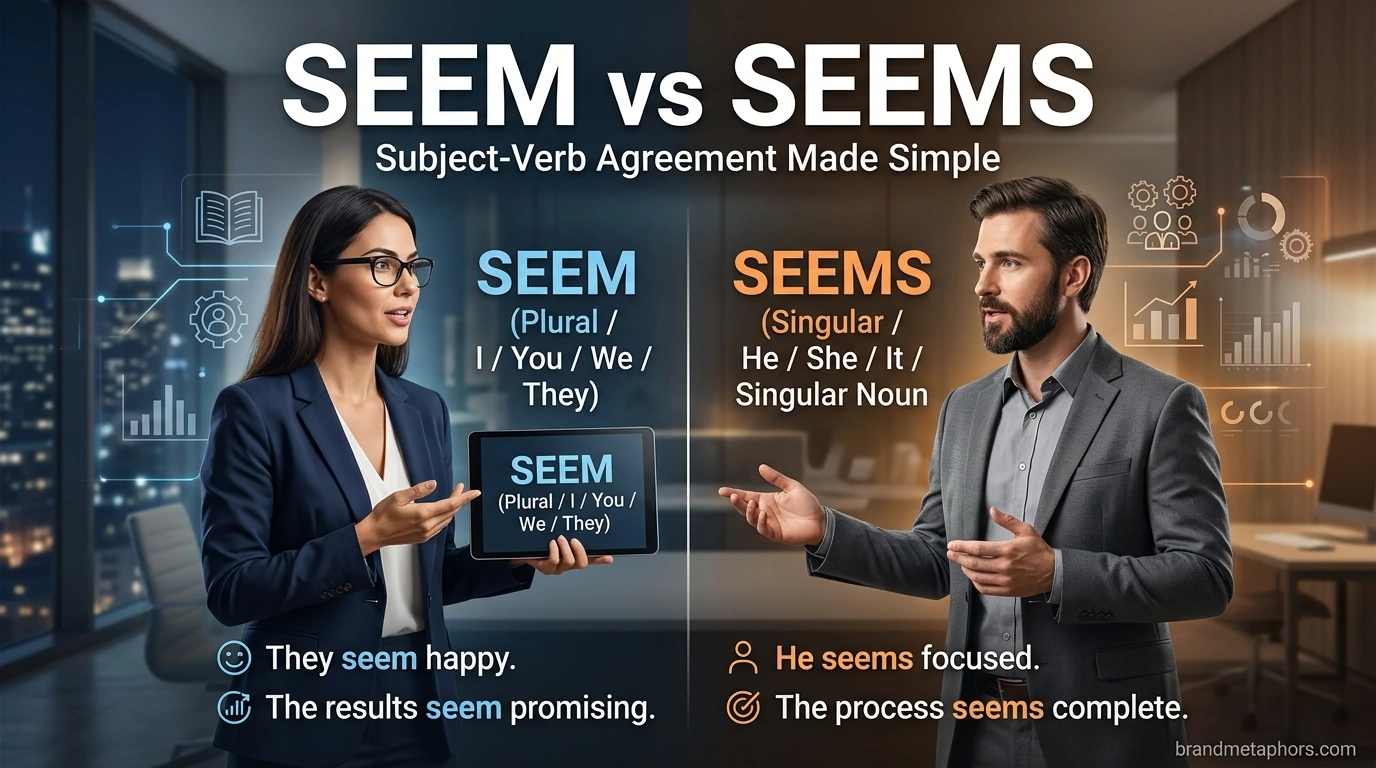
The Basic Grammar Rule
The rule is simple.
SubjectCorrect VerbIseemYouseemWeseemTheyseemHeseemsSheseemsItseemsSingular nounseemsPlural nounseem
Examples
Correct:
- The boy seems nervous.
- The girls seem excited.
- My teacher seems kind.
- My parents seem proud.
Incorrect:
- The boy seem nervous.
- The girls seems excited.
Always match the verb with the subject.
Why Subject-Verb Agreement Matters
English verbs change depending on the subject.
This is called subject-verb agreement.
Singular subjects usually take verbs ending in -s.
Plural subjects usually use the base verb.
Examples
Singular
- My sister seems busy.
- The cat seems hungry.
- This book seems interesting.
Plural
- My sisters seem busy.
- The cats seem hungry.
- These books seem interesting.
Correct agreement makes writing clear and natural.
Quick Comparison Table
FeatureSeemSeemsVerb formBase formThird-person singularUsed withI, You, We, TheyHe, She, ItSingular nounNoYesPlural nounYesNoPresent tenseYesYesMeaningAppearAppear
Sentence Examples for Every Subject
I
- I seem tired today.
- I seem ready for the exam.
- I seem more confident now.
You
- You seem happy.
- You seem worried.
- You seem very friendly.
We
- We seem prepared.
- We seem confident.
- We seem lucky.
They
- They seem interested.
- They seem excited.
- They seem confused.
He
- He seems tired.
- He seems busy.
- He seems honest.
She
- She seems kind.
- She seems nervous.
- She seems confident.
It
- It seems easy.
- It seems expensive.
- It seems impossible.
Using “Seem” and “Seems” in Different Types of Writing
These verbs appear in nearly every style of English.
Academic Writing
- The experiment seems successful.
- Students seem interested in science.
Creative Writing
Descriptive language often includes these verbs.
Example
The old house seemed asleep beneath the silver moon.
This sentence creates a picture for readers.
Story Writing
- The stranger seems mysterious.
- The village seems peaceful.
Conversation
- You seem upset.
- He seems happy today.
Business Writing
- The plan seems practical.
- The results seem positive.
Figurative Language and Creative Writing Examples
Although these verbs are not figurative themselves, they often introduce figurative language.
Metaphor Example
The classroom seems a battlefield before the exam.
Meaning:
Students are nervous and active.
Simile Example
She seems as calm as the ocean.
Meaning:
She appears peaceful.
Personification
The wind seems angry tonight.
Meaning:
The wind is described with human emotion.
Hyperbole
The mountain seems taller than the sky.
Meaning:
An exaggerated description.
Poetic Expression
Hope seems brighter after every storm.
This creates emotional impact.
Common Idioms That Use Similar Ideas
Many English expressions describe appearance or impressions.
Looks can be deceiving.
Meaning:
Appearances are not always true.
Example:
The old car still works perfectly. Looks can be deceiving.
Things are not always as they seem.
Meaning:
Reality may be different from appearances.
Example:
The job looked easy, but things were not always as they seemed.
At first glance
Meaning:
Based only on first impressions.
Example:
At first glance, the question seemed difficult.
Common Mistakes Students Make
Mistake 1
Incorrect:
She seem happy.
Correct:
She seems happy.
Mistake 2
Incorrect:
They seems tired.
Correct:
They seem tired.
Mistake 3
Incorrect:
My friends seems excited.
Correct:
My friends seem excited.
Mistake 4
Incorrect:
The teacher seem busy.
Correct:
The teacher seems busy.
Mistake 5
Incorrect:
The dogs seems hungry.
Correct:
The dogs seem hungry.
Tips to Remember the Difference
Tip 1
Singular subjects use seems.
Example:
The child seems sleepy.
Tip 2
Plural subjects use seem.
Example:
The children seem sleepy.
Tip 3
Replace the subject with a pronoun.
Example
The students seem excited.
Replace:
They seem excited.
Tip 4
Find the real subject before choosing the verb.
Example
The box of books seems heavy.
The subject is box, not books.
Tip 5
Ignore extra phrases.
Example
My brother with his friends seems confident.
The subject is brother.
Comparison Examples
IncorrectCorrectShe seem tired.She seems tired.They seems ready.They seem ready.The dog seem friendly.The dog seems friendly.My parents seems happy.My parents seem happy.We seems excited.We seem excited.
When to Use These Words
Use seem after:
- I
- You
- We
- They
- Plural nouns
Examples
- Birds seem quiet.
- We seem ready.
- The players seem confident.
Use seems after:
- He
- She
- It
- Singular nouns
Examples
- The bird seems quiet.
- My father seems tired.
- The movie seems interesting.
When to Avoid Grammar Mistakes
Always check:
- Is the subject singular?
- Is the subject plural?
- Is there a phrase between the subject and verb?
- Have you identified the real subject?
Avoid guessing.
Read the sentence aloud.
If it sounds strange, check the subject again.
Practice Exercises
Exercise 1
Choose the correct word.
- She (seem / seems) tired.
- They (seem / seems) excited.
- The dog (seem / seems) hungry.
- My parents (seem / seems) busy.
- I (seem / seems) ready.
Answers
- seems
- seem
- seems
- seem
- seem
Exercise 2
Correct the mistakes.
- He seem nervous.
- The students seems happy.
- We seems prepared.
- The flower seem beautiful.
- My brother and sister seems excited.
Answers
- He seems nervous.
- The students seem happy.
- We seem prepared.
- The flower seems beautiful.
- My brother and sister seem excited.
Exercise 3
Fill in the blanks.
- My teacher ______ very patient.
- These books ______ useful.
- The weather ______ nice today.
- The children ______ excited.
- It ______ impossible.
Answers
- seems
- seem
- seems
- seem
- seems
Improving Your Writing Skills

Using correct grammar makes every type of writing stronger.
Good writers combine:
- Strong vocabulary
- Correct grammar
- Descriptive language
- Figurative language
- Literary devices
- Creative expression
- Clear sentence structure
For example:
Basic:
The garden seems beautiful.
Better:
The garden seems like a colourful painting filled with dancing butterflies.
This version uses a simile-like image and richer descriptive language while keeping the grammar correct.
Reading books, practising daily, and checking subject-verb agreement will help you write naturally and confidently.
Frequently Asked Questions
1. What is the difference between “seem” and “seems”?
Both have the same meaning. The difference is grammatical. Use seem with plural subjects and seems with singular third-person subjects.
2. Can I use “seem” with “he”?
No. The correct form is he seems.
3. Why does “seems” end with “s”?
English present-tense verbs usually add -s for third-person singular subjects such as he, she, and it.
4. Is “they seems” correct?
No. The correct expression is they seem.
5. Can these words be used in creative writing?
Yes. They are commonly used in stories, poems, descriptive writing, and dialogue to express impressions, emotions, and observations.
Conclusion
Understanding the difference between seem and seems is a small but important step toward mastering English grammar. Although both words share the same meaning, they must match the subject correctly. Remember that seem is used with I, you, we, they, and plural nouns, while seems is used with he, she, it, and singular nouns.
Mastering this rule will improve your grammar, speaking, academic writing, creative writing, and everyday communication. As you continue learning English, combine correct grammar with descriptive language, figurative language, similes, metaphors, idioms, and other literary devices to make your writing clearer, more engaging, and more expressive. With regular practice and careful proofreading, using these verbs correctly will soon become second nature.