
Introduction
Good writing is more than using the right words. It is about choosing words that clearly express your ideas and help readers understand your message. Figurative language, descriptive language, metaphors, similes, and other literary devices make writing more colorful and memorable. They allow writers to paint pictures with words, create stronger emotions, and improve communication.
However, before using creative writing techniques, it is important to understand the meanings of similar-looking words. Many English learners confuse words that look or sound alike. One common pair is lath vs lathe. Although these words differ by only one letter, they have completely different meanings and are used in different situations.
Learning the difference will improve your vocabulary, writing skills, spelling, and confidence. This guide explains each word in simple language with clear definitions, comparison tables, sentence examples, common mistakes, and writing tips that students from grades 5–9 can easily understand.
What Does “Lath” Mean?
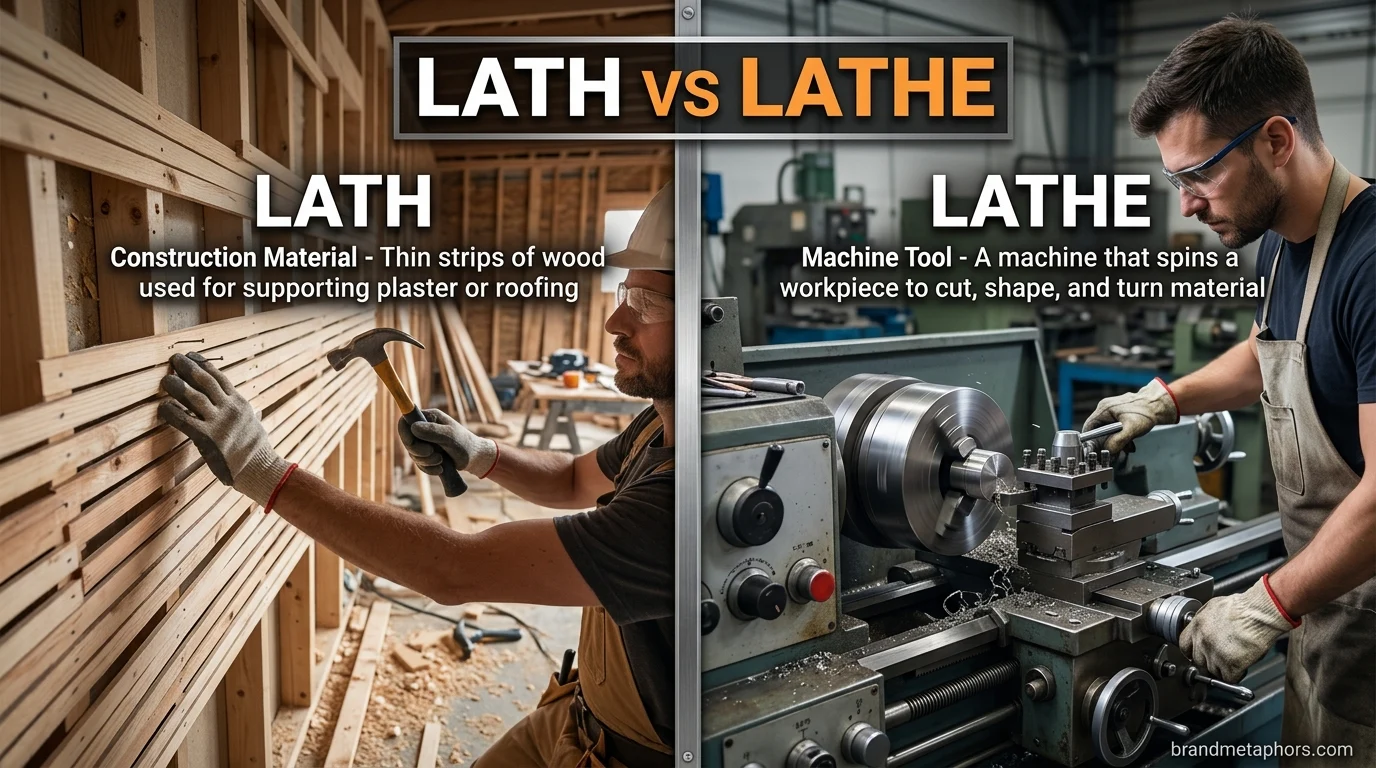
A lath is a thin, narrow strip of wood, metal, or another material.
Builders often use laths to support plaster on walls or ceilings. They are also used in fencing, roofing, and gardening projects.
Simple Definition
A lath is a thin strip that provides support or forms part of a structure.
Examples
- Workers nailed wooden laths to the wall before adding plaster.
- The old house still has original wooden laths.
- The gardener built a small fence using thin laths.
- The carpenter replaced the broken laths in the ceiling.
- Bamboo laths can support climbing plants.
Common Uses
- Construction
- Home renovation
- Gardening
- Fencing
- Roofing
What Does “Lathe” Mean?
A lathe is a machine that spins wood, metal, or plastic while tools shape it into different objects.
It is commonly used in woodworking, metalworking, engineering, and manufacturing.
Simple Definition
A lathe is a machine used to cut, shape, or polish materials by rotating them.
Examples
- The craftsman shaped a bowl on the lathe.
- Students learned how to use the wood lathe safely.
- The factory uses modern lathes to produce machine parts.
- He polished the table leg using a lathe.
- Engineers use precision lathes to create metal components.
Common Uses
- Woodworking
- Engineering
- Manufacturing
- Machine shops
- Metalworking
Quick Comparison Table
FeatureLathLathePart of SpeechNounNounMeaningThin strip of materialMachine that shapes materialUsed InBuilding and constructionManufacturing and woodworkingMaterialWood, metal, plasticMachine toolActionSupports structuresShapes rotating objectsEasy Memory TipThin stripTurning machine
Key Differences
Although the spellings are similar, the meanings are completely different.
LathLatheThin stripMachineUsed in wallsUsed in workshopsSupports plasterShapes wood and metalConstruction materialPower toolPassive objectWorking machine
Think of it this way:
- Lath = Long strip
- Lathe = Tool that turns
This simple trick helps many students remember the difference.
Sentence Examples
Using “Lath”
- The workers installed wooden laths before plastering.
- Every damaged lath needed replacement.
- The roof rested on strong wooden laths.
- Bamboo laths supported the tomato plants.
- The old building still contains traditional laths.
Using “Lathe”
- My grandfather carved bowls using a lathe.
- Safety glasses are necessary when using a lathe.
- The machine shop has several large lathes.
- The carpenter shaped chair legs on the lathe.
- Engineers repaired the broken lathe yesterday.
Figurative Language and Creative Writing

Although these are technical words, writers can sometimes use them creatively.
Figurative language makes writing more interesting by comparing ideas instead of describing them directly.
Metaphor Examples
- His patience became the lath holding the family together.
- Her creativity was the lathe shaping ordinary ideas into beautiful stories.
- Hope was the hidden lath beneath every success.
- Experience became the lathe that polished his character.
Simile Examples
- The fence stood like neat wooden laths.
- His workshop sounded like a busy lathe.
- Her ideas fit together like carefully placed laths.
- The machine spun like a fast-moving lathe.
Personification
- The old lathe whispered stories of skilled craftsmen.
- Every lath patiently held the ancient wall together.
These examples show how technical words can become part of descriptive language.
Literary Devices and Descriptive Language
Writers often improve storytelling by combining vocabulary with literary devices.
Imagery
“The fresh wooden laths filled the room with the smell of pine.”
Symbolism
A lath may symbolize support or strength.
A lathe may symbolize creativity, craftsmanship, or transformation.
Alliteration
- Smooth spinning lathe
- Long wooden laths
- Carefully carved creations
Hyperbole
“The giant lathe could shape a mountain.”
Personification
“The tired lathe finally rested after a long day.”
These devices make creative writing more engaging.
When to Use Each Word
Choose lath when discussing:
- Construction
- Building materials
- Wall repairs
- Roofing
- Wooden strips
- Garden supports
Choose lathe when discussing:
- Machines
- Woodworking
- Metalworking
- Engineering
- Manufacturing
- Carving projects
Easy Rule
If people build walls, think lath.
If people shape wood with a machine, think lathe.
Common Mistakes
Many learners accidentally confuse these words.
Mistake 1
❌ He carved the chair on a lath.
✅ He carved the chair on a lathe.
Mistake 2
❌ Workers attached the plaster to the lathe.
✅ Workers attached the plaster to the lath.
Mistake 3
❌ The machine shop repaired every lath.
✅ The machine shop repaired every lathe.
Mistake 4
❌ The wall uses several lathes.
✅ The wall uses several laths.
Why These Mistakes Happen
- Similar spelling
- Similar pronunciation
- Lack of construction vocabulary
- Lack of woodworking vocabulary
Reading more technical texts helps avoid these errors.
Vocabulary Enhancement
Learning related words improves English fluency.
Words Related to Lath
- Plaster
- Beam
- Board
- Stud
- Timber
- Framework
- Panel
- Wall
- Ceiling
- Structure
Words Related to Lathe
- Machine
- Turning
- Carving
- Spindle
- Tool
- Workshop
- Engineering
- Manufacturing
- Woodworking
- Precision
Using these related words naturally strengthens writing.
Comparison Examples
Construction
Workers placed wooden laths across the wall before plastering.
Woodworking
The craftsman shaped a beautiful vase using a lathe.
School Project
Students learned about old building methods using wooden laths.
Technology Class
Students practiced safely operating a wood lathe.
Tone and Style Usage
Different writing styles may use these words differently.
Informative Tone
Builders attached the laths before adding plaster.
Technical Tone
The CNC lathe produced accurate metal parts.
Narrative Tone
The old carpenter smiled as the lathe quietly spun.
Descriptive Tone
Rows of weathered laths covered the ancient cottage walls.
Creative Tone
Life became a lathe that slowly shaped her dreams.
Understanding tone helps writers choose the right expression.
Idiom Meaning and Word Choice

Neither lath nor lathe is commonly used in English idioms.
However, both can appear in figurative expressions created by writers.
Examples:
- Life is the lathe that shapes us.
- Friendship is the hidden lath supporting every difficult day.
These are creative metaphors rather than standard idioms.
Practice Exercises
Exercise 1
Choose the correct word.
- The carpenter shaped the table leg on the ________.
- The workers installed wooden ________ before plastering.
- The broken ________ needed repair in the machine shop.
- Bamboo ________ supported the climbing plants.
- The engineer learned to operate the ________ safely.
Answers
- lathe
- laths
- lathe
- laths
- lathe
Exercise 2
Correct the mistake.
- The plaster was attached to the lathe.
- He carved the bowl using a lath.
- The workshop repaired every lath machine.
Answers
- lath
- lathe
- lathe
Exercise 3
Fill in the blanks.
- A ________ is a machine.
- A ________ is a thin strip of wood.
- Builders use ________.
- Craftsmen use a ________.
Answers
- lathe
- lath
- laths
- lathe
Memory Tricks
Remember these simple clues.
Lath
Think:
L = Long strip
Lathe
Think:
Lathe = Tool that turns
Another trick:
- Walls need lath.
- Workshops need lathe.
These simple memory devices make spelling much easier.
Frequently Asked Questions
1. Are lath and lathe the same thing?
No. A lath is a thin strip of material, while a lathe is a machine used for shaping materials.
2. Which word is used in construction?
Lath is the correct word for construction, plaster walls, and roofing.
3. Which word is used in woodworking?
Lathe is the correct word because it is a woodworking and metalworking machine.
4. Can these words be used in creative writing?
Yes. Writers sometimes use them as metaphor examples or descriptive language to symbolize support, craftsmanship, or personal growth.
5. How can I remember the difference?
Remember that lath is a long strip used in building, while lathe is a turning machine used for carving and shaping.
Conclusion
Understanding the difference between lath and lathe helps you communicate more accurately in both everyday and technical English. While the two words look almost identical, their meanings are entirely different. A lath is a thin strip used mainly in construction, whereas a lathe is a machine that shapes wood, metal, or other materials.
By learning their definitions, practicing sentence examples, reviewing comparison tables, and exploring figurative language, similes, metaphors, and other literary devices, you can strengthen your vocabulary enhancement, improve descriptive language, and build better writing skills. Whether you are writing a school assignment, reading technical material, or creating imaginative stories, choosing the correct word will make your communication clearer and more effective.
Lath vs Lathe
Introduction
Good writing is more than using the right words. It is about choosing words that clearly express your ideas and help readers understand your message. Figurative language, descriptive language, metaphors, similes, and other literary devices make writing more colorful and memorable. They allow writers to paint pictures with words, create stronger emotions, and improve communication.
However, before using creative writing techniques, it is important to understand the meanings of similar-looking words. Many English learners confuse words that look or sound alike. One common pair is lath vs lathe. Although these words differ by only one letter, they have completely different meanings and are used in different situations.
Learning the difference will improve your vocabulary, writing skills, spelling, and confidence. This guide explains each word in simple language with clear definitions, comparison tables, sentence examples, common mistakes, and writing tips that students from grades 5–9 can easily understand.
What Does “Lath” Mean?
A lath is a thin, narrow strip of wood, metal, or another material.
Builders often use laths to support plaster on walls or ceilings. They are also used in fencing, roofing, and gardening projects.
Simple Definition
A lath is a thin strip that provides support or forms part of a structure.
Examples
- Workers nailed wooden laths to the wall before adding plaster.
- The old house still has original wooden laths.
- The gardener built a small fence using thin laths.
- The carpenter replaced the broken laths in the ceiling.
- Bamboo laths can support climbing plants.
Common Uses
- Construction
- Home renovation
- Gardening
- Fencing
- Roofing
What Does “Lathe” Mean?
A lathe is a machine that spins wood, metal, or plastic while tools shape it into different objects.
It is commonly used in woodworking, metalworking, engineering, and manufacturing.
Simple Definition
A lathe is a machine used to cut, shape, or polish materials by rotating them.
Examples
- The craftsman shaped a bowl on the lathe.
- Students learned how to use the wood lathe safely.
- The factory uses modern lathes to produce machine parts.
- He polished the table leg using a lathe.
- Engineers use precision lathes to create metal components.
Common Uses
- Woodworking
- Engineering
- Manufacturing
- Machine shops
- Metalworking
Quick Comparison Table
FeatureLathLathePart of SpeechNounNounMeaningThin strip of materialMachine that shapes materialUsed InBuilding and constructionManufacturing and woodworkingMaterialWood, metal, plasticMachine toolActionSupports structuresShapes rotating objectsEasy Memory TipThin stripTurning machine
Key Differences
Although the spellings are similar, the meanings are completely different.
LathLatheThin stripMachineUsed in wallsUsed in workshopsSupports plasterShapes wood and metalConstruction materialPower toolPassive objectWorking machine
Think of it this way:
- Lath = Long strip
- Lathe = Tool that turns
This simple trick helps many students remember the difference.
Sentence Examples
Using “Lath”
- The workers installed wooden laths before plastering.
- Every damaged lath needed replacement.
- The roof rested on strong wooden laths.
- Bamboo laths supported the tomato plants.
- The old building still contains traditional laths.
Using “Lathe”
- My grandfather carved bowls using a lathe.
- Safety glasses are necessary when using a lathe.
- The machine shop has several large lathes.
- The carpenter shaped chair legs on the lathe.
- Engineers repaired the broken lathe yesterday.
Figurative Language and Creative Writing
Although these are technical words, writers can sometimes use them creatively.
Figurative language makes writing more interesting by comparing ideas instead of describing them directly.
Metaphor Examples
- His patience became the lath holding the family together.
- Her creativity was the lathe shaping ordinary ideas into beautiful stories.
- Hope was the hidden lath beneath every success.
- Experience became the lathe that polished his character.
Simile Examples
- The fence stood like neat wooden laths.
- His workshop sounded like a busy lathe.
- Her ideas fit together like carefully placed laths.
- The machine spun like a fast-moving lathe.
Personification
- The old lathe whispered stories of skilled craftsmen.
- Every lath patiently held the ancient wall together.
These examples show how technical words can become part of descriptive language.
Literary Devices and Descriptive Language

Writers often improve storytelling by combining vocabulary with literary devices.
Imagery
“The fresh wooden laths filled the room with the smell of pine.”
Symbolism
A lath may symbolize support or strength.
A lathe may symbolize creativity, craftsmanship, or transformation.
Alliteration
- Smooth spinning lathe
- Long wooden laths
- Carefully carved creations
Hyperbole
“The giant lathe could shape a mountain.”
Personification
“The tired lathe finally rested after a long day.”
These devices make creative writing more engaging.
When to Use Each Word
Choose lath when discussing:
- Construction
- Building materials
- Wall repairs
- Roofing
- Wooden strips
- Garden supports
Choose lathe when discussing:
- Machines
- Woodworking
- Metalworking
- Engineering
- Manufacturing
- Carving projects
Easy Rule
If people build walls, think lath.
If people shape wood with a machine, think lathe.
Common Mistakes
Many learners accidentally confuse these words.
Mistake 1
❌ He carved the chair on a lath.
✅ He carved the chair on a lathe.
Mistake 2
❌ Workers attached the plaster to the lathe.
✅ Workers attached the plaster to the lath.
Mistake 3
❌ The machine shop repaired every lath.
✅ The machine shop repaired every lathe.
Mistake 4
❌ The wall uses several lathes.
✅ The wall uses several laths.
Why These Mistakes Happen
- Similar spelling
- Similar pronunciation
- Lack of construction vocabulary
- Lack of woodworking vocabulary
Reading more technical texts helps avoid these errors.
Vocabulary Enhancement
Learning related words improves English fluency.
Words Related to Lath
- Plaster
- Beam
- Board
- Stud
- Timber
- Framework
- Panel
- Wall
- Ceiling
- Structure
Words Related to Lathe
- Machine
- Turning
- Carving
- Spindle
- Tool
- Workshop
- Engineering
- Manufacturing
- Woodworking
- Precision
Using these related words naturally strengthens writing.
Comparison Examples
Construction
Workers placed wooden laths across the wall before plastering.
Woodworking
The craftsman shaped a beautiful vase using a lathe.
School Project
Students learned about old building methods using wooden laths.
Technology Class
Students practiced safely operating a wood lathe.
Tone and Style Usage
Different writing styles may use these words differently.
Informative Tone
Builders attached the laths before adding plaster.
Technical Tone
The CNC lathe produced accurate metal parts.
Narrative Tone
The old carpenter smiled as the lathe quietly spun.
Descriptive Tone
Rows of weathered laths covered the ancient cottage walls.
Creative Tone
Life became a lathe that slowly shaped her dreams.
Understanding tone helps writers choose the right expression.
Idiom Meaning and Word Choice
Neither lath nor lathe is commonly used in English idioms.
However, both can appear in figurative expressions created by writers.
Examples:
- Life is the lathe that shapes us.
- Friendship is the hidden lath supporting every difficult day.
These are creative metaphors rather than standard idioms.
Practice Exercises
Exercise 1
Choose the correct word.
- The carpenter shaped the table leg on the ________.
- The workers installed wooden ________ before plastering.
- The broken ________ needed repair in the machine shop.
- Bamboo ________ supported the climbing plants.
- The engineer learned to operate the ________ safely.
Answers
- lathe
- laths
- lathe
- laths
- lathe
Exercise 2
Correct the mistake.
- The plaster was attached to the lathe.
- He carved the bowl using a lath.
- The workshop repaired every lath machine.
Answers
- lath
- lathe
- lathe
Exercise 3
Fill in the blanks.
- A ________ is a machine.
- A ________ is a thin strip of wood.
- Builders use ________.
- Craftsmen use a ________.
Answers
- lathe
- lath
- laths
- lathe
Memory Tricks
Remember these simple clues.
Lath
Think:
L = Long strip
Lathe
Think:
Lathe = Tool that turns
Another trick:
- Walls need lath.
- Workshops need lathe.
These simple memory devices make spelling much easier.
Frequently Asked Questions
1. Are lath and lathe the same thing?
No. A lath is a thin strip of material, while a lathe is a machine used for shaping materials.
2. Which word is used in construction?
Lath is the correct word for construction, plaster walls, and roofing.
3. Which word is used in woodworking?
Lathe is the correct word because it is a woodworking and metalworking machine.
4. Can these words be used in creative writing?
Yes. Writers sometimes use them as metaphor examples or descriptive language to symbolize support, craftsmanship, or personal growth.
5. How can I remember the difference?
Remember that lath is a long strip used in building, while lathe is a turning machine used for carving and shaping.
Conclusion
Understanding the difference between lath and lathe helps you communicate more accurately in both everyday and technical English. While the two words look almost identical, their meanings are entirely different. A lath is a thin strip used mainly in construction, whereas a lathe is a machine that shapes wood, metal, or other materials.
By learning their definitions, practicing sentence examples, reviewing comparison tables, and exploring figurative language, similes, metaphors, and other literary devices, you can strengthen your vocabulary enhancement, improve descriptive language, and build better writing skills. Whether you are writing a school assignment, reading technical material, or creating imaginative stories, choosing the correct word will make your communication clearer and more effective.