
Have you ever noticed that some words or sentences read the same whether you read them from left to right or from right to left? They may look like simple word games, but they have fascinated writers, mathematicians, programmers, teachers, and language lovers for centuries.
These unique letter patterns appear in books, puzzles, poems, coding, biology, and even everyday life. They help improve spelling, logical thinking, and vocabulary while making language more fun and creative.
In this guide, you’ll discover what these reversible words and phrases are, how they work, their different forms, where they are used, why they matter, and plenty of easy examples. Whether you’re a student, writer, teacher, or simply curious, this article will help you understand the topic in a simple and enjoyable way.
What Is a Palindrome?
A palindrome is a word, number, phrase, or sequence that reads the same forward and backward.
For example:
- madam
- level
- racecar
- noon
- 121
- 1331
When reading these examples from either direction, the order stays exactly the same.
Simple Definition
A reversible sequence that looks identical when read from both directions.
Easy Formula
Forward Reading = Backward Reading
Example:
LEVEL
Forward: L-E-V-E-L
Backward: L-E-V-E-L
Both are identical.
History and Origin
These fascinating language patterns have existed for thousands of years.
Ancient Greek writers loved creating symmetrical phrases. The word itself comes from Greek:
- Palin = again
- Dromos = direction or way
Together, they mean “running back again.”
Over time, these reversible patterns spread into Latin, English, French, Arabic, Sanskrit, and many other languages.
Today, they are common in:
- Literature
- Mathematics
- Computer science
- Crossword puzzles
- Brain games
- Word competitions
Different Types
There are several kinds depending on what is reversed.
TypeExampleExplanationWordlevelSame spelling both waysPhraseNever odd or evenIgnores spaces and punctuationSentenceMadam, I’m AdamReads the same after removing punctuationNumber1221Digits match in reverseDate02/02/2020Same pattern both directionsDNA SequenceGAATTCBiological reverse symmetryBinary1001Same forward and backward in binary form
Each type follows the same basic rule: the sequence stays unchanged when reversed.
Common Word Examples
Here are many easy examples.
Three-Letter Words
- mom
- dad
- pop
- wow
- eye
- gig
- bib
Four-Letter Words
- noon
- deed
- peep
- toot
Five-Letter Words
- civic
- radar
- refer
- madam
- minim
Longer Examples
- racecar
- redder
- reviver
- rotator
- redivider
- detartrated
Many of these appear in dictionaries and are widely used in English.
Phrase Examples

Spaces and punctuation usually do not matter.
Examples include:
- Never odd or even
- Was it a rat I saw?
- Step on no pets
- Eva, can I see bees in a cave?
- Able was I ere I saw Elba
- Mr. Owl ate my metal worm
Let’s examine one.
Never odd or even
Remove spaces:
neveroddoreven
Reverse it:
neveroddoreven
Exactly the same.
Number Examples
These are popular in mathematics.
Examples:
- 11
- 22
- 101
- 202
- 303
- 1111
- 1221
- 4004
- 12321
- 1234321
Special Dates
Some calendar dates are also symmetrical.
Examples include:
- 02/02/2020
- 12/02/2021 (depending on date format)
People often celebrate these unusual calendar dates because they are rare and memorable.
Why Are They Important?
These patterns are much more than entertaining puzzles.
Improve Vocabulary
Students learn new words while discovering reversible spellings.
Build Observation Skills
Finding matching letters develops careful reading.
Strengthen Memory
Recognizing patterns helps the brain remember information better.
Encourage Creative Writing
Writers enjoy making clever phrases and poems.
Support Math Learning
Number symmetry teaches sequencing and logical thinking.
Develop Coding Skills
Programmers often solve related algorithm challenges.
Make Learning Fun
Teachers use these activities to keep students interested.
Real-Life Uses
Many people are surprised by how useful they are.
In Schools
Teachers use them to teach:
- spelling
- vocabulary
- reading
- critical thinking
In Literature
Authors create memorable names, titles, and wordplay.
In Mathematics
Mathematicians study reversible numbers and patterns.
In Computer Programming
Developers write programs to detect symmetrical strings.
Common interview questions include:
- Check whether a word matches its reverse.
- Find the longest symmetrical substring.
- Reverse a number without converting it into text.
In Biology
DNA sometimes contains reverse-complement sequences that scientists study.
In Games
Many puzzles and brain teasers include reversible words.
Examples include:
- crossword puzzles
- word searches
- spelling competitions
Benefits of Learning About Reversible Words
Learning these patterns offers many advantages.
Better Reading Skills
Children notice letter order more carefully.
Stronger Spelling
Repeated practice improves spelling accuracy.
Improved Concentration
Searching for patterns trains attention to detail.
Enhanced Creativity
Students enjoy inventing new examples.
Logical Thinking
Recognizing symmetry develops reasoning skills.
Better Problem Solving
Many puzzles require careful analysis.
Greater Interest in Language
Word games make English enjoyable.
How to Check Whether Something Is a Palindrome
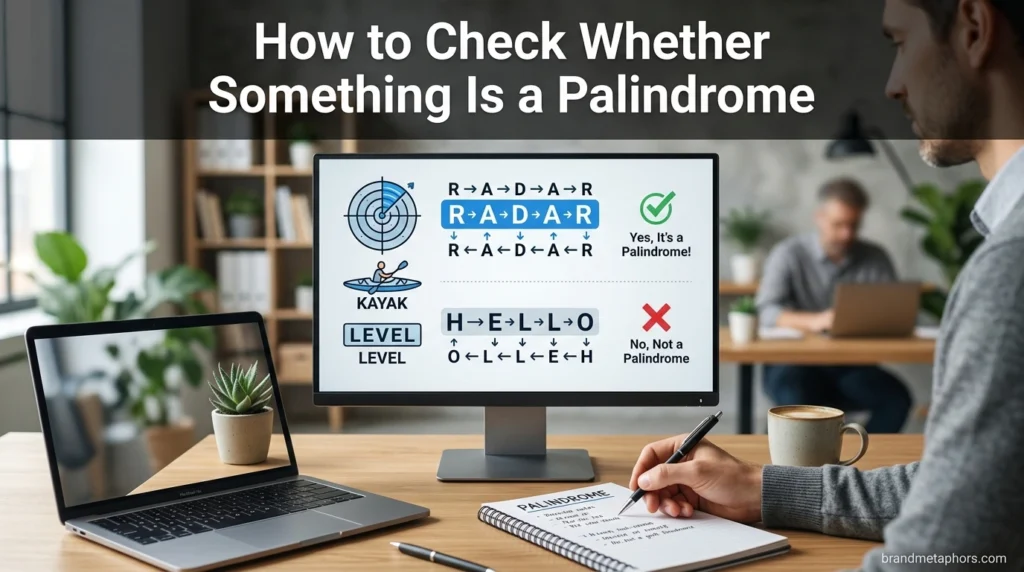
Checking is very easy.
Step 1
Write the word.
Example:
refer
Step 2
Reverse it.
refer
Step 3
Compare both versions.
If both match exactly, it qualifies.
For phrases:
- Remove spaces.
- Ignore punctuation.
- Ignore capitalization.
Example:
“Never odd or even”
becomes
neveroddoreven
Now reverse it.
The result is identical.
Fun Activities for Students
Teachers and parents can make learning enjoyable.
Activity 1
Find five reversible words in a dictionary.
Activity 2
Write your own phrase.
Activity 3
Circle all matching words in a worksheet.
Activity 4
Create number patterns.
Examples:
- 111
- 1221
- 12321
Activity 5
Challenge your friends.
Ask:
“Is ‘banana’ reversible?”
Answer:
No.
Ask:
“Is ‘level’ reversible?”
Answer:
Yes.
These simple games improve observation skills.
Common Mistakes
Many beginners make similar errors.
Ignoring Extra Spaces
Always remove spaces first.
Forgetting Punctuation
Periods and commas usually don’t count.
Mixing Uppercase and Lowercase
Letter case is normally ignored.
Assuming Similar Words Count
Example:
house
Reverse:
esuoh
Not identical.
Therefore, it does not qualify.
Confusing Near Matches
Example:
paper
Reverse:
repap
Different.
Not a match.
Interesting Facts
Here are some fun facts.
- Some languages contain hundreds of reversible words.
- They have existed for over 2,000 years.
- Many programming contests include related challenges.
- Some cities have roads or names with symmetrical spelling.
- World records exist for creating long reversible phrases.
- Famous puzzles often use these patterns.
- Mathematicians continue discovering interesting reversible numbers.
Quick Comparison of Examples
SequenceTypeQualifies?levelWord✅ YesracecarWord✅ YesnoonWord✅ YesappleWord❌ No1221Number✅ Yes45654Number✅ Yes1234Number❌ NoNever odd or evenPhrase✅ YesStep on no petsPhrase✅ YesBananaWord❌ No
Tips for Finding More Examples
Try these ideas:
- Read dictionaries carefully.
- Solve crossword puzzles.
- Play word games.
- Search children’s spelling books.
- Practice reversing words.
- Use online puzzle generators.
- Create your own examples with friends.
The more you practice, the easier it becomes to recognize symmetrical patterns.
Frequently Asked Questions (FAQs)
1. What is a palindrome in simple words?
It is a word, phrase, number, or sequence that reads the same forward and backward.
2. What is the easiest example?
Some simple examples include:
- mom
- dad
- level
- noon
- madam
3. Are spaces included?
Usually not. Spaces, punctuation, and capitalization are ignored for phrases.
4. Can numbers be palindromes?
Yes.
Examples include:
- 121
- 1221
- 1331
- 12321
5. Why are they important?
They improve vocabulary, spelling, memory, observation, logical thinking, and problem-solving skills.
6. Where are they used?
They are used in:
- education
- mathematics
- literature
- biology
- programming
- puzzles
- language learning
7. Is “banana” a palindrome?
No.
Forward:
banana
Backward:
ananab
They are different.
8. How can I find one?
Reverse the word, phrase, or number and compare it with the original. If both are exactly the same (ignoring spaces and punctuation where appropriate), it qualifies.
Conclusion
Reversible words, phrases, numbers, and sequences are much more than clever language tricks. They combine symmetry, creativity, and logic in a way that makes learning enjoyable for people of all ages. From simple examples like level and racecar to fascinating number patterns and memorable sentences, these structures appear across language, mathematics, science, and computer programming.
Learning to recognize them can strengthen spelling, reading, memory, and critical thinking while making vocabulary practice more engaging. Whether you’re solving puzzles, writing creatively, teaching students, or exploring coding challenges, understanding these unique patterns opens the door to a fun and rewarding part of language.
The next time you come across a word or number, try reading it backward—you might discover a perfect example hiding in plain sight.