
Introduction: Why Learning Comparisons Improves Your Writing
Good writing is more than using long words. It is about choosing the right words at the right time. Whether you are writing a school essay, a story, a poem, or a science report, understanding the correct meaning of words helps you communicate clearly.
Figurative language, descriptive language, metaphors, similes, and other literary devices make writing colorful and interesting. However, strong writing also depends on using factual vocabulary correctly. Confusing two similar words can change the meaning of an entire sentence.
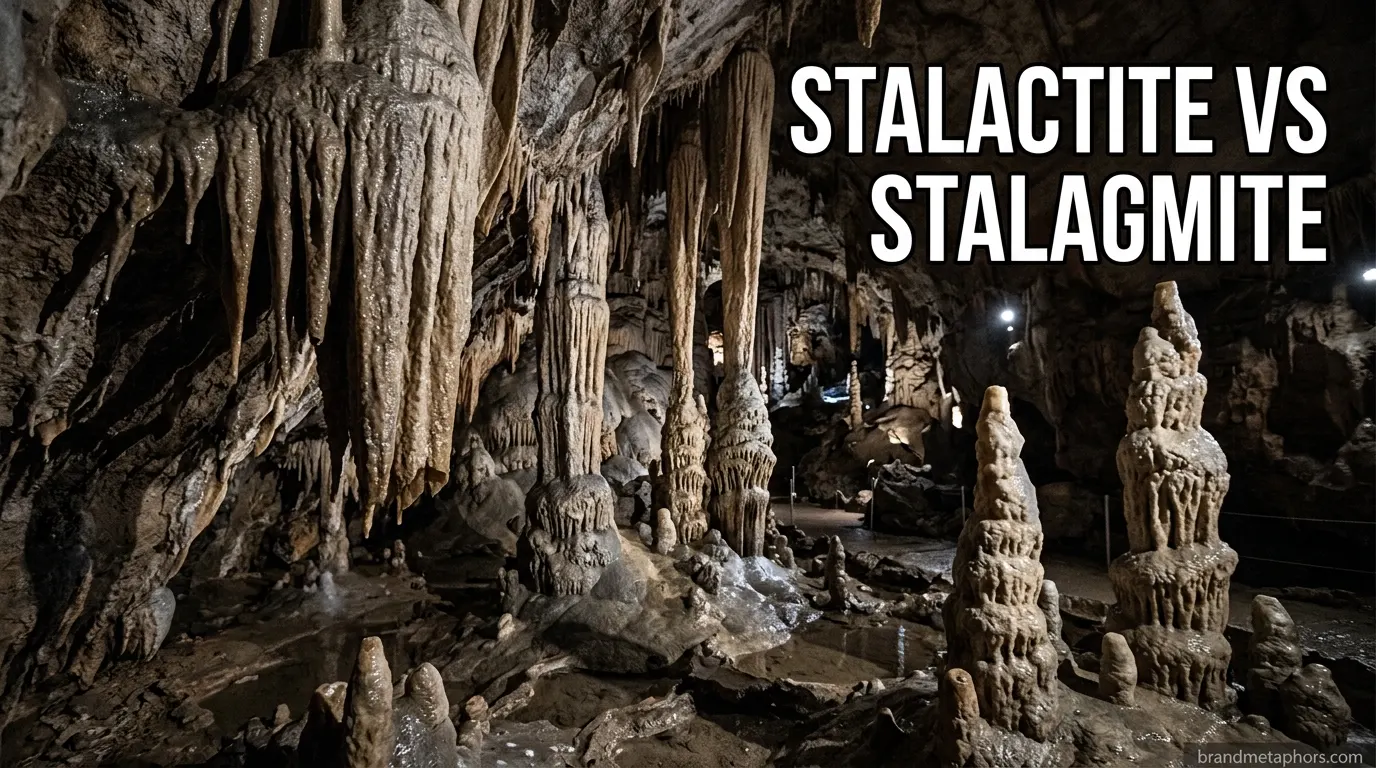
One of the most commonly confused pairs in science and geography is stalactite vs stalagmite. They look alike, sound alike, and both are found inside caves. Yet they grow in different directions and have different names.
This guide explains the difference in simple language. You’ll also discover memory tricks, comparison tables, examples, writing tips, common mistakes, exercises, and ways to use these words confidently in school assignments and creative writing.
What Are Cave Formations?
Before learning the difference, let’s understand where these formations come from.
Deep inside limestone caves, water slowly drips from the ceiling. This water contains dissolved minerals, especially calcium carbonate. As each drop falls, it leaves behind a tiny amount of mineral.
Over hundreds or even thousands of years, these tiny deposits grow into beautiful rock formations.
The two most famous cave formations are:
- One grows downward from the ceiling.
- The other grows upward from the cave floor.
Although they are formed by the same natural process, they grow in opposite directions.
What Is a Stalactite?
A stalactite is a mineral formation that hangs from the ceiling of a cave.
It forms when mineral-rich water drips from above. Each drop leaves behind a tiny mineral deposit. Over many years, the deposits become longer and thicker.
Key Features
FeatureDescriptionLocationCeilingDirectionGrows downwardShapeLong, pointed, hangingFormationMineral deposits from dripping water
Simple Definition
A stalactite is a rock formation that hangs like an icicle from a cave ceiling.
Sentence Examples
- The explorers admired the long formations hanging above them.
- Tiny drops of water slowly built the cave ceiling structures.
- The guide warned visitors not to touch the delicate mineral formations.
- Light reflected beautifully from the hanging rocks.
- Every drop added another tiny layer over hundreds of years.
What Is a Stalagmite?
A stalagmite is a mineral formation that grows upward from the cave floor.
When water falls from the ceiling, minerals collect on the ground. These deposits slowly build upward.
Key Features
FeatureDescriptionLocationFloorDirectionGrows upwardShapeThick, cone-shapedFormationMinerals deposited where water lands
Simple Definition
A stalagmite is a rock formation that grows upward from the floor of a cave.
Sentence Examples
- A tall mineral pillar rose from the cave floor.
- The rock formation looked like a stone mountain.
- Water drops slowly built the cone-shaped structure.
- Visitors walked carefully around the growing formations.
- Some cave floor formations are thousands of years old.
The Main Differences
Understanding the differences becomes easy when you compare them side by side.
FeatureStalactiteStalagmiteLocationCeilingFloorGrowthDownwardUpwardStarts FromCeilingGroundShapeHangingStandingWater SourceDripping from ceilingMinerals left on floor
Easy Way to Remember
Think about the letters.
Stalactite
- Contains the letter C
- C = Ceiling
Stalagmite
- Contains the letter G
- G = Ground
This memory trick is one of the easiest ways to avoid confusion.
How These Formations Are Created
Nature works very slowly.
Here is the process:
- Rainwater moves through soil.
- The water absorbs carbon dioxide.
- It dissolves small amounts of limestone.
- Water enters a cave.
- A drop hangs from the ceiling.
- Minerals remain behind.
- Thousands of drops create hanging formations.
- Water lands on the floor.
- More minerals collect below.
- Floor formations slowly rise upward.
Some cave formations grow less than one inch every hundred years.
That means many famous cave formations are older than human civilization.
Why Students Commonly Confuse These Words
Many learners mix these terms because:
- They start with similar letters.
- Both are cave formations.
- They form from the same minerals.
- Their spellings are similar.
- They are often introduced together in science books.
Fortunately, a simple memory trick makes remembering them much easier.
Memory Tricks That Really Work
Here are several easy methods.
Trick 1: Ceiling
C = Ceiling
The word with C belongs on the ceiling.
Trick 2: Ground
G = Ground
The word with G grows from the ground.
Trick 3: Icicle
Think about winter.
Icicles hang from roofs.
The hanging cave formation acts like an icicle.
Trick 4: Mighty Ground
The upward formation stands proudly like a mountain.
Ground equals upward growth.
Trick 5: Hand Motions
Point your finger downward when saying the ceiling formation.
Point upward when saying the floor formation.
Physical movement helps memory.
Using These Words in Descriptive and Creative Writing
Although these are scientific terms, they also improve descriptive language.
Writers often describe mysterious caves, fantasy worlds, or underground adventures.
Descriptive Example
The cave ceiling glittered with crystal formations while towering stone columns reached upward from the rocky floor.
Adventure Writing
The explorer carefully walked between towering cave pillars as water echoed through the darkness.
Nature Writing
Tiny drops of water created beautiful natural sculptures over countless centuries.
These details make scenes vivid for readers.
Figurative Language Inspired by Cave Formations
Figurative language makes writing more interesting by comparing one thing to another.
These cave formations can inspire creative expressions.
Simile Examples
- The cave ceiling sparkled like a palace of crystal chandeliers.
- The rock formation stood like a silent soldier.
- Water dripped like slow-moving clockwork.
- The cave looked like a frozen waterfall.
- The hanging rocks looked like giant icicles.
Metaphor Examples
- The cave was nature’s cathedral.
- The stone formations were ancient sculptures.
- The underground chamber became a palace of stone.
- Time was the artist of the cave.
- Every mineral deposit was a page in Earth’s history.
Personification
- The cave whispered ancient secrets.
- The water patiently carved its masterpiece.
- The rocks guarded the underground world.
- The cave welcomed curious travelers.
- The crystals danced in the flashlight.
These literary devices improve storytelling and descriptive writing.
Comparison Examples for Better Understanding
Here are clear comparisons.
SituationCorrect ChoiceHanging from the ceilingStalactiteGrowing from the floorStalagmiteLooks like an icicleStalactiteLooks like a coneStalagmiteMineral deposits aboveStalactiteMineral deposits belowStalagmite
Example Pair
Correct: The hanging formation dripped water onto the cave floor.
Correct: The upward-growing formation collected minerals for centuries.
Incorrect: The hanging formation grew from the cave floor.
Incorrect: The upward formation hung from the ceiling.
When to Use These Terms
Use these words when writing:
- Science assignments
- Geography projects
- Earth science lessons
- Nature reports
- Cave descriptions
- Travel articles
- Adventure stories
- Educational presentations
- Museum reports
- Environmental writing
They make scientific writing more accurate.
When to Avoid Using Them
Avoid using these terms when:
- Talking about ordinary rocks.
- Describing mountains.
- Discussing buildings.
- Referring to trees.
- Writing about outdoor cliffs.
- Using them without knowing the correct direction.
Using precise vocabulary improves writing quality.
Common Mistakes Students Make

Mistake 1
Thinking both words describe the same object.
Correction:
They are different formations.
Mistake 2
Mixing up ceiling and floor.
Correction:
Remember:
C = Ceiling
G = Ground
Mistake 3
Using the wrong direction.
Incorrect:
The ceiling formation grew upward.
Correct:
The ceiling formation grew downward.
Mistake 4
Spelling errors
Examples
- Stalagtite
- Stalagtmite
- Stalagtite
Always double-check spelling.
Mistake 5
Assuming they grow quickly.
Actually, they grow extremely slowly.
Vocabulary Expansion
Learning related words strengthens vocabulary.
WordMeaningCaveUnderground chamberLimestoneRock dissolved by waterMineralNatural substance in rocksDripFalling drops of waterCrystalMineral with regular shapeCavernLarge caveSpeleologyStudy of cavesDepositMaterial left behindErosionWearing away of rocksFormationNatural structure
Learning connected vocabulary improves reading comprehension.
Practice Exercises
Exercise 1
Fill in the blank.
- The rock hanging from the ceiling is called a ________.
- The cone-shaped formation growing upward is a ________.
- Minerals slowly build these formations through ________ water.
- These formations are commonly found inside ________.
- Many of them take thousands of ________ to grow.
Exercise 2
True or False
- One formation hangs from the ceiling.
- Both grow downward.
- Mineral-rich water creates them.
- Both are found in caves.
- They grow very quickly.
Exercise 3
Choose the Correct Word
- The cave ceiling was covered with (stalactites / stalagmites).
- The cave floor contained several (stalactites / stalagmites).
- Water slowly dripped from the (ceiling / ground).
- Minerals formed beautiful cave (formations / buildings).
- Scientists studied the ancient (rocks / clouds).
Quick Comparison Table
QuestionAnswerWhich hangs?StalactiteWhich stands?StalagmiteWhich begins on the ceiling?StalactiteWhich begins on the floor?StalagmiteWhich grows downward?StalactiteWhich grows upward?StalagmiteEasy memory trickC = Ceiling, G = Ground
Frequently Asked Questions
1. Which one hangs from the ceiling?
The hanging cave formation grows downward from the cave ceiling.
2. Which one grows upward?
The floor formation grows upward as minerals collect where water lands.
3. Can they ever meet?
Yes. After many thousands of years, they may grow together and form a single stone column.
4. Which memory trick is easiest?
Most students remember:
C = Ceiling
G = Ground
This simple trick works well in exams.
5. Why do writers learn these scientific words?
Knowing accurate vocabulary improves descriptive writing, creative storytelling, science reports, and overall communication skills.
Conclusion
Learning the difference between these two famous cave formations is much easier than it first appears. One hangs gracefully from the ceiling while the other rises steadily from the cave floor. Remembering C for Ceiling and G for Ground helps students avoid one of the most common science vocabulary mistakes.
Beyond science, understanding precise vocabulary strengthens writing skills, improves reading comprehension, and builds confidence in communication. Writers can also use these natural formations as inspiration for descriptive language, similes, metaphors, and other literary devices that make stories more vivid and engaging.
Whether you are preparing for a classroom quiz, writing an adventure story, completing a geography assignment, or simply expanding your vocabulary, mastering these terms is a small step that leads to clearer, more accurate, and more expressive writing.