

Understanding how to express improvement, comparison, and superiority is essential in English communication. One of the most common expressions used in everyday speech, academic writing, and professional communication is “much better.” It appears simple, but its usage carries nuance in tone, grammar, and context.
This guide explains its meaning, grammatical structure, alternatives, real-life applications, and writing techniques so learners, students, and writers can use comparative expressions confidently and naturally.
1. What Does “Much Better” Mean?
The phrase “much better” is used to show a significant improvement or higher degree of quality compared to something else or a previous state.
In simple terms:
- “Better” = improvement
- “Much better” = strong improvement or noticeable progress
Example:
- This phone is better than the old one.
- This phone is much better than the old one.
It emphasizes a stronger degree of comparison, making the statement more expressive and clear.
2. Grammatical Structure Behind Comparative Expressions
To understand how “much better” works, we need to look at comparatives in English grammar.
Basic structure:
much + comparative adjective/adverb
Common examples:
- much better
- much faster
- much easier
- much more interesting
Sentence pattern:
Subject + verb + much + comparative form + than + object
Example:
- This method is much better than the previous one.
Key point:
“Much” acts as an intensifier, strengthening the comparative adjective.
3. Difference Between “Better” and “Much Better”

Although both expressions show improvement, their intensity differs.
ExpressionMeaning StrengthUsage ContextExampleBetterMild improvementEveryday comparisonThis is better than that.Much betterStrong improvementClear or noticeable differenceThis is much better than that.
Explanation:
- “Better” suggests slight improvement.
- “Much better” emphasizes a significant or obvious improvement.
4. Types of Comparisons in English Language
Comparisons are not limited to just “better” or “worse.” English offers several structures:
1. Equal Comparison
- as + adjective + as Example: This book is as good as that one.
2. Comparative Degree
- better, faster, stronger Example: She is faster than him.
3. Superlative Degree
- best, fastest, strongest Example: She is the best player in the team.
4. Intensified Comparison
- much better, far better, way better Example: This solution is far better than the previous one.
5. Real-Life Uses of “Much Better”
This expression is widely used in daily life, academics, business, and emotional communication.
Everyday conversation:
- I feel much better today after resting.
Education:
- My understanding of grammar is much better now.
Workplace:
- This report is much better than the last version.
Health context:
- The patient is much better after treatment.
Technology:
- The new update is much better in performance.
6. Importance of Using Intensifiers in English Writing
Intensifiers like “much” make communication more precise and expressive.
Why they matter:
- Add emotional strength
- Improve clarity
- Make comparisons more meaningful
- Enhance writing style
- Help in persuasive communication
Without intensifiers:
- The sentence feels flat With intensifiers:
- The sentence becomes impactful
Example:
- Weak: This design is better.
- Strong: This design is much better.
7. Common Synonyms and Alternative Expressions
English offers many ways to express similar meanings without repeating the same phrase.
Alternatives include:
- far better
- significantly better
- a lot better
- greatly improved
- way better (informal)
- substantially better
Examples:
- The new version is significantly better than the old one.
- His performance is far better this time.
- This solution is a lot better for beginners.
8. Real-Life Dialogue Examples
Conversation 1: Health
A: How are you feeling now? B: I’m much better than yesterday.
Conversation 2: Study
A: Did you understand the topic? B: Yes, it’s much better after your explanation.
Conversation 3: Technology
A: Is the new app useful? B: Yes, it’s much better than the previous version.
These examples show natural spoken English usage.
9. Common Mistakes Learners Make
Many English learners misuse comparative expressions. Here are common errors:
1. Double comparison error
❌ more better ✔ better / much better
2. Wrong intensifier placement
❌ better much ✔ much better
3. Overuse in formal writing
Avoid using informal intensifiers like “way better” in academic essays.
4. Missing comparison object
❌ This is much better. ✔ This is much better than the old version.
10. Role in Academic and Creative Writing
Comparative expressions are essential in:
Academic writing:
- Research analysis
- Argument development
- Evaluation essays
Example:
- The new theory is much better supported by evidence.
Creative writing:
- Storytelling
- Descriptions
- Character development
Example:
- The city looked much better after the rain washed the streets clean.
11. Emotional and Figurative Use in Language
Beyond grammar, this phrase can carry emotional and figurative meaning.
Emotional use:
- I feel much better after talking to you.
Figurative use:
- The second draft is much better—it flows like a calm river instead of a rough stream.
Writers often use comparisons to create imagery and emotional depth.
12. Practical Writing Tips for Better Usage
To improve your English writing skills, follow these tips:
Tips:
- Use intensifiers only when needed
- Avoid repetition in a single paragraph
- Combine comparisons with context
- Practice writing descriptive sentences
- Read examples in books and articles
Practice exercise:
Rewrite simple sentences:
- This car is better. → This car is much better than the previous model.
Table: Summary of Comparative Intensifiers
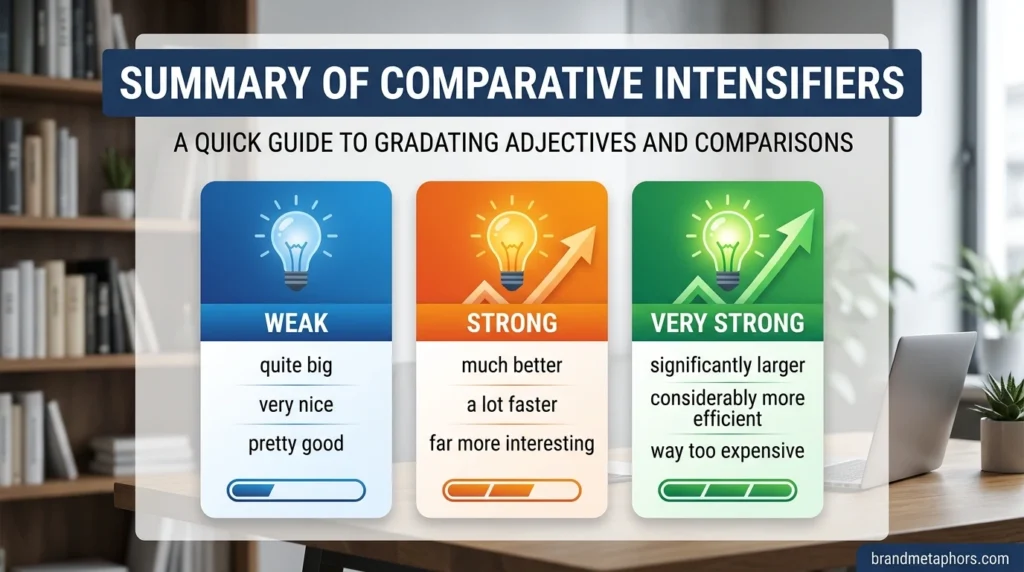
IntensifierStrength LevelExamplebetterlowThis is better.much bettermedium-highThis is much better.far betterhighThis is far better.significantly bettervery highThis is significantly better.way betterinformal/highThis is way better.
FAQs (Frequently Asked Questions)
1. What does “much better” mean in simple English?
It means something has improved a lot compared to before.
2. Is “much better” formal or informal?
It is neutral and can be used in both formal and informal contexts.
3. Can I say “more better” instead of “much better”?
No, “more better” is grammatically incorrect.
4. What is the difference between “better” and “much better”?
“Better” shows small improvement, while “much better” shows strong improvement.
5. Can “much better” be used in writing essays?
Yes, it is acceptable in academic writing when used correctly.
6. What are some synonyms of “much better”?
Far better, significantly better, a lot better, greatly improved.
7. Is “way better” correct English?
It is informal English, commonly used in speaking but not in formal writing.
8. How can I improve my use of comparative adjectives?
Practice writing sentences, read examples, and learn intensifiers like “much,” “far,” and “a lot.”
Conclusion
The expression “much better” plays an important role in English communication by helping speakers and writers express clear improvement and stronger comparison. Whether used in daily conversation, academic writing, or professional communication, it adds clarity, emphasis, and emotional strength to sentences.
By understanding its structure, alternatives, and proper usage, learners can improve their writing skills, expand vocabulary, and communicate ideas more effectively. Mastering comparative expressions ultimately leads to more natural, fluent, and impactful English writing.