
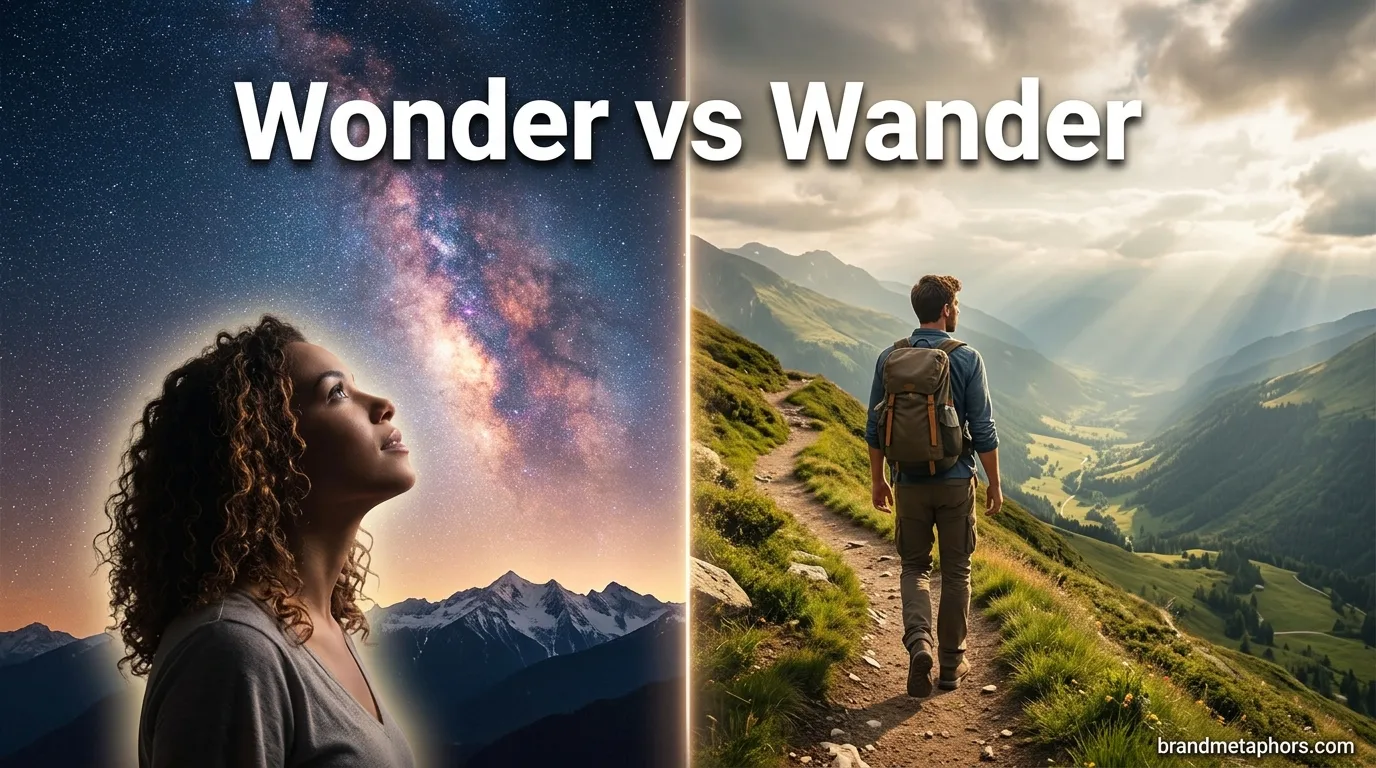
English is full of words that look and sound similar but have very different meanings. Learning these differences helps students, writers, and English learners improve their writing skills, vocabulary enhancement, and communication abilities. When writers understand word choices correctly, they create clearer sentences, stronger descriptive language, and more effective poetic expression.
One common pair that confuses many learners is wonder vs wander. These words differ by only one letter, yet they express completely different ideas. One relates to curiosity and amazement, while the other refers to movement without a fixed direction. Understanding the distinction can improve creative writing, academic writing, storytelling, and everyday conversations.
This comprehensive guide explains meanings, comparison examples, sentence examples, literary devices, figurative language connections, common mistakes, exercises, and practical tips for mastering these two commonly confused words.
What Does “Wonder” Mean?
The word wonder generally refers to curiosity, amazement, admiration, or a desire to know something.
Definition
Wonder means:
- A feeling of surprise or admiration
- Curiosity about something unknown
- Something remarkable or extraordinary
As a Verb
When used as a verb, wonder means to think about something or ask oneself a question.
Examples:
- I wonder where she went.
- We wonder how the stars were formed.
- The students wonder what will happen next.
As a Noun
When used as a noun, wonder refers to amazement or something extraordinary.
Examples:
- The ancient temple is a wonder of architecture.
- Children looked at the fireworks with wonder.
- Nature fills us with wonder and joy.
Synonyms of Wonder
- Curiosity
- Amazement
- Awe
- Admiration
- Surprise
- Fascination
What Does “Wander” Mean?
The word wander means to move around without a specific destination or purpose.
Definition
Wander refers to:
- Walking without a fixed direction
- Roaming freely
- Moving from place to place casually
Examples
- We wandered through the forest.
- The tourists wandered around the city.
- She likes to wander along the beach.
Synonyms of Wander
- Roam
- Drift
- Stroll
- Meander
- Explore
- Travel aimlessly
Quick Comparison Table

FeatureWonderWanderMeaningCuriosity or amazementMove without directionPart of SpeechNoun and VerbVerbRelated ToThoughts and feelingsMovement and travelExampleI wonder why it happened.I wander through the park.SynonymsCuriosity, aweRoam, strollUsageThinkingMoving
Key Differences Between Wonder and Wander
Although these words look similar, they belong to different contexts.
Wonder
Associated with:
- Curiosity
- Thinking
- Questions
- Amazement
- Admiration
Example:
- I wonder how birds navigate during migration.
Wander
Associated with:
- Walking
- Traveling
- Roaming
- Exploring
- Physical movement
Example:
- We wandered through the mountain trails all afternoon.
Easy Memory Trick
- Wonder = Thinking
- Wander = Walking
If the sentence involves thoughts or questions, use wonder.
If it involves movement or travel, use wander.
Sentence Examples for Better Understanding
Wonder Sentence Examples
- I wonder what the future holds.
- She wondered whether the answer was correct.
- The child stared at the sky in wonder.
- We wonder how technology will evolve.
- They wondered why the train was late.
- The audience watched the performance with wonder.
- I often wonder about life on other planets.
- Scientists wonder how the universe began.
Wander Sentence Examples
- We wandered through the old market.
- The dog wandered away from home.
- Tourists wandered around the museum.
- He wandered along the riverbank.
- The travelers wandered through several villages.
- She wandered aimlessly after school.
- We wandered in the woods for hours.
- The child wandered into the garden.
Wonder and Wander in Creative Writing
Creative writing relies heavily on word choice. Understanding these words helps writers create stronger imagery and emotional impact.
Using Wonder
Wonder creates:
- Curiosity
- Mystery
- Emotional depth
- Sense of discovery
Example:
She gazed at the stars and wondered whether anyone else was looking back.
This sentence creates intrigue and imagination.
Using Wander
Wander creates:
- Movement
- Exploration
- Freedom
- Adventure
Example:
He wandered through forgotten streets searching for hidden stories.
This sentence creates a sense of journey and exploration.
Figurative Language and Literary Devices
Writers often use wonder and wander in figurative language to make writing more vivid and memorable.
Figurative Language
Figurative language goes beyond literal meaning to create imagery and emotion.
Examples include:
- Metaphors
- Similes
- Personification
- Symbolism
Metaphor Examples
A metaphor compares two things without using “like” or “as.”
Wonder Metaphors
- Her mind was a universe of wonder.
- Curiosity is the key that unlocks wonder.
Wander Metaphors
- His life was a wandering river.
- The journey wandered through time itself.
Simile Examples
A simile compares using “like” or “as.”
Wonder Similes
- She stared in wonder like a child seeing snow for the first time.
- His curiosity spread like sunlight.
Wander Similes
- They wandered like leaves in the wind.
- The traveler moved as freely as a cloud.
Personification Examples
Personification gives human qualities to non-human things.
Examples
- Wonder knocked gently at her heart.
- The road wandered across the valley.
These literary devices enhance descriptive language and poetic expression.
Wonder and Wander in Poetry
Poets frequently use both words because they express important human experiences.
Wonder in Poetry
Wonder often symbolizes:
- Curiosity
- Beauty
- Spiritual discovery
- Imagination
Example:
In silent skies I stand and wonder, What secrets hide beyond the thunder.
Wander in Poetry
Wander often symbolizes:
- Freedom
- Exploration
- Self-discovery
- Adventure
Example:
I wander through the fields alone, Seeking paths I’ve never known.
Poets use these words to evoke emotions and imagery.
Common Idioms and Expressions

Expressions Using Wonder
Wonder of the World
Meaning: Something extremely impressive.
Example:
- The monument is considered a wonder of the world.
No Wonder
Meaning: It is not surprising.
Example:
- He studied every day. No wonder he passed.
Wonder About
Meaning: Think about something.
Example:
- I often wonder about the future.
Expressions Related to Wander
Wander Off
Meaning: Move away casually.
Example:
- The child wandered off during the picnic.
Wander Around
Meaning: Move casually from place to place.
Example:
- We wandered around the city center.
Wander Through
Meaning: Travel through slowly.
Example:
- They wandered through the countryside.
When to Use Wonder
Use wonder when discussing:
Curiosity
- I wonder what happened.
Questions
- We wonder why prices increased.
Amazement
- She looked at the waterfall in wonder.
Imagination
- Children wonder about magical worlds.
Reflection
- Many people wonder about their future.
When to Use Wander
Use wander when discussing:
Physical Movement
- We wandered through the forest.
Exploration
- Travelers wander around historic sites.
Roaming
- The cat wandered outside.
Adventure
- They wandered across the countryside.
Lack of Direction
- He wandered without a map.
Common Mistakes and How to Avoid Them
Many English learners mix these words because their spelling is similar.
Mistake 1
❌ I wander why she is late.
✅ I wonder why she is late.
Reason: The sentence expresses curiosity, not movement.
Mistake 2
❌ We wondered around the city.
✅ We wandered around the city.
Reason: The sentence describes movement.
Mistake 3
❌ The child was full of wander.
✅ The child was full of wonder.
Reason: The sentence refers to amazement.
Mistake 4
❌ I wonder through the park every evening.
✅ I wander through the park every evening.
Reason: Walking requires wander.
Vocabulary Enhancement Through Related Words
Words Related to Wonder
WordMeaningCuriosityDesire to knowAweDeep admirationAmazementGreat surpriseFascinationStrong interestMarvelSomething wonderful
Words Related to Wander
WordMeaningRoamMove freelyStrollWalk leisurelyMeanderMove without directionDriftMove slowlyExploreTravel and discover
Learning related words improves vocabulary and writing flexibility.
Practice Exercises
Exercise 1: Fill in the Blank
Choose wonder or wander.
- I _____ what happened yesterday.
- We _____ through the old town.
- The child stared in _____.
- Tourists often _____ around the museum.
- Scientists _____ about the origins of life.
Answers
- wonder
- wandered
- wonder
- wander
- wonder
Exercise 2: Correct the Mistakes
- I wander why he left.
- We wondered through the forest.
- She was filled with wander.
- The dog wondered away.
Correct Answers
- I wonder why he left.
- We wandered through the forest.
- She was filled with wonder.
- The dog wandered away.
Tips for Remembering the Difference
Think About the Letter “A”
The letter A in wander can remind you of:
- Adventure
- Around
- Away
All involve movement.
Think About Curiosity
Wonder is connected to:
- Questions
- Curiosity
- Thinking
If your sentence contains a question, wonder is usually correct.
Simple Formula
Wonder = Mind
Wander = Movement
This memory trick helps avoid confusion.
Why Understanding These Words Improves Writing

Using precise vocabulary strengthens writing quality.
Benefits include:
- Better communication
- Stronger descriptive language
- Improved creative writing
- Enhanced storytelling
- More accurate academic writing
- Greater vocabulary development
- Better understanding of literary devices
- More effective poetic expression
Writers who choose the correct word create clearer and more engaging content.
Frequently Asked Questions (FAQs)
1. What is the main difference between wonder and wander?
Wonder relates to curiosity or amazement, while wander refers to moving around without a specific direction.
2. Can wonder be both a noun and a verb?
Yes. It can express curiosity as a verb and amazement as a noun.
3. Is wander always related to walking?
Usually, but it can also describe moving aimlessly in a broader sense, such as thoughts wandering.
4. Which word is used for asking questions internally?
Wonder is used when thinking about something or asking yourself a question.
5. How can I remember the difference easily?
Remember:
- Wonder = Thinking
- Wander = Walking
This simple rule works in most situations.
Conclusion
The distinction between wonder and wander is simple once you understand their core meanings. Wonder is connected to curiosity, amazement, admiration, and questioning. Wander is connected to movement, exploration, roaming, and traveling without a fixed destination.
Mastering this difference improves writing skills, vocabulary enhancement, descriptive language, and communication accuracy. Whether you are writing stories, poetry, essays, or everyday messages, choosing the correct word helps readers understand your meaning instantly. By practicing sentence examples, studying figurative language, exploring literary devices, and completing exercises, students and writers can confidently use both words and avoid one of the most common vocabulary mistakes in English.