
Writing begins with a tiny spark. A blank page waits in silence. The cursor blinks like a distant lighthouse in the dark. Some days, words arrive easily. Other days, they hide behind clouds of doubt. Yet every writer, from a student filling a notebook to a novelist crafting a masterpiece, faces the same challenge: turning thoughts into language.
This is where metaphors become powerful. They help us understand writing in vivid and memorable ways. Instead of seeing writing as a simple act of putting words on paper, metaphors transform it into a journey, a garden, a bridge, or even a river. They reveal the emotions, struggles, and joys hidden within the creative process.
Understanding metaphors about writing is useful for authors, bloggers, students, teachers, and anyone who wants to communicate more effectively. These comparisons make abstract ideas easier to grasp and add color to both reading and writing. They can inspire creativity, reduce fear, and help writers explain their experiences in fresh ways.
In this article, we will explore ten powerful metaphors about writing, their meanings, examples, practical applications, and creative exercises to help you develop your own unique voice.
Writing as a Journey
Meaning and Explanation
One of the most common metaphors compares writing to a journey. Every piece of writing starts somewhere and moves toward a destination. The writer becomes a traveler, while readers become companions along the road.
The beginning introduces the path. The middle contains obstacles and discoveries. The ending reaches the destination.
Example Scenario
A novelist starts with a simple idea. Along the way, characters evolve, unexpected plot twists emerge, and the story arrives at a satisfying conclusion.
Example sentence:
“My novel became a long journey through unfamiliar landscapes of imagination.”
Alternative Expressions
- Writing is an adventure.
- Writing is a road trip.
- Writing is a voyage across unknown seas.
- Writing is a trek through mountains.
Mini Story
Many famous authors have described their work as exploration. They often begin without knowing exactly where the story will end. Like travelers following a winding path, they discover the route as they move forward.
Writing as Building a House
Meaning and Explanation
Writing can also be viewed as constructing a house. Every strong piece needs a solid foundation, sturdy walls, and a welcoming entrance.
Ideas form the foundation. Paragraphs create the walls. Details become furniture that makes the space comfortable for readers.
Example Scenario
A student writing an essay starts with research, organizes points logically, and supports arguments with evidence.
Example sentence:
“Each paragraph was another brick in the house of my argument.”
Alternative Expressions
- Writing is architecture.
- Writing is construction.
- Writing is designing a home.
- Writing is laying bricks of thought.
Sensory Detail
Imagine the sound of hammers, the scent of fresh wood, and the satisfaction of seeing a structure rise from empty ground. Good writing often feels exactly like that.
Writing as Planting a Garden
Meaning and Explanation
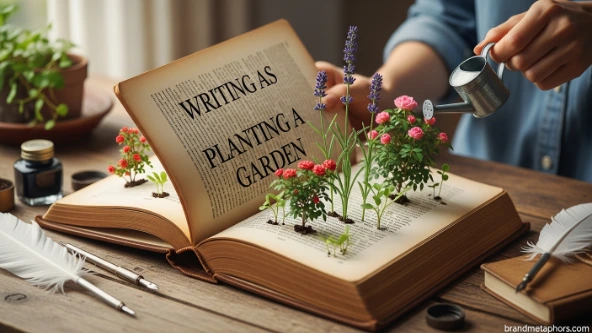
This metaphor highlights patience and growth. Ideas begin as seeds. With time, effort, and attention, they blossom into stories, articles, and poems.
Writers must nurture their work through revision and care.
Example Scenario
A blogger records an idea in a notebook. Weeks later, that tiny thought grows into a complete article.
Example sentence:
“I planted a single idea and watched it bloom into a chapter.”
Alternative Expressions
- Writing is gardening.
- Writing is cultivating creativity.
- Writing is growing ideas.
- Writing is tending a field of words.
Mini Story
A poet once carried a notebook filled with brief observations. Years later, those small notes became collections of poems admired by readers worldwide. Tiny seeds can grow into beautiful gardens.
Writing as Painting a Picture
Meaning and Explanation
Writers use words much like artists use paint. They create images in readers’ minds through description and detail.
Every sentence adds color, shape, texture, and emotion.
Example Scenario
A travel writer describes a sunset over the ocean so vividly that readers feel present in the scene.
Example sentence:
“Her words painted a picture brighter than any photograph.”
Alternative Expressions
- Writing is drawing with words.
- Writing is creating verbal art.
- Writing is sketching emotions.
- Writing is coloring imagination.
Sensory Detail
Think about golden sunlight, crashing waves, and cool ocean air. Strong writing helps readers experience these sensations without leaving their chairs.
Writing as a Bridge
Meaning and Explanation
Writing often serves as a bridge connecting people, cultures, generations, and ideas.
Through written words, one person can share thoughts with another, even across great distances and long periods of time.
Example Scenario
A grandfather writes letters to his grandchildren. Years later, those letters still carry wisdom and love.
Example sentence:
“My journal became a bridge between my past and present self.”
Alternative Expressions
- Writing is a connection.
- Writing is a pathway.
- Writing is a link between minds.
- Writing is a crossing over distance.
Cultural Reference
Ancient literature still speaks to modern readers because writing creates bridges across centuries.
Writing as a River
Meaning and Explanation
A river flows continuously, changing direction while moving forward. Writing often follows a similar pattern.
Ideas stream from the mind, sometimes calm and smooth, sometimes wild and unpredictable.
Example Scenario
A writer enters a state of flow and fills several pages without stopping.
Example sentence:
“The words flowed like a river after a spring rain.”
Alternative Expressions
- Writing is a stream.
- Writing is flowing water.
- Writing is a current of thought.
- Writing is an endless cascade of ideas.
Emotional Detail
When inspiration arrives, writing can feel effortless. The words seem to carry themselves downstream.
Writing as Weaving a Tapestry
Meaning and Explanation
Stories often contain many threads. Characters, themes, dialogue, and settings intertwine to create a larger picture.
Like a skilled weaver, a writer combines separate elements into one meaningful design.
Example Scenario
A novelist balances multiple storylines that eventually connect in a surprising way.
Example sentence:
“She wove memories, emotions, and dreams into a rich tapestry of words.”
Alternative Expressions
- Writing is weaving.
- Writing is stitching ideas together.
- Writing is crafting patterns.
- Writing is connecting threads.
Literary Example
Epic novels often resemble tapestries because many events and characters unite to form one complete story.
Writing as Lighting a Lantern
Meaning and Explanation
Writing can illuminate ideas, reveal truth, and guide others through confusion.
A well-written piece helps readers understand something they previously could not see clearly.
Example Scenario
A teacher writes an article explaining a difficult concept in simple language.
Example sentence:
“His essay was a lantern shining through the darkness of misunderstanding.”
Alternative Expressions
- Writing is illumination.
- Writing is lighting a path.
- Writing is revealing hidden things.
- Writing is bringing clarity.
Emotional Impact
Readers often remember writing that helps them see the world differently.
Writing as a Conversation
Meaning and Explanation
Although readers may never meet the author, writing often feels like a personal conversation.
The writer speaks. The reader listens, reflects, and responds internally.
Example Scenario
A blogger shares personal experiences in a warm, friendly tone.
Example sentence:
“Every article felt like a conversation with an old friend.”
Alternative Expressions
- Writing is dialogue.
- Writing is communication.
- Writing is speaking through paper.
- Writing is sharing thoughts.
Real-Life Example
Many successful social media creators write as if they are talking directly to one person. This creates stronger connections.
Writing as Opening a Door
Meaning and Explanation
Writing opens doors to knowledge, imagination, opportunities, and personal growth.
A single book can introduce readers to new worlds and perspectives.
Example Scenario
A child reads fantasy stories and develops a lifelong love of literature.
Example sentence:
“That short story opened a door to endless possibilities.”
Alternative Expressions
- Writing is unlocking potential.
- Writing is opening gateways.
- Writing is revealing new worlds.
- Writing is creating opportunities.
Sensory Detail
Picture an old wooden door slowly opening. Beyond it lies a landscape filled with wonder and discovery. Good writing creates that feeling.
Three Powerful Metaphors Every Writer Should Try
Writing Is a Garden
Meaning: Ideas need patience and care.
Example:
“I watered my ideas until they bloomed into stories.”
Alternative:
“My creativity grew like flowers in spring.”
Writing Is a River
Meaning: Thoughts flow naturally.
Example:
“The chapter poured onto the page like rushing water.”
Alternative:
“My imagination became an unstoppable stream.”
Writing Is a Lantern
Meaning: Words provide clarity.
Example:
“The article illuminated a difficult subject.”
Alternative:
“Her writing guided readers through uncertainty.”
Interactive Exercises for Practicing Writing Metaphors
Exercise 1: Complete the Sentence
Finish these statements:
- Writing is a __________.
- My ideas are __________.
- A rough draft feels like __________.
- Revision is __________.
Exercise 2: Create Your Own Metaphor
Choose one object:
- Clock
- Ocean
- Mountain
- Tree
- Compass
Explain how writing resembles that object.
Exercise 3: Sensory Writing Challenge
Describe writing using:
- One sound
- One smell
- One texture
- One emotion
Combine them into a short paragraph.
Exercise 4: Story Starter
Write a paragraph beginning with:
“Writing was a hidden doorway, and I finally found the key.”
Bonus Tips for Using Writing Metaphors
In Creative Writing
Use metaphors to deepen emotional impact and create memorable imagery.
On Social Media
Metaphors make captions more engaging and shareable.
Example:
“Today my creativity felt like a kite dancing in the wind.”
In Everyday Communication
Metaphors help explain complex ideas quickly and clearly.
In Teaching
Teachers can use writing metaphors to help students understand the writing process.
In Personal Journals
Creative comparisons encourage reflection and self-discovery.
Frequently Asked Questions
What are metaphors about writing?
They are figurative comparisons that describe writing through images such as journeys, gardens, rivers, or bridges to make the concept easier to understand.
Why are writing metaphors useful?
They simplify abstract ideas, inspire creativity, and help writers express thoughts in vivid and memorable ways.
What is the most common metaphor for writing?
Writing as a journey is one of the most popular because it reflects progress, discovery, challenges, and achievement.
Can beginners use writing metaphors?
Yes. Beginners often find metaphors helpful because they make the writing process less intimidating and more engaging.
How can I create my own writing metaphor?
Think about an object, activity, or experience and identify similarities between it and the writing process. Then express that comparison creatively.
Conclusion
Writing is far more than arranging words on a page. It is a journey through imagination, a house built from ideas, a garden nurtured with patience, a river of flowing thoughts, and a lantern that illuminates understanding. These metaphors help us see the creative process from fresh perspectives and remind us that every writer experiences growth, discovery, and transformation.
Whether you are drafting a novel, composing a blog post, sharing a social media caption, or keeping a private journal, metaphors can enrich your language and deepen your connection with readers. They turn ordinary explanations into memorable experiences. Most importantly, they reveal that writing is not merely a task—it is an adventure filled with possibility. Every blank page is a new path waiting to be explored, and every word is another step forward.