
Creativity often arrives like a sudden flash of lightning across a dark sky. One moment, the mind feels empty and silent. The next, an idea sparks into existence, illuminating possibilities that were hidden just seconds before. Think of an artist staring at a blank canvas, a writer facing an untouched page, or an inventor tinkering late into the night. Creativity has always carried an air of mystery, wonder, and transformation.
Because creativity is such an abstract concept, metaphors help us understand it. They give shape to something invisible. They turn imagination into images we can see, feel, and remember. A metaphor can transform creativity from a vague idea into a garden, a river, a fire, or a treasure chest waiting to be opened.
Whether you are a writer, student, entrepreneur, teacher, artist, or simply someone who wants fresh ideas, learning metaphors for creativity can enrich your language and deepen your thinking. These metaphors help make communication more vivid, memorable, and inspiring.
In this article, we’ll explore some of the most powerful metaphors for creativity, their meanings, examples, and practical uses. You’ll also find exercises, storytelling elements, and tips to help bring these metaphors into your writing and daily life.
Why Use Metaphors for Creativity?
Understanding Abstract Ideas Through Images
Creativity cannot be touched or measured directly. Metaphors bridge that gap by connecting creativity to familiar experiences.
When someone says creativity is a “spark,” we instantly picture energy and beginnings. When it is described as a “garden,” we imagine growth and nurturing.
Metaphors make abstract concepts easier to understand and remember.
Making Writing More Engaging
Readers connect with images more than definitions. A metaphor paints a picture in the mind.
Instead of saying:
“She had many ideas.”
You might say:
“Her mind was a fountain overflowing with possibilities.”
The second sentence feels alive and memorable.
Inspiring New Perspectives
Metaphors encourage fresh thinking. They help us see creativity from different angles and discover unexpected connections.
Creativity as a Spark of Fire
Meaning and Explanation
One of the most common metaphors for creativity is fire. Creativity often begins with a tiny spark that grows into something powerful.
Just as a single match can light an entire campfire, one small idea can lead to a masterpiece, business, invention, or solution.
Example Sentence
“A spark of creativity ignited her imagination and inspired a bestselling novel.”
Alternative Expressions
- A flame of inspiration
- A creative wildfire
- An ember of possibility
- A blazing vision
Sensory Details
Imagine the warmth of a fire on a cold evening. The crackling sounds and dancing flames mirror how ideas grow and spread.
Mini Story
Many inventors describe breakthrough moments as sparks. One unexpected thought suddenly connects years of work, creating something entirely new.
Creativity as a Garden
Meaning and Explanation
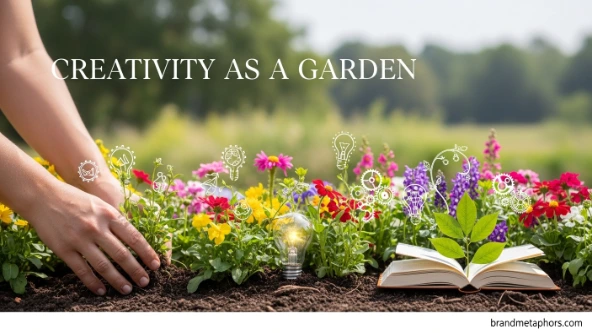
A garden symbolizes growth, patience, and care. Creative ideas often require nurturing before they bloom.
Just as flowers need sunlight and water, ideas need time, effort, and attention.
Example Sentence
“She tended her creative garden every day by sketching and journaling.”
Alternative Expressions
- Planting seeds of imagination
- Cultivating ideas
- Harvesting inspiration
- Growing possibilities
Cultural Connection
Many ancient cultures viewed wisdom and creativity as gardens filled with beauty and abundance.
Emotional Detail
The image of a flourishing garden creates feelings of hope, renewal, and potential.
Creativity as a Flowing River
Meaning and Explanation
A river represents movement and continuous creation. Ideas often flow naturally when we stop forcing them.
Creative thinking is rarely static. It moves, twists, and adapts like water.
Example Sentence
“Once she relaxed, creativity flowed through her like a river.”
Alternative Expressions
- Stream of ideas
- Current of inspiration
- Ocean of imagination
- Waterfall of innovation
Real-Life Example
Many writers report entering a state called “flow” where ideas seem to arrive effortlessly, almost like water finding its path downhill.
Sensory Imagery
Picture the soothing sound of rushing water and its endless motion.
Creativity as a Treasure Chest
Meaning and Explanation
This metaphor suggests that creativity contains hidden riches waiting to be discovered.
Everyone possesses creative treasures, but unlocking them requires curiosity and exploration.
Example Sentence
“His imagination was a treasure chest filled with unexpected gems.”
Alternative Expressions
- Hidden goldmine of ideas
- Vault of inspiration
- Chest of possibilities
- Storehouse of innovation
Storytelling Element
Think of a child opening an old wooden chest in an attic. Each item inside reveals a new adventure. Creativity works the same way.
Emotional Impact
This metaphor creates excitement and anticipation.
Creativity as a Journey
Meaning and Explanation
Creativity is rarely a destination. It is a path filled with discoveries, challenges, and surprises.
Every project becomes an adventure.
Example Sentence
“Writing the novel became a creative journey through unexplored territory.”
Alternative Expressions
- Road of imagination
- Adventure of ideas
- Path of innovation
- Voyage of discovery
Literary Reference
Many classic stories follow heroes on journeys. Creative work often mirrors this pattern.
Sensory Details
Imagine winding roads, distant mountains, and unexplored horizons.
Creativity as a Lighthouse
Meaning and Explanation
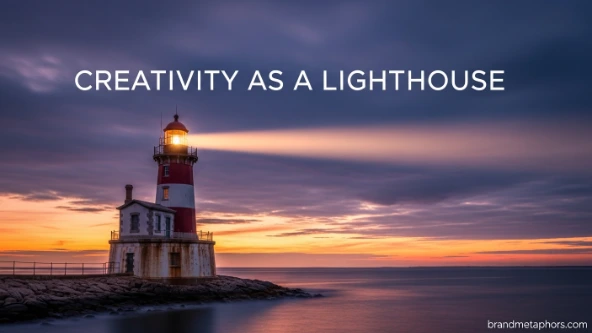
A lighthouse guides ships through darkness. Creativity often helps people navigate problems and uncertainty.
Creative solutions illuminate possibilities that others may overlook.
Example Sentence
“Her creativity became a lighthouse during difficult times.”
Alternative Expressions
- Beacon of inspiration
- Guiding light
- Lamp of innovation
- Torch of imagination
Real-Life Scenario
Businesses often rely on creative thinking to find opportunities during economic challenges.
Emotional Tone
This metaphor conveys hope, guidance, and resilience.
Creativity as a Fountain
Meaning and Explanation
A fountain symbolizes abundance and continuous generation.
Some ideas lead to many more ideas, creating an endless cycle of innovation.
Example Sentence
“His mind was a fountain of creativity.”
Alternative Expressions
- Wellspring of inspiration
- Endless source of ideas
- Creative spring
- Flowing imagination
Sensory Description
Picture sparkling water rising and falling under sunlight.
Literary Appeal
The fountain metaphor adds elegance and richness to descriptions.
Creativity as a Puzzle
Meaning and Explanation
Creative thinking often involves connecting pieces in unexpected ways.
A painter combines colors. A scientist combines facts. A writer combines words.
Each creative act resembles solving a puzzle.
Example Sentence
“She assembled the pieces of creativity until a solution emerged.”
Alternative Expressions
- Connecting the dots
- Building the picture
- Solving the mystery
- Arranging the pieces
Real-Life Example
Many innovations happen when people combine ideas from different fields.
Emotional Element
The puzzle metaphor adds curiosity and excitement.
Creativity as a Tree
Meaning and Explanation
A tree symbolizes strength, growth, and branching possibilities.
One idea can develop into countless related ideas.
Example Sentence
“His creativity grew like a mighty tree with endless branches.”
Alternative Expressions
- Branches of imagination
- Roots of inspiration
- Forest of ideas
- Tree of innovation
Cultural Reference
Trees often symbolize wisdom and life in myths and literature.
Sensory Detail
Imagine leaves rustling in the wind and branches stretching toward the sky.
Creativity as a Magic Key
Meaning and Explanation
A key unlocks doors. Creativity opens opportunities, solutions, and possibilities.
It helps people move beyond limitations.
Example Sentence
“Creativity was the magic key that unlocked her success.”
Alternative Expressions
- Key to innovation
- Door-opener of ideas
- Unlocking potential
- Gateway to imagination
Storytelling Example
In fairy tales, magical keys reveal hidden rooms and secret worlds. Creativity does something similar in real life.
Emotional Impact
This metaphor inspires curiosity, empowerment, and wonder.
Three Practical Tips for Using Metaphors for Creativity
Tip 1: Match the Metaphor to the Mood
Choose warm metaphors like fire or gardens for positive inspiration.
Choose adventurous metaphors like journeys or treasure hunts for exploration.
Tip 2: Use Sensory Language
Add sounds, colors, smells, and textures.
Instead of:
“Creativity came suddenly.”
Write:
“Creativity arrived like a lightning bolt splitting the midnight sky.”
Tip 3: Mix Familiar and Fresh Images
Combine traditional metaphors with unique details.
Example:
“Her creativity was a river carrying silver boats of possibility.”
Interactive Exercises to Practice Creativity Metaphors
Exercise 1: Complete the Sentence
Finish these prompts:
- Creativity is a __________.
- My imagination is a __________.
- Ideas grow like __________.
- Inspiration feels like __________.
Exercise 2: Create Your Own Metaphor
Choose one object:
- Clock
- Mountain
- Rainbow
- Bridge
Explain how creativity resembles that object.
Exercise 3: Daily Observation Challenge
Look around your room and pick three objects.
Ask:
“How could each object represent creativity?”
Write your answers in a notebook.
Bonus Tips for Writers, Bloggers, and Social Media Creators
Use Metaphors in Headlines
Examples:
- Creativity Is a Garden: Learn How to Grow Better Ideas
- The Spark That Ignites Innovation
- Unlocking Creativity’s Hidden Treasure Chest
Add Visual Metaphors to Social Posts
Metaphorical language often attracts attention and engagement.
Example:
“Today my creativity felt like a kite finally catching the wind.”
Use Metaphors in Storytelling
Metaphors create emotional connections and memorable imagery.
Readers often remember vivid images longer than facts.
Build a Personal Metaphor Collection
Keep a notebook of creative metaphors you discover or invent.
Over time, this becomes a valuable resource for writing.
Conclusion
Creativity is one of humanity’s most fascinating abilities. Yet because it is invisible, we often rely on metaphors to understand and describe it. Whether creativity appears as a spark of fire, a flourishing garden, a flowing river, a treasure chest, a journey, a lighthouse, a fountain, a puzzle, a tree, or a magic key, each metaphor reveals a different aspect of the creative process.
These metaphors do more than decorate language. They help us think differently, communicate more effectively, and appreciate the many forms creativity can take. By practicing and creating your own metaphors, you can strengthen both your imagination and your writing.
The next time inspiration arrives, ask yourself: What metaphor best captures this moment? The answer may open a whole new world of possibilities.
FAQs
What are metaphors for creativity?
Metaphors for creativity are figurative comparisons that describe creativity through vivid images such as fire, gardens, rivers, treasure chests, and journeys.
Why are metaphors useful when discussing creativity?
Metaphors make abstract ideas easier to understand, remember, and communicate. They also make writing more engaging and expressive.
What is the most common metaphor for creativity?
One of the most common metaphors is a spark of fire because creativity often begins with a small idea that grows into something significant.
How can writers use creativity metaphors effectively?
Writers can use metaphors to create vivid imagery, strengthen emotional impact, and help readers visualize abstract concepts.
Can metaphors improve creative thinking?
Yes. Metaphors encourage people to view ideas from different perspectives, often leading to new insights and innovative solutions.