
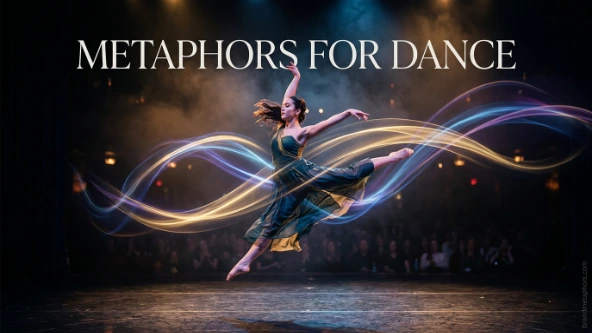
The music begins with a soft whisper. A foot taps the floor. A body sways. Suddenly, the room transforms into a world of motion. Every turn tells a story. Every leap carries emotion. Dance is more than movement. It is a language without words.
Throughout history, people have used dance to celebrate, grieve, worship, and connect. Yet describing dance can be challenging. How do you capture the magic of movement in words? This is where metaphors become powerful tools.
Metaphors for dance help writers, speakers, teachers, and artists paint vivid pictures. They turn ordinary descriptions into memorable images. Instead of saying someone danced gracefully, you might say they were “a feather floating on the wind.” The image instantly creates emotion and meaning.
In this article, you will discover creative metaphors for dance, learn how to use them effectively, explore examples, and practice crafting your own. Whether you are a writer, student, dancer, or creative thinker, these ideas can help your words move as beautifully as a dance itself.
Why Metaphors for Dance Matter
Turning Movement into Imagery
Dance is visual and emotional. Metaphors translate movement into images readers can easily understand.
Instead of describing every step, a metaphor captures the feeling behind the movement.
Example:
“Dance was a river flowing through the room.”
The reader immediately senses fluidity and motion.
Creating Emotional Connection
Strong metaphors help readers feel what dancers feel.
They communicate joy, freedom, passion, struggle, and elegance more effectively than literal descriptions.
Making Writing More Memorable
People remember vivid images. A powerful metaphor stays in the mind long after the sentence is read.
Dance as a River
Meaning and Explanation
One of the most popular metaphors for dance compares it to a river.
A river moves continuously. It bends, twists, rushes, and slows. Dance often follows a similar path.
The metaphor emphasizes flow, grace, and natural movement.
Example Sentence
“She danced like a river winding through a quiet valley.”
Alternative Expressions
- Dance is a flowing stream.
- Dance is an endless current.
- Dance is water finding its path.
Sensory Details
Imagine cool water gliding over smooth stones. The movement feels effortless and calm.
Mini Story
A ballet dancer practiced for years to make difficult moves appear easy. Watching her perform felt like watching a river. There was strength beneath the surface, yet everything seemed natural.
Dance as a Conversation
Meaning and Explanation
Dance often resembles a conversation between partners, musicians, and emotions.
Every movement becomes a response to another movement.
Example Sentence
“Their dance was a conversation spoken through footsteps.”
Alternative Expressions
- Dance is silent dialogue.
- Dance is a language of motion.
- Dance is a wordless discussion.
Real-Life Example
In ballroom dancing, partners constantly communicate through subtle signals. A shift of weight or gentle touch can guide an entire routine.
Emotional Impact
This metaphor highlights connection, understanding, and teamwork.
Dance as a Flame
Meaning and Explanation
A flame flickers, leaps, and glows with energy. Many dances share these qualities.
This metaphor is perfect for passionate performances.
Example Sentence
“His dance was a flame blazing across the stage.”
Alternative Expressions
- Dance is a spark of life.
- Dance is a burning ember.
- Dance is a wildfire of emotion.
Sensory Details
Picture bright colors, warmth, and quick bursts of movement.
Literary Connection
Many poets have compared human passion to fire. Using the same image for dance adds intensity and excitement.
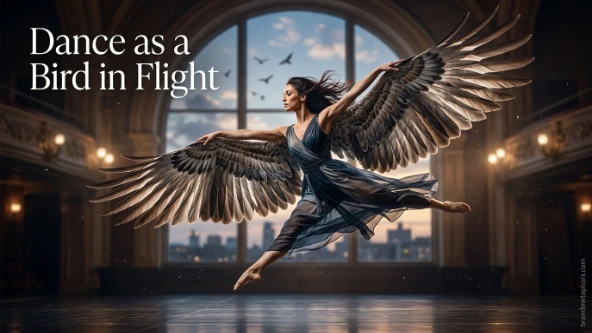
Dance as a Bird in Flight
Meaning and Explanation
Birds symbolize freedom, beauty, and effortless movement.
When dancers leap or spin, they often appear to leave gravity behind.
Example Sentence
“She was a bird soaring above invisible skies.”
Alternative Expressions
- Dance is wings unfolding.
- Dance is flight without feathers.
- Dance is freedom in motion.
Mini Story
During a contemporary performance, a dancer leaped across the stage. The audience held its breath. For a moment, she seemed suspended in the air like an eagle riding the wind.
Emotional Effect
This metaphor creates feelings of freedom and possibility.
Dance as Poetry
Meaning and Explanation
Poetry uses rhythm, emotion, and structure. Dance does the same through movement.
Both art forms tell stories and express feelings.
Example Sentence
“Every step was a line in a living poem.”
Alternative Expressions
- Dance is poetry in motion.
- Dance is a moving verse.
- Dance is rhythm made visible.
Cultural Reference
The phrase “poetry in motion” has been used for decades to describe beautiful movement in sports, art, and dance.
Why It Works
This metaphor highlights creativity and artistic expression.
Dance as a Storm
Meaning and Explanation
Some dances are powerful, dramatic, and unpredictable.
A storm metaphor emphasizes energy and force.
Example Sentence
“The dancers became a storm sweeping across the stage.”
Alternative Expressions
- Dance is thunder in motion.
- Dance is a whirlwind of feeling.
- Dance is a gathering tempest.
Sensory Details
Imagine crashing waves, roaring wind, and flashes of lightning.
Emotional Impact
This metaphor works especially well for intense performances.
Dance as a Journey
Meaning and Explanation
Every dance has a beginning, middle, and end.
Like a journey, it takes participants and audiences somewhere new.
Example Sentence
“The performance was a journey through joy and sorrow.”
Alternative Expressions
- Dance is a path of discovery.
- Dance is a road of expression.
- Dance is an adventure of movement.
Real-Life Application
Choreographers often build routines that tell stories, making the journey metaphor especially fitting.
Emotional Resonance
The audience travels emotionally alongside the dancer.
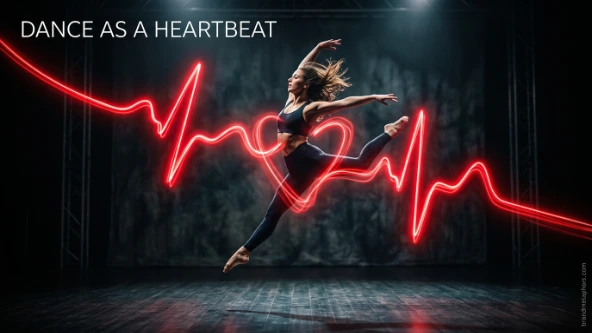
Dance as a Heartbeat
Meaning and Explanation
Music and dance rely on rhythm. The heartbeat naturally symbolizes rhythm and life.
Example Sentence
“The dance was the heartbeat of the celebration.”
Alternative Expressions
- Dance is life’s pulse.
- Dance is rhythm made visible.
- Dance is the drum inside the soul.
Cultural Example
Many traditional dances are connected to drums and communal rhythms, reinforcing the heartbeat imagery.
Sensory Experience
Imagine feeling vibrations through the floor as dancers move together.
Dance as a Garden
Meaning and Explanation
A garden grows, blooms, and changes over time.
Dance skills develop similarly through practice and care.
Example Sentence
“Her dance blossomed like a garden in spring.”
Alternative Expressions
- Dance is a blooming flower.
- Dance is a field of possibilities.
- Dance is a growing vine.
Mini Story
A beginner dancer struggled with simple steps. Months later, confidence blossomed. Like a garden, growth happened little by little.
Emotional Message
This metaphor emphasizes patience and development.
Dance as a Dream
Meaning and Explanation
Dreams often feel magical and limitless.
Dance can create the same sense of wonder.
Example Sentence
“The performance unfolded like a dream beneath moonlight.”
Alternative Expressions
- Dance is a waking dream.
- Dance is imagination in motion.
- Dance is a fantasy brought to life.
Sensory Details
Think of soft lights, floating movements, and a sense of mystery.
Why Readers Love It
Dream imagery creates beauty and enchantment.
How to Create Your Own Metaphors for Dance
Observe Movement Carefully
Watch how dancers move.
Ask yourself:
- Does the movement resemble water?
- Does it look like fire?
- Does it remind you of nature?
Focus on Emotion
Think about what the dance makes you feel.
A joyful dance may become sunshine.
A dramatic dance may become a storm.
Use the Five Senses
Consider:
- What does the dance look like?
- What sounds accompany it?
- What emotions arise?
Sensory details strengthen metaphors.
Keep It Original
Instead of repeating common metaphors, create fresh comparisons.
Example:
“Dance was a constellation rearranging itself across the stage.”
Unique imagery captures attention.
Interactive Exercises for Practicing Dance Metaphors
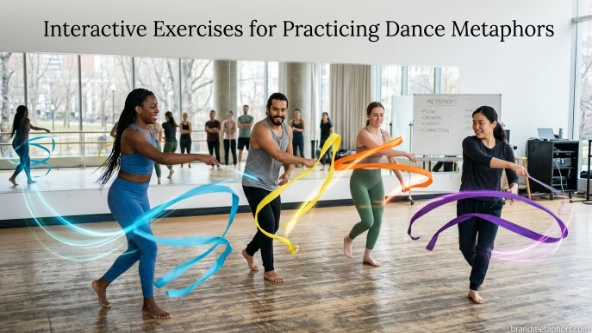
Exercise 1: Complete the Sentence
Finish these statements:
- Dance is a __________.
- Dance moves like a __________.
- The dancer became a __________.
Write at least five answers.
Exercise 2: Nature Challenge
Compare dance to:
- A mountain
- A waterfall
- A cloud
- A tree
- The ocean
Explain why each comparison works.
Exercise 3: Emotion Mapping
Choose one emotion:
- Joy
- Anger
- Hope
- Love
- Fear
Create a dance metaphor based on that feeling.
Example:
“Joy is a kite dancing in a bright summer sky.”
Exercise 4: Story Building
Write a short paragraph using three different dance metaphors in one scene.
This helps develop creativity and imagery.
Bonus Tips for Using Dance Metaphors in Writing and Social Media
For Creative Writing
Use metaphors to reveal character emotions and deepen scenes.
For Poetry
Combine rhythm and metaphor to create memorable lines.
For Social Media Captions
Examples:
- “Dancing through life like a river finding its way.”
- “Today my soul became a bird in flight.”
- “Every step is poetry written on the floor.”
For Speeches and Presentations
Metaphors make ideas more engaging and easier to remember.
For Everyday Conversations
Creative language adds color and personality to communication.
Frequently Asked Questions
What is a metaphor for dance?
A metaphor for dance is a figure of speech that compares dance to another object, idea, or experience without using “like” or “as.” It helps create vivid imagery and deeper meaning.
Why are metaphors useful when describing dance?
Metaphors transform physical movement into emotional and visual experiences that readers can easily imagine and remember.
What are common metaphors for dance?
Popular metaphors include dance as a river, flame, conversation, bird in flight, poem, journey, heartbeat, garden, storm, and dream.
Can dance metaphors improve creative writing?
Yes. They add imagery, emotion, depth, and originality, making descriptions more engaging and memorable.
How can I create my own dance metaphors?
Observe movement carefully, focus on emotions, use sensory details, and connect dance to nature, objects, experiences, or feelings that share similar qualities.
Conclusion
Dance is one of humanity’s oldest and most expressive art forms. Yet movement alone does not always capture its full beauty in words. Metaphors bridge that gap. They transform steps into rivers, spins into storms, leaps into flights, and performances into dreams.
Whether you see dance as a flame of passion, a conversation of souls, or a journey of self-discovery, metaphors allow you to express its magic with greater depth and imagination. They enrich stories, poems, social media posts, speeches, and everyday conversations.
The next time you watch a dancer glide across a stage or sway to music, look beyond the movement. Ask yourself what image comes to mind. You may discover that dance is not merely motion—it is a river, a bird, a heartbeat, a poem, or perhaps something entirely your own. That is the true beauty of metaphor: it invites us to see familiar things in extraordinary ways.