
Introduction: When “Lost” Feels Like a Landscape, Not a Word
There are moments when being lost is not just a directionless state—it becomes a whole landscape. Imagine standing in a fog-drenched city where streetlights blur into halos, or walking through a forest where every tree looks familiar yet none feels like home. Even silence begins to feel heavy, as if it has weight.
We often think of “lost” as simply not knowing where we are. But in language and literature, lost becomes something far richer: a metaphor for confusion, emotional distance, identity crises, heartbreak, or even transformation. Writers, poets, and storytellers use metaphors for lost not just to describe disorientation, but to give shape to invisible emotions.
Understanding these metaphors is powerful. It helps readers express feelings they cannot easily name. It helps writers create emotional depth. And in everyday life, it gives us language for moments when we feel untethered from ourselves or the world around us.
This article explores metaphors for “lost,” weaving through imagery, storytelling, and creative exercises so you can use them in writing, speech, or reflection.
1. Lost as a Ship Without a Compass: Navigating Emotional Seas
Meaning and Explanation
One of the most classic metaphors for being lost is a ship without a compass. It represents a person drifting through life or emotions without guidance, clarity, or direction.
Emotional Depth
This metaphor often appears in literature about heartbreak, grief, or life transitions. It evokes isolation, vastness, and vulnerability—like being surrounded by endless water with no shore in sight.
Example Sentence or Scenario
“She felt like a ship without a compass, drifting through each day without knowing where she would eventually land.”
Alternative Expressions
- A sailboat caught in aimless tides
- A vessel adrift in silent waters
- A navigator without stars
Sensory Imagery
Cold salt air. Endless gray horizons. The creak of wood under unseen currents.
Mini Storytelling
In maritime folklore, sailors once believed that losing sight of the North Star meant losing not just direction but fate itself. A ship without guidance was not just lost—it was surrendered to the sea’s will.
Interactive Prompt
Write a paragraph describing your current emotional state using a sea-based metaphor. What kind of ocean are you in?
2. Lost as a Forest Without Trails: The Maze of Choices
Meaning and Explanation
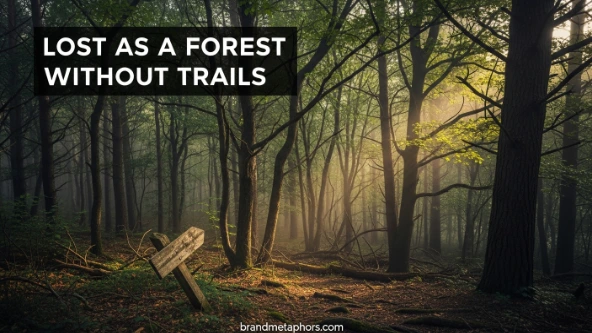
A forest without trails symbolizes confusion in decision-making or identity. Every direction looks similar, and certainty disappears.
Emotional Depth
This metaphor captures moments when life feels overwhelming—too many choices, too many unknowns.
Example Sentence or Scenario
“He wandered through the situation like someone in a forest without trails, each decision disappearing into thicker uncertainty.”
Alternative Expressions
- A jungle of unanswered questions
- A woodland with no marked path
- A maze of green silence
Sensory Imagery
Damp earth underfoot. Whispering leaves. Light fractured through dense branches.
Cultural Reference
Fairy tales often use enchanted forests to represent moral confusion—think of characters who must “lose themselves” before they find truth.
Mini Exercise
List three decisions you’re currently unsure about. Now describe them as “paths in a forest.” What does each path feel like?
3. Lost as a Broken Compass: When Inner Direction Fails
Meaning and Explanation
A broken compass symbolizes internal confusion rather than external circumstances. The problem is not the world—it is the inability to interpret it.
Emotional Depth
This metaphor often relates to identity crises, self-doubt, or emotional burnout.
Example Sentence or Scenario
“After everything changed, his instincts felt like a broken compass spinning without purpose.”
Alternative Expressions
- A faulty inner map
- A directionless needle
- An uncalibrated heart
Sensory Imagery
A spinning needle. Static silence. A feeling of being mentally untethered.
Mini Storytelling
In survival stories, a broken compass often marks the turning point where characters must rely on intuition rather than tools—transforming confusion into self-trust.
Interactive Prompt
When have you ignored your “inner compass”? Write a short reflection on how it felt.
4. Lost as a Falling Leaf: Drifting Through Change
Meaning and Explanation
A falling leaf represents surrender to forces beyond control—wind, time, and change.
Emotional Depth
This metaphor is gentle rather than chaotic. It reflects acceptance, transition, and vulnerability.
Example Sentence or Scenario
“She felt like a falling leaf, no longer anchored to the branches of her old life.”
Alternative Expressions
- A leaf carried by autumn wind
- A drifting petal in slow descent
- A feather in seasonal air
Sensory Imagery
Crackling branches. Soft rustling air. The slow spin of descent.
Mini Storytelling
In Japanese haiku tradition, falling leaves often symbolize impermanence—beauty that exists precisely because it cannot stay.
Creative Exercise
Write five short lines describing your life as a seasonal transition. Are you in spring, summer, autumn, or winter?
5. Lost as a City Without Street Signs: Modern Disorientation
Meaning and Explanation
This metaphor reflects confusion in complex environments—urban life, digital overload, or social pressure.
Emotional Depth
It represents overwhelm in modern life where everything exists but nothing feels navigable.
Example Sentence or Scenario
“The new job felt like a city without street signs—loud, fast, and impossible to decode.”
Alternative Expressions
- A metropolis without maps
- A skyline of unreadable signals
- A digital maze without labels
Sensory Imagery
Neon lights. Crowded sidewalks. Notifications overlapping like noise.
Mini Exercise
Describe your daily routine as a “city journey.” Where do you feel lost or overwhelmed?
6. Lost as a Shadow Without a Source: Identity Dissolution
Meaning and Explanation
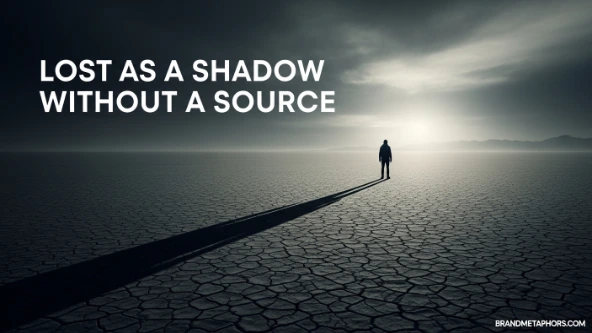
A shadow without a source suggests losing connection to identity or self-understanding.
Emotional Depth
This metaphor is deeply psychological, often used in existential reflection.
Example Sentence or Scenario
“He moved through life like a shadow without a source, present but undefined.”
Alternative Expressions
- A reflection without a mirror
- A silhouette without light
- An outline without substance
Sensory Imagery
Dim light. Empty echoes. A sense of invisibility.
Mini Storytelling
In philosophy, shadows often symbolize perception versus reality—what we think we are versus what we truly are.
Reflection Prompt
What makes you feel most “like yourself”? Write it down as a source of light for your shadow.
7. Lost as a Language You Cannot Speak: Emotional Disconnect
Meaning and Explanation
This metaphor describes inability to express feelings or communicate inner experiences.
Emotional Depth
It highlights isolation, misunderstanding, or emotional silence.
Example Sentence or Scenario
“Grief made her feel like she was trapped inside a language she could not speak.”
Alternative Expressions
- Words behind locked doors
- Silence written in foreign script
- A voice untranslated
Sensory Imagery
Muted sounds. Lips forming unheard words. Heavy pauses.
Interactive Exercise
Write one emotion you struggle to express. Now describe it as if it were a foreign language.
8. Lost as a Clock Without Hands: Frozen Time
Meaning and Explanation
A clock without hands symbolizes stagnation—time passing without meaning or progress.
Emotional Depth
This metaphor is often used in grief, depression, or waiting periods in life.
Example Sentence or Scenario
“After the loss, every day felt like a clock without hands.”
Alternative Expressions
- Time standing still
- A frozen hourglass
- Moments without movement
Sensory Imagery
Silent rooms. Dust gathering. Light unchanged across hours.
Mini Exercise
Think of a time in your life that felt “paused.” Describe it as a broken timepiece.
9. Lost as a Song Without Melody: Emotional Incompletion
Meaning and Explanation
This metaphor reflects emotional emptiness or lack of purpose.
Emotional Depth
It suggests something essential is missing, even if everything else is intact.
Example Sentence or Scenario
“His routine continued, but it felt like a song without melody.”
Alternative Expressions
- A rhythm without music
- A chorus without harmony
- A tune missing its soul
Sensory Imagery
Muted instruments. Empty echoes of sound. Half-finished notes.
Creative Prompt
What “melody” is missing in your life right now? Write a paragraph imagining its return.
10. Finding Meaning in Being Lost: Transformation Through Disorientation
Meaning and Explanation
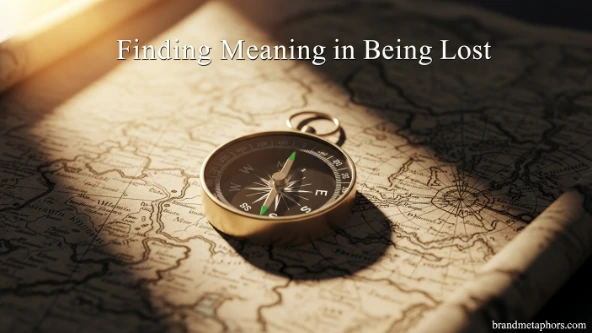
Being lost is not always negative. It can be a phase of transformation, discovery, or reinvention.
Emotional Depth
This metaphor reframes loss of direction as a necessary step toward growth.
Example Sentence or Scenario
“Sometimes being lost is just the beginning of finding a truer path.”
Alternative Expressions
- A pause before direction
- A blank map waiting to be drawn
- A detour toward clarity
Mini Storytelling
Many explorers, artists, and thinkers describe their greatest breakthroughs as moments of being “lost” before insight arrived.
Interactive Reflection
Write about a time you felt lost—but later realized it led you somewhere important.
Conclusion
Metaphors for being lost do more than describe confusion—they transform it into something visible, relatable, and even beautiful. Whether it is a ship drifting in silence, a forest without trails, or a clock without hands, each metaphor gives shape to experiences that are otherwise difficult to express.
And perhaps the most important truth is this: being lost is not always an ending. Sometimes it is a threshold, a quiet pause before a new direction appears.
When we learn to speak in metaphors, we don’t just describe being lost—we learn how to understand it, survive it, and eventually move through it.
FAQs
What are metaphors for being lost used for?
They help express emotional confusion, identity struggles, or uncertainty in a vivid and relatable way.
Why are metaphors important in describing “lost” feelings?
They turn abstract emotions into imagery, making them easier to understand and communicate.
Can being lost be a positive metaphor?
Yes, it can represent transformation, discovery, and personal growth.
How can I use these metaphors in writing?
Use them in storytelling, poetry, journaling, or even social media captions to add emotional depth.
What is the most powerful metaphor for being lost?
It depends on context, but “a ship without a compass” and “a forest without trails” are among the most commonly used.