
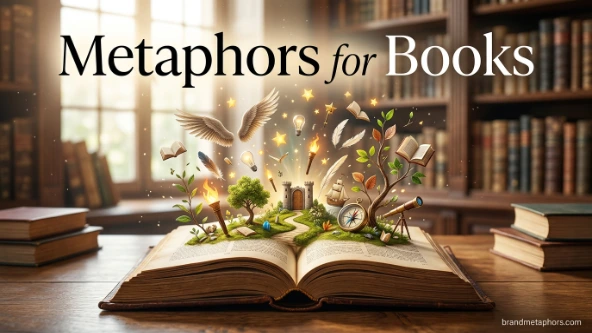
Introduction: When a Book Feels Like a Living Thing
There is a particular silence that only books can create. Not an empty silence, but a full one—the kind that hums softly when your fingers brush against a page, when the paper smells faintly of ink and time, and when the world outside fades into something distant and unimportant. In that moment, a book is no longer just an object. It becomes a doorway, a companion, sometimes even a mirror reflecting thoughts you didn’t know you had.
We often say “I’m reading a book,” but what we really experience is far richer. A book can feel like a voyage across oceans, a fire in the dark, or a garden growing quietly in the mind. This is where metaphors for books become powerful. They help us express the invisible experience of reading—the emotions, transformations, and discoveries that happen between the lines.
Understanding and using metaphors for books is not just a literary exercise. It sharpens creative writing, deepens emotional expression, and helps us communicate why stories matter. Whether you are a writer, student, teacher, or casual reader, these comparisons can change how you see reading itself—not as an activity, but as an experience of becoming.
Let’s step into that world where books are more than pages—they are places, forces, and living companions.
Books as Doors to Other Worlds: Metaphors for Escape and Discovery
One of the most timeless metaphors for books is that they are doors. A door suggests transition—moving from one reality into another.
A book, in this sense, is not static. It is a threshold. One moment you are sitting in a quiet room; the next, you are walking through medieval streets, floating in space, or standing inside someone else’s memory.
Meaning & Explanation: This metaphor highlights the escapist and immersive nature of reading. Books transport readers beyond physical boundaries.
Example Sentence: “Every time she opened a novel, it felt like unlocking a hidden door into a life she had never lived before.”
Alternative Expressions:
- Books are gateways to imagination
- Books are portals to other lives
- Books are passageways through time and space
Sensory & Emotional Detail: Imagine the faint creak of a door opening—not in a house, but in the mind. A rush of air that smells like rain in a distant city or dust from an ancient library. That is what reading feels like when books become doors.
Mini Storytelling Moment: A child in a small village reads about the ocean for the first time. She has never seen the sea, but through the book, she feels salt on her lips and hears waves crashing in her imagination. The book becomes her first doorway to a world she has yet to visit.
Books as Companions: Metaphors for Solitude and Connection
Books are often described as friends, and this metaphor is deeply human. Unlike objects, companions imply presence, comfort, and understanding.
A book waits for you. This does not interrupt. It does not judge. It simply exists, ready to continue where you left off.
Meaning & Explanation: This metaphor emphasizes emotional support and personal connection in reading.
Example Sentence: “In lonely evenings, books became her quiet companions, speaking without words but never without meaning.”
Alternative Expressions:
- Books are silent friends
- Books are lifelong companions
- Books are patient listeners
Sensory & Emotional Detail: Think of sitting near a window during a rainy night. The world outside is blurred, but a book beside you feels steady, almost warm, like a presence rather than an object.
Cultural Reference: Many writers, including Virginia Woolf, often spoke about reading as a private conversation between the reader and the author—an invisible companionship across time.
Interactive Reflection Prompt: Think about a book that stayed with you emotionally. What kind of “friend” was it—comforting, challenging, inspiring, or honest?
Books as Seeds of Thought: Metaphors for Growth and Transformation
Books can also be seen as seeds planted in the soil of the mind. This metaphor reflects how reading does not end when the book closes—it begins something that grows later.
A single idea in a book can expand into reflection, change beliefs, or even reshape identity over time.
Meaning & Explanation: Books initiate intellectual and emotional growth, often in subtle and long-term ways.
Example Sentence: “That philosophy book was a small seed that slowly grew into a forest of new questions in his mind.”
Alternative Expressions:
- Books plant ideas in the mind
- Books grow thoughts within us
- Books cultivate inner landscapes
Sensory & Emotional Detail: Picture soil after rain—dark, rich, waiting. A book drops into the mind like a seed, and even days later, something unseen begins to sprout.
Mini Storytelling Moment: A university student reads a short essay on kindness. At first, it feels ordinary. Weeks later, she notices herself pausing before speaking harshly, choosing gentler words instead. The book never told her what to do—it simply planted something that grew on its own.
Interactive Exercise: Write down one idea from a book you recently read. Now imagine it as a seed. What kind of “plant” might it grow into in your thoughts or behavior?
Books as Mirrors: Metaphors for Self-Reflection
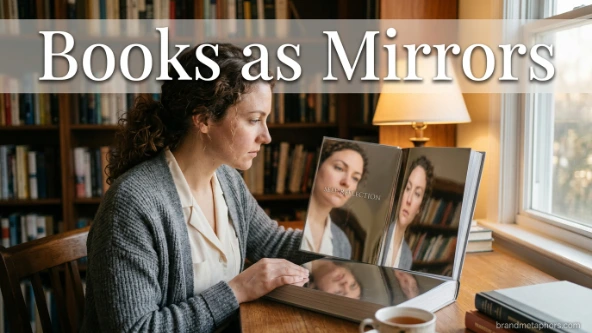
Books are not only windows into other worlds—they are also mirrors reflecting our own. When we read, we often find ourselves in the characters, situations, or emotions on the page.
Meaning & Explanation: This metaphor emphasizes self-awareness and emotional recognition through reading.
Example Sentence: “The novel felt like a mirror, revealing parts of himself he had never spoken aloud.”
Alternative Expressions:
- Books reflect the self
- Books show hidden versions of us
- Books are emotional mirrors
Sensory & Emotional Detail: Unlike a physical mirror, this one reflects feelings rather than appearance. You might not see your face, but you recognize your fears, hopes, and contradictions staring back at you.
Literary Reference: Many modern novels, especially psychological fiction, use characters as mirrors for readers’ inner conflicts—showing that storytelling often returns us to ourselves.
Interactive Prompt: After reading a story, ask: Which character felt most familiar to me, and why?
Books as Time Machines: Metaphors for Memory and History
Books allow us to travel across centuries, cultures, and forgotten moments. In this way, they function like time machines.
Meaning & Explanation: Books preserve and transmit knowledge, allowing readers to experience past and future imaginatively.
Example Sentence: “That history book was a time machine, carrying her into battles, revolutions, and forgotten voices.”
Alternative Expressions:
- Books travel through time
- Books preserve moments
- Books carry the past forward
Sensory & Emotional Detail: Imagine dust rising from ancient pages, voices from centuries ago echoing faintly through the text. Reading becomes a journey backward and forward simultaneously.
Mini Storytelling Moment: A teenager reads letters from World War II soldiers. Suddenly, history is no longer a chapter in a textbook—it is a lived experience of fear, hope, and humanity.
Books as Fire: Metaphors for Passion and Intensity
Books can ignite something within us. They can disturb, inspire, and awaken strong emotions—like fire.
Meaning & Explanation: This metaphor captures the transformative emotional impact of powerful literature.
Example Sentence: “That rebellious novel lit a fire in her thoughts she could not easily extinguish.”
Alternative Expressions:
- Books ignite imagination
- Books burn with ideas
- Books spark emotional change
Sensory & Emotional Detail: Warmth spreading through the chest, a sudden rush of urgency—that is how a powerful book feels when it changes your perspective instantly.
Interactive Exercise: Recall a book that changed your opinion or emotion strongly. Describe it as a “fire.” Was it a spark, a blaze, or a slow burn?
How to Use Book Metaphors in Creative Writing and Daily Life
Metaphors are not just decorative language—they shape how we think and communicate.
In Writing: Use book metaphors to make descriptions more vivid. Instead of saying “I enjoyed the book,” you might write, “The book opened a door I didn’t want to close.”
In Social Media: Short metaphor-based captions are powerful:
- “This book was a quiet storm in my thoughts.”
- “A doorway I didn’t know I needed.”
In Daily Conversation: Metaphors help express reading experiences more emotionally and clearly.
Bonus Tip: Avoid overusing one metaphor. Mix them—books can be doors in one context and seeds in another, depending on the experience you want to describe.
Interactive Writing Practice: Create Your Own Book Metaphor
Try this simple exercise:
- Think of your favorite book.
- Choose a category: object, place, weather, or emotion.
- Complete the sentence: “This book is like a ______ because ______.”
Example: “This book is like a lighthouse because it guided me through confusing thoughts.”
This practice strengthens creativity and helps you develop your personal voice in writing.
Why Book Metaphors Matter in Modern Reading Culture
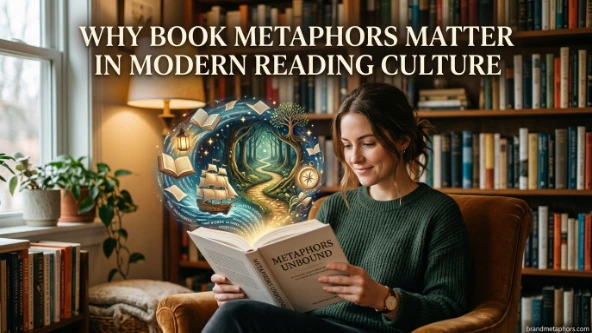
In a fast-paced digital world, metaphors remind us that reading is not mechanical—it is deeply human. Books are not just content; they are experiences shaped by emotion, memory, and imagination.
When we describe books as doors, seeds, fires, or mirrors, we are not just being poetic—we are acknowledging the emotional architecture of reading itself.
Conclusion
A book is never just paper and ink. It is a doorway that opens quietly, a companion that waits patiently, a seed that grows silently, a mirror that reflects truth, a fire that transforms thought, and a time machine that bends memory.
Metaphors allow us to say what reading truly feels like when literal language falls short. They remind us that every book we open is not just something we read—but something that, in subtle ways, reads us back.
So the next time you pick up a book, pause for a moment. Ask yourself not only what it says—but what it becomes in your mind.
FAQs: Metaphors for Books
1. What are metaphors for books?
Metaphors for books are figurative comparisons that describe books as something else, like doors, seeds, or companions, to express their deeper meaning.
2. Why are metaphors used to describe books?
They help express emotional and imaginative experiences of reading that literal language cannot fully capture.
3. What is the most common metaphor for books?
One of the most common is “books are doors,” symbolizing escape and discovery.
4. How can I use book metaphors in writing?
You can use them in essays, stories, captions, or reflections to make descriptions more vivid and expressive.
5. Can books have multiple metaphors at once?
Yes, a single book can be a mirror, a fire, and a seed depending on how it affects the reader.