

Introduction (The Quiet Strength We Often Overlook)
In a quiet kitchen before sunrise, a mother moves softly between stove and sink. The world outside is still asleep, but inside this small space, life is already being prepared. A warm meal, a folded uniform, a gentle reminder whispered before the day begins—these moments often go unnoticed, yet they hold the shape of a lifetime.
Have you ever wondered why people struggle to describe a mother fully? Words often fall short, so we turn to metaphors for mother—because she is not just one thing. She is comfort and discipline, silence and voice, strength and softness all at once. Metaphors help us understand what everyday language cannot fully hold.
In real life, we feel a mother more than we explain her. She is the first home we ever know and often the emotional center we return to. This article explores different metaphors for mother, each revealing a layer of her meaning in human life. Through simple images and real-life reflections, we can better understand her role not just in families, but in shaping who we become.
Mother as a Shelter in Life’s Storm
One of the most common metaphors for mother is a shelter. This image captures her role as a place of safety during emotional and physical storms. When life becomes difficult, people often instinctively turn to their mothers for comfort.
A shelter does not stop the rain, but it protects you while it falls. In the same way, a mother may not remove every problem, but she creates a space where pain feels lighter. A child returning home after failure often finds not judgment, but calm understanding.
Real-Life Reflection
A student who fails an exam may feel the world is collapsing. Yet, a mother often responds with simple words: “Try again, I am here.” That moment becomes emotional shelter.
This metaphor teaches us that safety is not always about solving problems. Sometimes, it is about presence, patience, and emotional warmth that allows healing to begin.
Mother as Light in Darkness
Another powerful image is mother as light. Light represents guidance, clarity, and hope in confusion. Many people recall their mother’s advice during uncertain moments as something that “lit the way.”
When a child feels lost, a mother often provides direction through simple truths. She may not use complex explanations, but her words carry clarity.
Emotional Meaning
Light does not force the path; it reveals it. Similarly, a mother’s influence is gentle but powerful. Her guidance helps shape decisions even when she is not physically present.
In adulthood, people often realize that many of their values—honesty, kindness, patience—were first “lit” by their mother’s behavior. This metaphor shows how deeply her presence continues to guide life choices long after childhood.
Mother as the First Teacher of Life
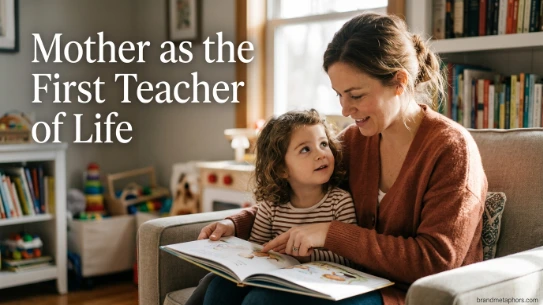
Before schools and books, there is a mother. She is often the first teacher, introducing language, behavior, and emotional understanding.
What She Teaches Without Formal Lessons
- How to speak and listen
- How to care for others
- How to express emotions
- How to understand right and wrong
A mother does not always teach through structured lessons. Instead, she teaches through daily life. A child watching her patience learns patience. A child observing kindness learns empathy.
Real-Life Scene
A toddler repeating words while the mother smiles and corrects gently shows how learning begins in love, not pressure.
This metaphor highlights that education is not only academic. The earliest and deepest form of learning happens through emotional connection, and a mother is often its first source.
Mother as Emotional Anchor
An anchor keeps a ship steady even when the sea is rough. In the same way, a mother often serves as an emotional anchor for the family.
When stress, conflict, or uncertainty rises, her presence helps stabilize emotions. She may not always speak loudly, but her calmness creates balance.
Everyday Example
During family disagreements, a mother often steps in quietly, not to dominate but to restore peace. Her presence alone can reduce tension.
This metaphor shows emotional strength that is not aggressive. Instead, it is steady, grounded, and reliable. Even when life feels uncertain, knowing that someone remains constant brings deep comfort.
Mother as a Garden That Nurtures Growth
A garden requires care, patience, and constant attention. Similarly, a mother nurtures growth in children over time.
She waters habits, removes emotional weeds like fear or doubt, and protects young growth from harm.
H3: The Process of Nurturing
- Encouragement during failure
- Discipline when needed
- Emotional support during change
H3: Long-Term Impact
Just like a garden reflects years of care, a child’s personality often reflects years of maternal nurturing. Confidence, kindness, and resilience often grow from this steady care.
This metaphor reminds us that growth is not instant. It is shaped slowly, often quietly, through daily effort and love.
Mother as a Natural Healer
A mother often becomes a healer in both physical and emotional pain. A child’s tears often stop with her presence, even before any medicine is given.
Healing here is not only about curing illness. It includes emotional recovery from fear, sadness, or loneliness.
Real-Life Scene
A child with a fever feels better simply by being held and comforted by their mother. The pain may remain, but fear decreases.
This metaphor shows that healing begins with emotional safety. A mother’s touch, voice, or presence often becomes the first step toward recovery.
Mother as a Bridge Between Generations

A bridge connects two sides that might otherwise remain separate. A mother often connects generations—past traditions and future possibilities.
She passes values from her parents to her children while also adapting to new times.
H3: Cultural Connection
- Old traditions preserved in daily habits
- Family values passed through stories
- Adaptation to modern life while respecting roots
This role is often invisible but powerful. Without this bridge, cultural memory may weaken over time.
The metaphor shows that a mother is not only part of a family’s present but also a carrier of its history and future.
Mother as a Storyteller of Identity
Many people first learn about the world through stories told by their mothers. These stories may be simple, but they shape imagination and identity.
H3: Types of Stories Mothers Tell
- Moral stories before sleep
- Family history and memories
- Personal life lessons
- Cultural tales and beliefs
Through storytelling, a mother builds a child’s understanding of right, wrong, and meaning in life.
These stories often stay in memory far longer than expected, shaping decisions and beliefs even in adulthood. This metaphor highlights how identity is built not just through experience, but through shared narratives.
Mother as Timekeeper of Daily Life
A mother often becomes the quiet timekeeper of the household. She remembers schedules, routines, and important moments that keep life organized.
From waking children for school to remembering birthdays and responsibilities, she helps structure time.
Real-Life Insight
When she is absent, families often realize how many small things she managed silently.
This metaphor reflects discipline and order. It shows how much invisible effort is required to maintain balance in daily life. Her presence often gives rhythm to the household.
Mother as Safe Home, Not Just a Place

Home is not just walls and rooms. Often, it is a person. For many, a mother becomes that sense of home.
Even far away, her voice or memory can bring comfort.
Emotional Meaning
- Feeling of belonging
- Sense of acceptance
- Emotional return point in life
This metaphor shows that “home” is emotional, not only physical. A mother often becomes the place where identity feels accepted and understood.
Misunderstandings About Motherhood in Modern Life
While metaphors for mother are beautiful, they can also create unrealistic expectations. Society sometimes assumes a mother must always be strong, patient, and selfless.
Common Misunderstandings
- Mothers must never feel tired
- Mothers should always know what to do
- Emotional needs of mothers are less important
These ideas can create pressure. In reality, mothers are human too, with emotions, limits, and needs.
A Balanced Understanding
Modern life encourages a more realistic view: mothers give love, but they also need support, rest, and respect. Understanding this balance helps make the metaphor more humane and fair.
Conclusion
Metaphors for mother help us understand something that is deeply felt but not easily explained. She is shelter, light, teacher, anchor, garden, healer, bridge, storyteller, timekeeper, and home—all at once.
Each metaphor reveals a different layer of her presence in human life. Together, they show that motherhood is not a single role but a collection of emotional, practical, and spiritual meanings.
In everyday life, we may not always notice these layers, but they shape who we are in powerful ways. A mother’s influence often becomes visible only when we reflect back on our journey.
In the end, these metaphors are not just poetic ideas. They are reminders of gratitude, awareness, and understanding. They invite us to see motherhood not as ordinary, but as one of the deepest human experiences shaping love, identity, and life itself.