
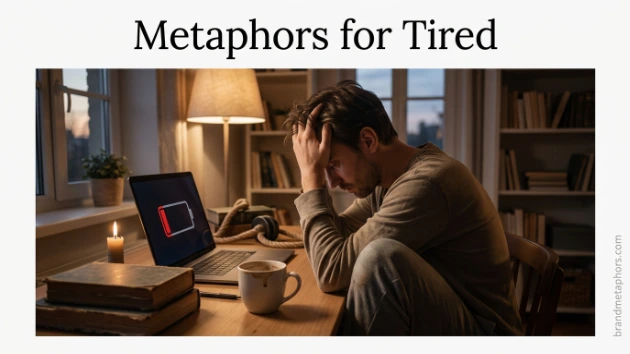
The clock blinks 2:17 a.m., its pale digits cutting through the quiet like a whisper that won’t let you sleep. Your eyelids feel like heavy curtains refusing to rise, your thoughts move like slow traffic in a fog, and even the simplest task—reaching for a glass of water—feels like lifting a mountain. You’re not just tired. You’re something deeper, heavier, harder to name.
That’s where metaphors come in.
Metaphors for tired don’t just describe fatigue—they translate it. They turn an invisible feeling into something tangible, something we can see, hear, and almost touch.
Whether you’re a writer trying to evoke emotion, a student describing burnout, or someone simply trying to express how drained you feel, these metaphors can give your exhaustion a voice.
In this article, we’ll explore powerful metaphors for tired, unpack their meanings, and show you how to use them creatively in writing, conversation, and even social media. Along the way, you’ll find storytelling elements, practical examples, and interactive exercises to spark your imagination.
Why Use Metaphors for Tired? (And Why They Matter)
Saying “I’m tired” is like describing the ocean as “wet.” It’s technically correct—but it misses the depth.
Metaphors allow you to:
- Capture different shades of fatigue (physical, emotional, mental)
- Make your writing more vivid and relatable
- Connect with readers on a sensory and emotional level
- Add creativity to everyday communication
Think of fatigue not as a single feeling, but as a spectrum—from the gentle drowsiness of a rainy afternoon to the crushing weight of burnout. Metaphors help map that spectrum.
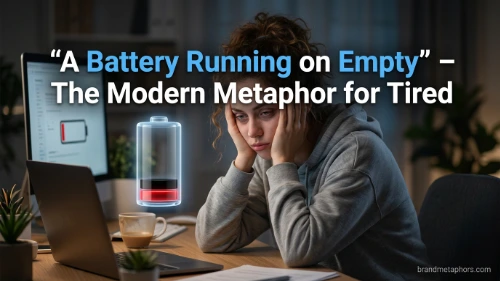
1. “A Battery Running on Empty” – The Modern Metaphor for Tired
Meaning & Explanation
This metaphor compares your energy levels to a device with a drained battery. It reflects total depletion—no reserves, no backup power, just a blinking red warning.
Example Scenario
After working a double shift and staying up late to meet a deadline, you might say:
“I feel like a battery running on empty—any second, I’m going to shut down.”
Alternative Ways to Express It
- “My energy bar is at zero.”
- “I’m running on fumes.”
- “I’ve got nothing left in the tank.”
Sensory & Emotional Layer
This metaphor carries a quiet anxiety—the anticipation of collapse. It’s not just exhaustion; it’s the fear of stopping altogether.
Mini Storytelling
Imagine a young teacher grading papers late into the night. Her coffee has gone cold, her eyes blur over the same sentence, and her laptop flashes 2% battery. She laughs softly—not at the laptop, but at herself. Same here, she thinks.
Bonus Tip
Use this metaphor in modern or tech-related contexts—it resonates strongly with digital-age audiences.
2. “Walking Through Molasses” – The Weight of Physical and Mental Fatigue
Meaning & Explanation
This metaphor emphasizes slowness and resistance. Every movement feels heavy, sticky, and frustratingly delayed.
Example Sentence
“By the afternoon, I felt like I was walking through molasses—every step took twice the effort.”
Alternative Expressions
- “Moving through quicksand”
- “Dragging my feet through mud”
- “Wading through thick fog”
Sensory Details
You can almost feel it:
- The thick pull against your legs
- The sluggish rhythm of your body
- The quiet frustration of not being able to speed up
Cultural Reference
This metaphor often appears in literature describing long journeys or emotional struggle—where time seems to stretch and effort multiplies.
Mini Storytelling
A university student sits in a lecture hall, the professor’s voice echoing faintly. Words drift past like clouds, ungraspable. He tries to take notes, but his pen moves as if underwater. Each sentence feels like pushing through syrup.
Bonus Tip
Perfect for describing mental fatigue or burnout—especially when focus and clarity are affected.
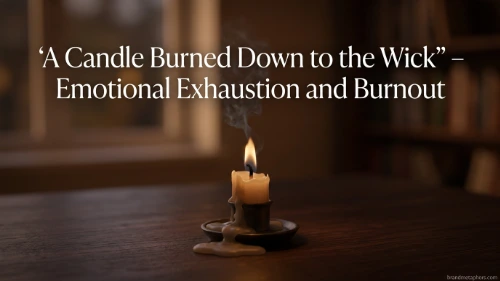
3. “A Candle Burned Down to the Wick” – Emotional Exhaustion and Burnout
Meaning & Explanation
This metaphor suggests that all energy has been used up—completely consumed. It often carries an emotional undertone of overgiving or overworking.
Example Scenario
“After months of juggling work and family, she felt like a candle burned down to the wick.”
Alternative Ways to Say It
- “Burned out completely”
- “Nothing left but smoke”
- “Used up to the last drop”
Emotional Depth
This metaphor is powerful because it implies sacrifice. The candle gives light—but at the cost of itself.
Literary Touch
You might imagine a dimly lit room, a candle flickering weakly, its flame struggling to hold on. That fragile glow mirrors the last bit of someone’s energy.
Real-Life Reflection
Think of caregivers, parents, or people in high-pressure jobs. They often give so much of themselves that they forget to replenish their own energy.
Bonus Tip
Use this metaphor in reflective or emotional writing—it carries depth and poignancy.
Interactive Exercise: Create Your Own Metaphors for Tired
Let’s make this practical—and fun.
Prompt 1: Nature-Inspired Metaphors
Complete this sentence:
“I feel as tired as a __________.”
Examples:
- “leaf at the end of autumn, barely clinging to its branch”
- “river running dry under a relentless sun”
Prompt 2: Object-Based Metaphors
Think of an everyday object and connect it to fatigue:
“My mind is like a __________.”
Try:
- “a cluttered desk with no space left to think”
- “a dim light flickering in a storm”
Prompt 3: Emotion-Driven Metaphors
Describe tiredness as an emotional state:
“My exhaustion feels like __________.”
For example:
- “a quiet room after everyone has left”
- “a song slowing down to silence”
SEO Tips: Using “Metaphors for Tired” in Writing and Content
If you’re creating content—blogs, captions, or stories—here’s how to use these metaphors effectively:
1. Match the Tone
- Use light metaphors for casual content (“running on fumes”)
- Use deeper ones for emotional writing (“burned to the wick”)
2. Pair with Visuals
On social media, combine metaphors with imagery:
“Today, I’m a phone at 1% battery 🔋—barely holding on.”
3. Keep It Relatable
Choose metaphors your audience understands. Modern readers connect easily with tech-based imagery.
4. Avoid Overuse
One strong metaphor is better than five weak ones. Let it breathe.
More Creative Metaphors for Tired (Quick Inspiration List)
Here are additional ideas you can explore:
- “Like a book with all its pages worn thin”
- “A train slowing to a stop at the end of the line”
- “A storm that has spent all its rain”
- “An old clock ticking slower with each second”
- “A shadow fading at sunset”
Each one captures a slightly different shade of tiredness—physical, emotional, or existential.
Bringing It Into Daily Life
Metaphors aren’t just for writing—they’re for living.
Instead of saying:
“I’m exhausted.”
Try:
“I feel like a candle that’s been burning all day.”
The invites empathy. It paints a picture. It helps others feel what you’re experiencing.
Conclusion
Tiredness is universal—but the way we express it doesn’t have to be ordinary.
Metaphors for tired transform a simple feeling into something vivid, emotional, and deeply human. They help us articulate what’s hard to say, connect with others, and even understand ourselves better.
So the next time fatigue settles into your bones, don’t just say you’re tired. Ask yourself:
What does my tiredness look like today?
Is it a fading candle? A drained battery? Or something entirely your own?
FAQs About Metaphors for Tired
1. What are metaphors for tired?
Metaphors for tired are figurative expressions that describe exhaustion by comparing it to something else, making the feeling more vivid and relatable.
2. Why should I use metaphors instead of just saying “tired”?
Metaphors add depth, emotion, and creativity. They help others better understand the intensity and type of fatigue you’re experiencing.
3. Can metaphors for tired be used in professional writing?
Yes, but use them carefully. Subtle metaphors can enhance engagement, especially in storytelling, blogs, or speeches.
4. What’s the difference between physical and emotional tiredness in metaphors?
Physical tiredness often uses movement-based metaphors (e.g., “walking through mud”), while emotional tiredness leans toward imagery of depletion (e.g., “burned-out candle”).
5. How can I create my own metaphors for tired?
Think about how fatigue feels in your body or mind, then compare it to an object, scene, or experience that mirrors that sensation.
6. Are simple metaphors better than complex ones?
Often, yes. Clear and relatable metaphors are more effective than overly complicated ones.