
The Spark: When Achievement Feels Like Fire in Your Hands
The room is quiet, the kind of quiet that hums. You stare at the final line you’ve written, the last checkbox ticked, the project finally done. And then it happens—a small, electric thrill, like striking a match in the dark.
Accomplishment is not just an outcome; it’s a sensation, a story, a moment that deserves to be expressed in more than plain words.
Yet “accomplish” often feels too flat for such a vibrant experience. That’s where metaphors step in. They give shape to success, turning abstract achievements into something we can see, feel, and remember. Whether you’re a writer, student, or professional, learning metaphors for accomplishment can elevate your expression and deepen your connection with your audience.
This article explores creative, vivid ways to describe accomplishment—so you don’t just say it, you show it.
Why Use Metaphors for Accomplishment in Writing and Speech
Metaphors transform simple communication into something powerful. Instead of saying “I finished my goal,” you might say, “I crossed the finish line with burning lungs and a full heart.” Suddenly, your success feels alive.
Using metaphors for accomplishment helps you:
- Create emotional resonance
- Make your message memorable
- Add personality and depth
- Engage readers or listeners more deeply
In storytelling, essays, or even social media captions, metaphors can turn everyday achievements into compelling narratives.
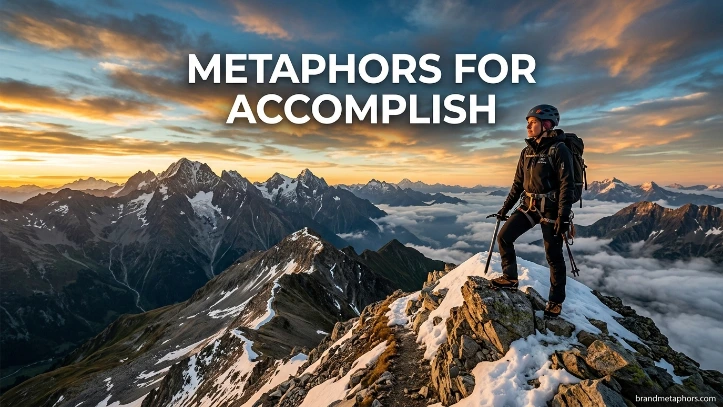
Metaphor #1: Climbing a Mountain of Effort
Meaning and Explanation
This metaphor compares accomplishment to scaling a mountain—a journey filled with struggle, persistence, and gradual progress. It emphasizes effort, endurance, and the rewarding view at the top.
Example Scenario
After months of preparing for exams, a student might say: “I finally reached the summit of my studies.”
Alternative Ways to Express It
- “I conquered the peak of my goals.”
- “I climbed my way to success.”
- “I stood at the top of my hard work.”
Sensory and Emotional Details
Imagine the burn in your legs, the cold wind against your face, and then—the breathtaking view when you reach the top. That’s accomplishment: hard-earned and deeply satisfying.
Mini Storytelling
Think of explorers who spent years trekking harsh terrains. Their success wasn’t just about reaching a place—it was about surviving the journey. Your goals, too, are mountains waiting to be climbed.
Metaphor #2: Lighting a Long-Awaited Flame

Meaning and Explanation
This metaphor frames accomplishment as igniting something after patience and effort. It symbolizes hope, persistence, and the moment of breakthrough.
Example Scenario
A writer completing their first book might say: “I finally lit the flame I’ve been guarding for years.”
Alternative Expressions
- “I sparked my long-awaited success.”
- “I brought my dream to life.”
- “I ignited the fire of achievement.”
Emotional Layer
There’s warmth here—like sitting beside a fire you struggled to build. It’s comforting, personal, and deeply fulfilling.
Cultural Touch
Fire has long symbolized creation and transformation in myths and literature. Accomplishment, like fire, changes everything it touches.
Metaphor #3: Unlocking a Door to New Possibilities

Meaning and Explanation
This metaphor compares accomplishment to opening a door that leads to new opportunities. It highlights growth and transition.
Example Scenario
Landing a new job after months of searching: “I finally unlocked the door to my future.”
Alternative Ways to Say It
- “I opened a new chapter.”
- “I stepped through a doorway of opportunity.”
- “I turned the key to my success.”
Sensory Detail
The click of a lock, the slow creak of a door opening—these small moments carry anticipation and excitement.
Real-Life Reflection
Every achievement leads somewhere new. One door opens, and suddenly, there’s a hallway full of possibilities waiting.
How Metaphors Make Your Achievements More Memorable
Plain statements fade quickly. But metaphors linger. When you describe accomplishment creatively, you give your audience something to visualize and feel.
For example:
- “I finished my work” → forgettable
- “I built my success brick by brick” → vivid and lasting
Metaphors act like anchors for memory, helping your message stay with readers long after they’ve finished reading.
Interactive Exercise: Create Your Own Accomplishment Metaphors

Try this simple activity:
Step 1: Think of a Recent Achievement
It can be small or big—finishing a task, learning a skill, or overcoming a challenge.
Step 2: Ask Yourself
What did it feel like? Was it slow, fast, difficult, exciting?
Step 3: Turn It into a Metaphor
Use structures like:
- “It felt like…”
- “It was as if…”
- “I became…”
Example
“I completed my project” → “It felt like planting a seed and finally seeing it bloom.”
Using Accomplishment Metaphors in Social Media and Daily Life
Metaphors aren’t just for essays—they shine in everyday communication.
Social Media
Instead of: “Finally achieved my goal!” Try: “I just crossed a finish line I once thought was miles away.”
Conversations
Instead of: “I did it.” Try: “I cracked the code I’d been stuck on for weeks.”
These small changes make your words more engaging and relatable.
Bonus Tips for Writing Powerful Metaphors
Keep It Relatable
Use images people understand—nature, journeys, light, or building.
Avoid Overcomplication
Simple metaphors are often the most effective.
Match the Tone
Choose metaphors that fit the mood—joyful, serious, or reflective.
Be Original
Try combining ideas in new ways, like: “Success felt like stitching together pieces of a broken map.”
Expanding Your Creativity: More Metaphor Ideas for Accomplish

Here are a few quick inspirations:
- Building a Bridge – connecting effort to outcome
- Harvesting a Field – reaping what you’ve sown
- Finishing a Marathon – endurance and perseverance
- Solving a Puzzle – clarity after confusion
- Launching a Ship – beginning a new journey
Each metaphor offers a different shade of accomplishment.
Practice Prompts to Sharpen Your Skills
Try these prompts:
- Describe finishing a difficult task as a weather-related metaphor.
- Compare achieving a dream to a musical experience.
- Turn a small daily win into a poetic metaphor.
Write at least three variations for each. The more you practice, the more natural it becomes.
Bringing It All Together: Your Voice, Your Victory
Accomplishment is deeply personal, yet universally understood. By using metaphors, you give your achievements texture, color, and life. You transform a simple statement into a story worth telling.
Whether you’re writing a blog, posting online, or reflecting in a journal, metaphors allow you to celebrate success in a way that feels authentic and memorable.
FAQs
1. What are metaphors for accomplishment?
They are figurative expressions that describe achieving something by comparing it to another experience, like climbing a mountain or lighting a flame.
2. Why should I use metaphors instead of plain language?
Metaphors make your writing more vivid, emotional, and memorable, helping your audience connect with your message.
3. Can metaphors be used in professional writing?
Yes, when used appropriately, they can enhance clarity and engagement in speeches, presentations, and even business writing.
4. How do I create my own metaphors?
Think about the feeling or process of your achievement, then compare it to something familiar or sensory.
5. Are simple metaphors better than complex ones?
Often, yes. Simple metaphors are easier to understand and more impactful.
Conclusion
Accomplishment deserves more than a quiet acknowledgment—it deserves expression that reflects its true weight and beauty. Metaphors give you that power. They turn effort into imagery, success into story, and goals into journeys worth sharing.
So the next time you achieve something—big or small—don’t just say it. Paint it.