

The Sudden Storm Inside a Clear Sky
One moment, the air is still—sunlight pooling gently on the ground, everything calm, expected, almost rehearsed. Then, without warning, the sky splits open. Thunder cracks. Wind lashes. The world shifts from serenity to chaos in a heartbeat.
That is unpredictability.
It’s the missed call that changes your life, the laughter that turns into silence, the plan that dissolves into something entirely new. We live surrounded by the unpredictable, yet often struggle to describe it. That’s where metaphors step in—bridges between the known and the unknowable.
Metaphors for unpredictability don’t just decorate language—they make sense of uncertainty. They help writers evoke emotion, help speakers connect, and help all of us give shape to the shapeless. Whether you’re crafting stories, writing social media captions, or simply trying to explain a chaotic day, mastering these metaphors can transform your expression.
Let’s explore them deeply—through meaning, examples, storytelling, and creative practice.
What Does “Unpredictable” Really Mean?
Unpredictable describes anything that cannot be anticipated or controlled. that resists patterns. It defies logic. It surprises—sometimes delightfully, sometimes destructively.
In writing and speech, unpredictability adds tension, excitement, and realism. Life itself is not linear, and language that reflects that truth feels alive.
Think of unpredictability as:
- A break in expectations
- A shift without warning
- A force beyond control
Metaphors turn this abstract concept into something visible, tangible, and emotionally resonant.
Why Use Metaphors for Unpredictable Situations?

Metaphors do more than explain—they immerse.
They help you:
- Create vivid imagery
- Evoke emotional reactions
- Make abstract ideas relatable
- Add rhythm and creativity to writing
Instead of saying “life is unpredictable,” imagine saying: “Life is a dice roll in a dimly lit room.”
Suddenly, the idea feels alive—uncertain, tense, mysterious.
Metaphor #1: A Roller Coaster Without a Track
Meaning & Explanation
This metaphor captures chaos, lack of control, and constant surprise. A roller coaster already implies ups and downs—but without a track, it becomes wild, dangerous, and impossible to anticipate.
Example Scenario
“His career felt like a roller coaster without a track—thrilling one moment, terrifying the next.”
Alternative Ways to Express It
- A ride through chaos
- A free-falling thrill
- A journey with no map
Sensory & Emotional Details
You can almost feel it—the drop in your stomach, the wind screaming past your ears, the uncertainty of what comes next.
Mini Storytelling
A young entrepreneur launches a startup. One day investors applaud, the next day everything collapses. Success and failure blur into a dizzying ride—no track, no guarantees.
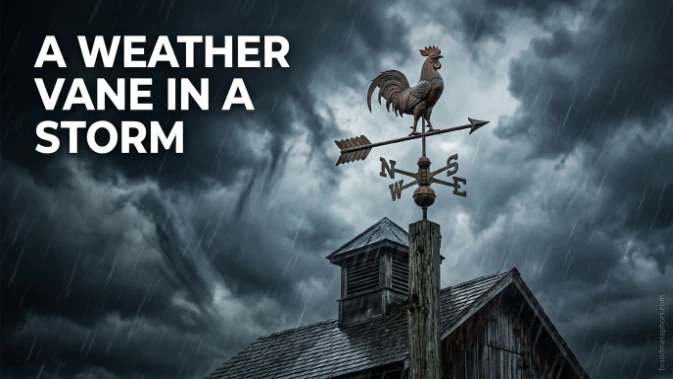
Metaphor #2: A Weather Vane in a Storm
Meaning & Explanation
A weather vane spins wildly in chaotic winds, pointing nowhere stable. This metaphor reflects inconsistency, rapid change, and instability.
Example Sentence
“Her moods were like a weather vane in a storm—shifting without warning.”
Alternative Expressions
- A leaf in the wind
- A compass gone mad
- A spinning arrow
Emotional Texture
There’s restlessness here—an inability to settle, a sense of being tossed around by unseen forces.
Cultural Note
Weather has long symbolized unpredictability in literature—from Shakespeare’s storms to modern cinematic chaos.
Metaphor #3: A Box of Fireworks with a Short Fuse

Meaning & Explanation
This metaphor emphasizes sudden bursts of energy or chaos—unexpected explosions of emotion, action, or events.
Example Scenario
“The meeting was a box of fireworks with a short fuse—no one knew when things would explode.”
Alternative Ways
- A ticking spark
- A hidden explosion
- A surprise ignition
Sensory Details
Crackling sounds. Sudden flashes. Bright bursts in the dark. Beautiful—but dangerous.
Real-Life Reflection
Think of tense family gatherings or volatile workplaces—everything seems calm until suddenly it isn’t.
Creative Exercise: Build Your Own Unpredictable Metaphor
Try this simple prompt:
pace 1: Think of something chaotic (nature, objects, experiences). Step 2: Ask: What makes it unpredictable? Step 3: Turn it into a comparison.
Example:
- Chaos: Ocean waves
- Trait: Constant change
- Metaphor: “Her thoughts were like waves crashing against an unseen shore.”
Your Turn
Complete this sentence:
- “My day felt like _________.”
Try writing three different versions—one dramatic, one humorous, one poetic.
Using Unpredictable Metaphors in Writing
To use these metaphors effectively:
Keep Them Relatable
Choose imagery people understand—weather, travel, games, nature.
Match the Tone
A playful metaphor suits humor; a darker one suits drama.
Avoid Overuse
Too many metaphors can overwhelm. Use them like spices—just enough to enhance flavor.
Blend with Storytelling
Instead of dropping a metaphor randomly, weave it into a scene.
Example: “By midnight, the party had become a roller coaster without a track—music blaring, people shouting, laughter turning into arguments.”
Metaphors for Social Media & Daily Life
Metaphors for unpredictability are perfect for:
Social Media Captions
- “Life’s been a storm with no forecast lately.”
- “Just riding a trackless roller coaster called Monday.”
Conversations
- “This week? Total fireworks box energy.”
Journaling
Describe your emotions creatively—it helps process chaos.
Literary & Cultural Echoes of Unpredictability
Throughout history, writers have used metaphor to express uncertainty.
- In literature, storms often symbolize emotional turmoil.
- In poetry, shifting landscapes represent unstable feelings.
- In films, sudden twists mirror life’s unpredictability.
These metaphors connect us to a shared human experience—the unknown.
Bonus Tips: Mastering the Art of Unpredictable Imagery
- Mix contrasts: Calm vs chaos creates strong imagery
- Use motion: Movement conveys unpredictability
- Engage senses: Sound, touch, sight make metaphors vivid
- Stay original: Twist familiar ideas into something new
Example: Instead of “a storm,” try: “a whisper that suddenly becomes thunder.”
Practice Prompts for Creative Growth
- Describe a person using an unpredictable metaphor
- Write a short paragraph about a chaotic day
- Create a metaphor using food, weather, and emotion combined
Example: “His temper was like boiling milk—quiet until it suddenly overflowed.”
FAQs About Metaphors for Unpredictable
1. What is a simple metaphor for unpredictable?
A common one is “like the weather”—always changing and hard to predict.
2. Why are metaphors important in writing?
They make abstract ideas vivid, emotional, and easier to understand.
3. Can metaphors be used in everyday conversation?
Absolutely. They make speech more expressive and engaging.
4. How do I create my own metaphors?
Observe the world, find similarities, and connect ideas creatively.
5. Are unpredictable metaphors useful in storytelling?
Yes—they add tension, realism, and emotional depth to narratives.
Conclusion
Unpredictability can feel unsettling—but it’s also where life becomes vivid, meaningful, and real. Through metaphors, we don’t just describe chaos—we understand it, shape it, and even appreciate it.
A storm may arrive without warning. A roller coaster may lose its track. Fireworks may explode unexpectedly. But in those moments of uncertainty, language gives us control—a way to capture the uncapturable.
So the next time life surprises you, don’t just call it unpredictable.
Call it poetry.