

It begins quietly. A flicker behind the ribs. A pause in the middle of a sentence. The way your eyes linger a second too long on a passing train, a fading sunset, a name on your phone you don’t dial. Yearning is not loud—it hums. It stretches time. It makes ordinary moments feel like doorways to somewhere else.
We’ve all felt it: that deep, almost poetic ache for something distant—someone, somewhere, some version of life we can almost touch but not quite hold. But how do you express something so intangible?
That’s where metaphors come in.
In this article, we’ll explore metaphors for yearning that help you articulate longing with vivid clarity. Whether you’re a writer, a student, a poet, or someone trying to understand their own emotions, these metaphors will give your feelings shape, texture, and voice.
What Is Yearning? Understanding the Language of Longing
Yearning is more than just wanting—it’s a deep emotional pull toward something absent. It often carries a mix of hope and sadness, desire and distance.
Think of it as:
- A bridge between what is and what could be
- A quiet tension between presence and absence
- A feeling that lives both in memory and imagination
Metaphors help translate this abstract emotion into something tangible—something readers (or listeners) can feel.
Why Metaphors for Yearning Matter in Writing and Life
Metaphors do more than decorate language—they create emotional resonance.
When you say, “I miss you,” it’s clear. But when you say, “I am a shoreline waiting for your tide,” it becomes unforgettable.
Using metaphors for yearning:
- Deepens emotional expression
- Makes writing more vivid and memorable
- Helps others connect to your feelings
- Gives structure to complex inner experiences
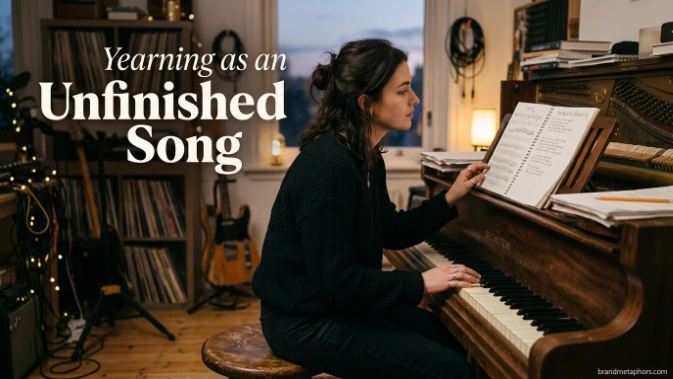
Metaphor #1: Yearning as an Unfinished Song
Meaning & Explanation
Yearning is like a melody that never resolves—a tune that lingers without closure. It suggests incompleteness, repetition, and emotional tension.
Example Scenario
You keep thinking about a dream you never pursued. Every time you hear music, it reminds you of what could have been.
Sentence: “My dreams play like an unfinished song, looping through my mind without ever reaching the final note.”
Alternative Expressions
- A chorus that never ends
- A note suspended in air
- A melody searching for its harmony
Sensory & Emotional Details
You can almost hear it—the soft repetition, the unresolved chord, the silence that follows but doesn’t satisfy.
Mini Storytelling
A pianist sits in a dim room, playing the same phrase over and over, unable to finish it. Not because they don’t know how—but because something is missing.
Metaphor #2: Yearning as a Distant Lighthouse
Meaning & Explanation
This metaphor portrays yearning as something guiding yet unreachable—visible but far away.
Example Scenario
You’re striving toward a goal that feels constantly out of reach.
Sentence: “Her future glowed like a distant lighthouse—steady, bright, and impossibly far.”
Alternative Expressions
- A star you can see but never touch
- A horizon that keeps moving
- A light across the ocean
Sensory & Emotional Details
Salt in the air. Waves crashing. The flicker of light cutting through darkness—but never getting closer.
Cultural Reference
Think of sailors navigating endless seas, guided by something they may never actually reach.
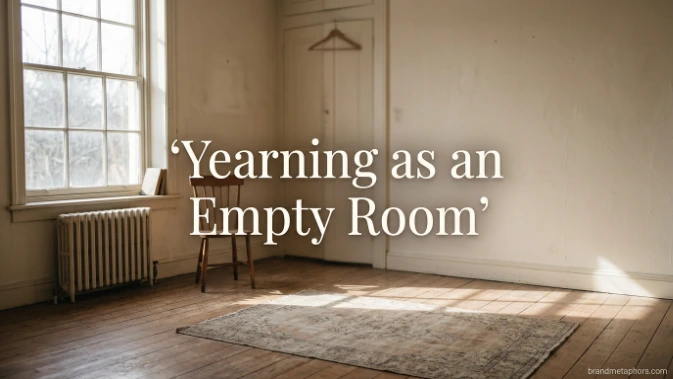
Metaphor #3: Yearning as an Empty Room
Meaning & Explanation
Yearning can feel like absence—a space that used to be filled but now echoes with silence.
Example Scenario
Missing someone who used to be part of your daily life.
Sentence: “Without him, the house felt like an empty room, echoing with memories that refused to fade.”
Alternative Expressions
- A chair left untouched
- A hollow echo
- A space where laughter used to live
Sensory & Emotional Details
Dust floating in still air. Quiet footsteps. The faint memory of voices that once filled the space.
Metaphors for Yearning in Literature and Culture
Throughout history, writers and poets have used powerful imagery to express longing:
- Lovers separated by distance
- Travelers chasing unknown lands
- Characters reaching for impossible dreams
Yearning is central to storytelling because it drives action, emotion, and transformation.
It’s the force behind:
- Love stories
- Hero’s journeys
- Personal growth arcs
Interactive Exercise: Create Your Own Yearning Metaphor

Try this simple exercise:
Step 1: Identify What You Long For
Is it a person? A place? A version of yourself?
Step 2: Choose a Concrete Image
Pick something physical:
- Nature (ocean, sky, fire)
- Objects (mirror, door, clock)
- Sensations (heat, silence, wind)
Step 3: Connect the Emotion
Ask: How does this object behave like my feeling?
Example
Longing for home → A suitcase that never fully unpacks
Your Turn
Write 3 metaphors for your own yearning.
Using Yearning Metaphors in Creative Writing
To make your metaphors powerful:
Tip 1: Be Specific
Avoid generic images. Instead of “sad,” try:
- “a window fogged with unsaid words”
Tip 2: Engage the Senses
Include:
- Sound
- Texture
- Light
- Movement
Tip 3: Keep It Natural
Don’t force complexity. The best metaphors feel effortless.
Social Media & Everyday Uses of Yearning Metaphors
You don’t need to be a novelist to use these.
For Social Media Captions
- “Still waiting like a tide that forgot its moon.”
- “Some dreams echo louder the longer they stay quiet.”
In Conversations
- “It feels like I’m chasing something that keeps stepping back.”
In Journaling
Metaphors help you process emotions without overthinking.
Bonus Metaphor Ideas for Yearning
Here are a few more you can use or adapt:
- A letter never sent
- A door slightly open but unreachable
- A shadow that moves just ahead of you
- A garden waiting for rain
- A clock stuck between seconds
Each of these captures a different shade of longing.
Practice Prompts to Deepen Your Expression
Try these creative prompts:
- Write a paragraph describing yearning as weather
- Compare longing to a journey you can’t finish
- Describe missing someone using only physical objects
- Turn your metaphor into a short poem
- Write a scene where a character experiences silent yearning
Common Mistakes to Avoid When Using Metaphors
- Overcomplicating imagery
- Mixing too many metaphors
- Using clichés without adding a fresh twist
- Ignoring emotional clarity
Keep it simple, vivid, and authentic.
FAQs About Metaphors for Yearning
1. What is a good metaphor for yearning?
A strong metaphor is one that captures both desire and distance, like “a lighthouse across a stormy sea.”
2. Why is yearning often used in literature?
Because it drives emotion, conflict, and character development—it keeps readers engaged.
3. Can metaphors help with emotional expression?
Yes, they make abstract feelings easier to understand and communicate.
4. How do I create original metaphors?
Start with a real object or experience, then connect it to your emotion in a unique way.
5. Are metaphors only for writing?
No, they can be used in speech, journaling, social media, and even self-reflection.
Conclusion
Yearning is one of the most human emotions we experience—quiet, persistent, and deeply personal. It lives in the spaces between moments, in the pauses between words, in the distance between where we are and where we wish to be.
Metaphors give that feeling a body. A voice. A place to exist outside of us.
Whether it’s an unfinished song, a distant lighthouse, or an empty room, each metaphor is a way of saying: this is what it feels like to want something deeply.
And sometimes, simply naming that feeling—beautifully, vividly—is enough to bring us a little closer to it.