

Imagine standing beneath a mountain for the first time. Its peak seems to disappear into the sky, while the ground beneath your feet suddenly feels small. Yet “big” does not quite capture the feeling. A mountain can be large in size, powerful in presence, and important in the way it changes the landscape around it. That is where Metaphors for Big become useful. Instead of simply saying something is large, metaphors help readers see, feel, and understand its size or importance. Moreover, they can make ordinary descriptions more vivid and memorable. Whether you are writing a story, poem, school assignment, social media caption, or personal reflection, the right comparison can turn a simple idea into a striking image. Therefore, learning creative ways to describe size, greatness, influence, and importance can make your writing much more expressive.
What Are Metaphors for Big (and Why They Matter)

A metaphor for “big” goes beyond literal size. It connects magnitude to something relatable—nature, emotion, myth, or everyday experience.
Instead of saying:
- “The problem was big”
You might say:
- “The problem loomed like a storm on the horizon.”
The difference? One informs. The other immerses.
Metaphors matter because they:
- Make abstract ideas tangible
- Create emotional resonance
- Improve memorability
- Add creativity and voice
When something is “big,” it’s rarely just physical—it can be overwhelming, powerful, beautiful, or terrifying. Metaphors capture that nuance.
Why Writers and Speakers Need Better Words for Big
Overusing words like “big,” “huge,” or “massive” dulls your message. Readers skim past them. But a strong metaphor pauses them—it invites them into the experience.
Think of it this way:
- “A big opportunity” → forgettable
- “An open door stretching into the unknown” → intriguing
Whether you’re writing fiction, essays, captions, or speeches, metaphors help your audience feel scale rather than just understand it.
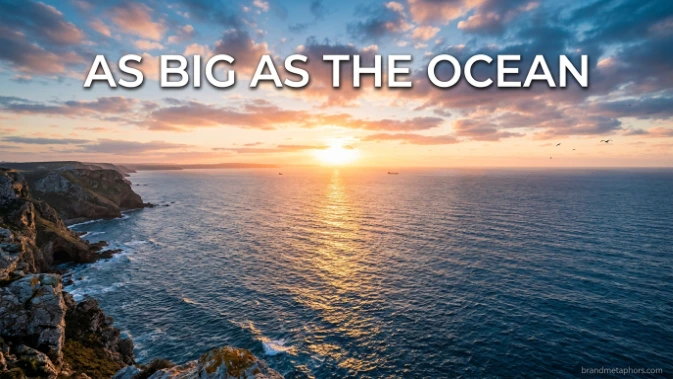
As Big as the Ocean”
Meaning and Explanation
The ocean is one of the most universal symbols of vastness. It represents depth, mystery, and endless reach.
When you compare something to the ocean, you’re not just saying it’s large—you’re saying it’s:
- Expansive
- Deep
- Possibly overwhelming
Example Sentence
“Her dreams were as big as the ocean, stretching far beyond the horizon anyone else could see.”
Alternative Expressions
- As vast as the sea
- Like a tide that never ends
- As deep as the blue beneath waves
Sensory & Emotional Layer
You can almost hear the waves crashing, smell the salt air, feel the wind. The metaphor becomes an experience.
Mini Story
A young artist in a small village once told her teacher, “I want to paint the world.” The teacher laughed. Years later, her murals covered entire cities—her ambition, like the ocean, had no shore.
A Mountain of…”
Meaning and Explanation
Mountains symbolize size, weight, and challenge. This metaphor often conveys something overwhelming or difficult to overcome.
Example Sentence
“He had a mountain of responsibilities resting on his shoulders.”
Alternative Expressions
- A towering pile of
- A peak of pressure
- A cliff of commitments
Sensory & Emotional Layer
You feel the weight, the climb, the breathlessness. It’s not just big—it’s demanding.
Real-Life Scenario
Imagine opening your inbox on Monday morning—hundreds of unread emails. That’s not just “a lot.” That’s a mountain waiting to be climbed.
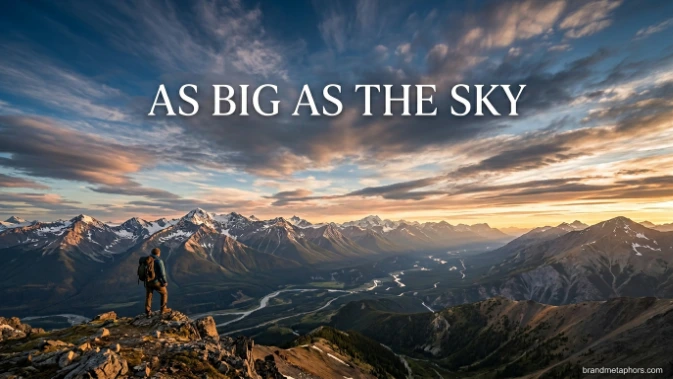
As Big as the Sky”
Meaning and Explanation
The sky represents openness, infinity, and limitless possibility. It’s a softer, more hopeful kind of “big.”
Example Sentence
“His imagination was as big as the sky, filled with ideas that had no boundaries.”
Alternative Expressions
- Endless as the horizon
- Wide as the heavens
- Limitless like open air
Sensory & Emotional Layer
This metaphor feels light, freeing. It invites wonder rather than pressure.
Cultural Touch
Poets across cultures have used the sky to symbolize freedom and dreams. It’s a metaphor that carries both scale and emotion.
Creative Ways to Build Your Own Metaphors for Big

You don’t have to rely on common phrases. You can create your own metaphors using a simple structure:
Big thing → Compare to → Familiar vast object or experience
Examples:
- “His anger was a wildfire spreading across dry land.”
- “The city was a labyrinth that never ended.”
- “Her love filled the room like sunlight pouring through windows.”
Tips for Creating Original Metaphors
- Use Nature – Oceans, skies, forests, storms
- Use Movement – Floods, waves, explosions
- Use Emotion – Fear, joy, ambition as expanding forces
- Think Visually – What would this “big” thing look like if you could see it?
Metaphors for Big in Everyday Communication

You don’t need to be a novelist to use metaphors. They work beautifully in daily life.
Examples
Instead of:
- “I have a big problem”
Try:
- “I’m staring at a wall I don’t know how to climb.”
Instead of:
- “That was a big success”
Try:
- “That moment felt like fireworks lighting up the sky.”
Why This Works
Metaphors make your speech:
- More engaging
- More expressive
- More memorable
Even in casual conversations, they leave an impression.
Using Metaphors for Big in Social Media & Writing
In a world of scrolling, metaphors can stop thumbs.
Social Media Examples
- “Chasing dreams bigger than the horizon.”
- “Building something that feels like the sky—endless and open.”
- “Carrying a mountain, but learning to climb it.”
Writing Applications
- Blog posts
- Poetry
- Storytelling
- Personal branding
Bonus Tip
Pair metaphors with visuals. A caption about the ocean alongside a sea image? Instant emotional impact.
Practice Metaphors for Big
Let’s make this practical and fun.
Expand the Sentence
Take this sentence:
- “I have a big idea.”
Rewrite it using a metaphor.
Examples:
- “I have an idea that stretches like the horizon at sunrise.”
- “I’m holding a spark that could turn into a wildfire.”
Personal Reflection
Think about something big in your life right now:
- A goal
- A challenge
- A feeling
Now describe it using a metaphor.
Prompt:
- “This feels like…”
Sensory Writing
Pick a metaphor (ocean, mountain, sky) and add sensory details:
- What does it sound like?
- What does it feel like?
- What emotion does it carry?
Avoiding Clichés While Describing Big Things

Some metaphors are overused:
- “Big as a house”
- “Huge as an elephant”
They’re not wrong—but they lack freshness.
How to Keep It Original
- Add a twist: “Big as a house abandoned in the middle of nowhere.”
- Combine ideas: “A mountain of silence pressing down.”
- Personalize it: “As big as the dreams I had at ten.”
Turning “Big” into Emotion, Not Just Size
The best metaphors don’t just describe size—they reveal feeling.
Compare:
- “A big fear” vs
- “A shadow stretching across every thought.”
The second one tells us:
- It’s not just large
- It’s consuming
Emotional Layers You Can Add
- Overwhelm → storms, floods
- Joy → light, sky, music
- Fear → shadows, darkness, cliffs
- Ambition → fire, horizons, stars
Let Language Grow as Big as Your Ideas
“Big” is just the beginning. It’s a placeholder—a doorway into something richer, deeper, and more expressive.
When you use metaphors, you:
- Turn scale into story
- Turn words into images
- Turn ideas into experiences
So the next time something feels too big to describe, don’t shrink it into a simple word. allow it expand. Let it breathe. Let it become an ocean, a mountain, a sky.
FAQs About Metaphors for Big
What is a metaphor for “big”?
A metaphor for “big” is a figurative comparison that expresses size or magnitude using imagery, such as “as vast as the ocean” or “a mountain of problems.”
Why should I use metaphors instead of simple words?
Metaphors make your language more vivid, emotional, and memorable. They help readers feel what you mean rather than just understand it.
Can metaphors be used in everyday conversation?
Yes! Metaphors are powerful in daily speech, social media, and casual writing. They make your communication more engaging.
How do I create my own metaphors?
Start by identifying what feels “big,” then compare it to something vast or relatable—like nature, movement, or emotion.
Are common metaphors okay to use?
They’re fine, but try to add a personal or creative twist to keep your language fresh and unique.
What is a metaphor for something very big?
A metaphor for something very big compares it with a powerful or vast image, such as a mountain, ocean, or giant wave. The comparison helps readers imagine its size or impact.
What is a good metaphor for a big dream?
A big dream can be described as a mountain touching the sky or an ocean without an end. These images suggest ambition, possibility, and a goal that reaches far beyond ordinary limits.
How can I describe something important without saying “big”?
You can compare it to a foundation, lighthouse, star, or other meaningful image. For example, calling someone’s advice “a lighthouse” shows that it is important because it provides guidance.
Can metaphors describe emotional size?
Yes. Metaphors are especially useful for emotions because feelings cannot always be measured physically. A powerful emotion might be described as a giant wave, a storm, or an ocean.
How do I create my own metaphor for something big?
First, decide what kind of “big” you mean. Then choose an image that shares that quality. Finally, explain the connection with a clear detail so the comparison feels natural and meaningful.
Conclusion
Describing something as “big” does not always mean talking about physical size. Instead, it can mean powerful, important, ambitious, overwhelming, impressive, or full of possibility. Therefore, the best metaphor depends on the kind of greatness you want to show.
A mountain can represent height, strength, and challenge. An endless ocean can suggest depth, freedom, and limitless possibility. Meanwhile, a giant wave can capture force, movement, and lasting impact.
Moreover, strong metaphors give readers something they can picture. They turn abstract ideas into scenes that feel real.
Ultimately, the goal is not simply to make something sound bigger. It is to help the reader feel its size, understand its importance, and remember its impact. Sometimes, one vivid comparison can make a small sentence feel larger than life.