
Introduction
Words are powerful tools. The right word can make your writing clear, engaging, and memorable. This is why learning vocabulary is so important for students, writers, and English learners. Along with grammar, figurative language, descriptive language, and creative writing techniques, choosing the correct word helps readers understand exactly what you mean.
Many English learners become confused by similar-looking words. One common pair is invaluable and valuable. At first glance, they seem like opposites because the prefix in- often means “not.” However, that is not the case here. Surprisingly, invaluable actually describes something that is even more precious than merely valuable.
Understanding the difference will improve your writing skills, expand your vocabulary, and help you communicate with confidence. Whether you are writing essays, stories, emails, or business documents, knowing which word to choose makes a noticeable difference.
This guide explains the meanings, grammar, examples, common mistakes, literary uses, figurative language connections, and practical exercises in simple language suitable for Grade 7–9 readers.
What Does Valuable Mean?
The adjective valuable describes something that has worth, usefulness, importance, or financial value.
It can refer to:
- Money
- Objects
- Skills
- Information
- People
- Experiences
Simple Definition
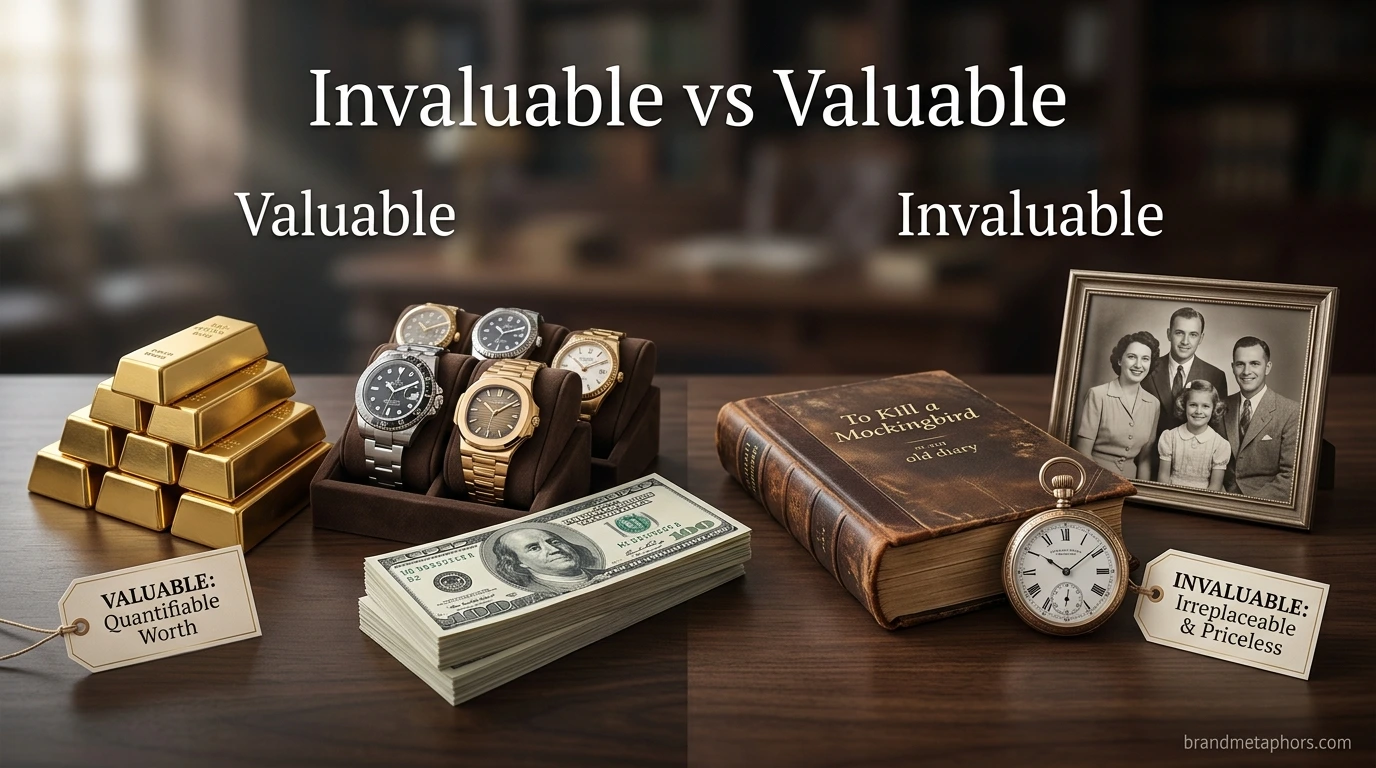
Valuable = Worth a lot or very useful.
Examples
- The necklace is valuable because it contains real diamonds.
- Your advice was valuable during the project.
- Learning another language is a valuable skill.
- This old painting is extremely valuable.
- Good teachers provide valuable lessons.
The word often describes things that have measurable or practical worth.
What Does Invaluable Mean?
Although the word starts with in-, it does not mean “not valuable.”
Instead, it means:
- So valuable that its worth cannot be measured
- Extremely helpful
- Beyond price
- Irreplaceable
Simple Definition
Invaluable = Extremely valuable or impossible to replace.
Think of it this way:
Its value is so great that nobody can calculate it.
Examples
- My grandmother’s advice was invaluable.
- Her experience became invaluable during the emergency.
- The doctor’s quick decision proved invaluable.
- Volunteers made an invaluable contribution.
- His support was invaluable throughout the difficult year.
Here, the value is emotional, practical, or personal rather than financial.
Quick Comparison Table
FeatureValuableInvaluableMeaningWorth a lotBeyond ordinary valueStrengthHighEven higherCan describe money?YesRarelyEmotional importanceSometimesVery oftenFinancial valueYesUsually notReplaceableOftenUsually difficult or impossibleFormal writingYesYesEveryday speechYesYes
Why Do People Get Confused?
The confusion comes from the prefix in-.
Usually:
- correct → incorrect
- complete → incomplete
- visible → invisible
People naturally expect:
valuable → invaluable = not valuable
But English contains many historical exceptions.
In this word, in- comes from older language development and creates the meaning:
“Too valuable to calculate.”
That is why invaluable is actually stronger than valuable.
When Should You Use Valuable?
Use valuable when describing something important, useful, expensive, or beneficial.
Appropriate Situations
Physical Objects
- valuable jewellery
- valuable artwork
- valuable antiques
- valuable coins
Example:
The museum protects many valuable treasures.
Skills
- valuable experience
- valuable knowledge
- valuable training
Example:
Computer skills are valuable in today’s workplace.
Advice
Example:
Your suggestions were valuable.
Time
Example:
Thank you for your valuable time.
Resources
Example:
Water is one of Earth’s most valuable resources.
When Should You Use Invaluable?

Choose invaluable when something is exceptionally important and cannot easily be replaced.
Emotional Support
Example:
My parents gave me invaluable encouragement.
Professional Help
Example:
The engineer’s knowledge was invaluable.
Education
Example:
Practice gives students invaluable confidence.
Emergencies
Example:
The guide’s local knowledge proved invaluable during the storm.
Friendship
Example:
A true friend is invaluable.
In these cases, the emphasis is not on money but on extraordinary importance.
Comparison Examples in Sentences
Seeing both words together makes the difference much clearer.
ValuableInvaluableThe ring is valuable.The memories attached to the ring are invaluable.Her laptop is valuable.Her experience is invaluable.The painting is valuable.His guidance was invaluable.The book is valuable.The teacher’s support was invaluable.Gold is valuable.Good health is invaluable.
Notice that valuable often describes possessions, while invaluable often describes qualities, people, experience, or support.
Using These Words in Creative Writing
Good writers choose words carefully to create stronger emotions.
Descriptive Language
Instead of saying:
The old diary was important.
Write:
The old diary became an invaluable family treasure.
Instead of:
His advice helped me.
Write:
His advice proved invaluable during my hardest days.
These stronger word choices make stories more vivid.
Figurative Language and Literary Devices
Although these words themselves are not figures of speech, they often appear in figurative language.
Metaphor Examples
- Knowledge is an invaluable treasure.
- Hope is an invaluable light.
- Kindness is an invaluable gift.
- Wisdom is an invaluable compass.
These metaphors compare ideas without using “like” or “as.”
Simile Examples
- Her advice was as valuable as gold.
- His friendship was like an invaluable jewel.
- The lesson was as valuable as experience.
- Good books are like invaluable guides.
Similes use “like” or “as.”
Poetic Expression
Writers often use these words in poetry.
Example:
Love is an invaluable flame that never fades.
Or:
Every valuable lesson leaves a lasting mark.
Such expressions create emotional impact.
Idiom Connections
Many English idioms express similar ideas.
Examples include:
- Worth its weight in gold
- A treasure trove
- A gold mine of information
- Priceless advice
- Worth every penny
These idioms emphasize great value without repeating the same adjective.
Common Mistakes to Avoid

Mistake 1
❌ This old coin is invaluable because it costs £20.
✅ This old coin is valuable because it costs £20.
Reason:
The coin has financial value, but not necessarily extraordinary importance.
Mistake 2
❌ My pencil is invaluable.
✅ My favourite pen is invaluable because it belonged to my grandfather.
Reason:
Ordinary items are usually valuable, not invaluable, unless they have special meaning.
Mistake 3
❌ Invaluable means not valuable.
✅ Invaluable means extremely valuable.
This is the biggest mistake learners make.
Mistake 4
Using invaluable too often.
If everything is invaluable, then nothing feels especially important.
Reserve it for truly exceptional situations.
Tone and Style Usage
Different situations require different vocabulary.
SituationBetter ChoiceBusiness reportValuableSchool essayEitherAcademic writingBothEmotional speechInvaluableProduct descriptionValuablePersonal letterInvaluableHistorical writingBoth
Formal Tone
The research provided valuable evidence.
The professor’s guidance was invaluable.
Informal Tone
That app is really valuable.
Your help was absolutely invaluable.
Vocabulary Enhancement for Better Writing
Learning similar words improves your vocabulary.
Synonyms of Valuable
- useful
- worthwhile
- precious
- beneficial
- important
- treasured
- prized
- respected
Synonyms of Invaluable
- priceless
- indispensable
- irreplaceable
- essential
- beyond price
- immeasurable
- unmatched
- extraordinary
Related Vocabulary
- significance
- usefulness
- appreciation
- importance
- benefit
- contribution
- worth
- excellence
Using a variety of words makes your writing more interesting.
Practice Exercises
Exercise 1
Choose the correct word.
- Your help during the competition was ________.
- This necklace is very ________.
- Her years of experience became ________.
- Gold remains a ________ metal.
- His kindness was ________.
Answers
- invaluable
- valuable
- invaluable
- valuable
- invaluable
Exercise 2
Rewrite the Sentences
Original:
The teacher helped us.
Improved:
The teacher’s guidance was invaluable.
Original:
This watch costs a lot.
Improved:
This watch is valuable.
Exercise 3
Create Your Own Sentences
Write one sentence using valuable to describe an object.
Write one sentence using invaluable to describe a person or experience.
Tips for Remembering the Difference
Remember these easy tricks:
- Valuable = has worth.
- Invaluable = worth so much you cannot measure it.
- Valuable often describes things.
- Invaluable often describes people, advice, experience, support, or memories.
- Think “priceless” whenever you see invaluable.
A simple memory aid:
If you could replace it with money, it is probably valuable. If you could never replace it, it is probably invaluable.
Frequently Asked Questions
1. Does invaluable mean not valuable?
No. It means extremely valuable or priceless.
2. Which word is stronger?
Invaluable expresses a greater degree of importance than valuable.
3. Can both words describe people?
Yes. However, invaluable is more common because it highlights exceptional importance.
Example:
- She is an invaluable team member.
4. Is invaluable the same as priceless?
Almost. Both suggest something has such great worth that it cannot easily be measured or replaced.
5. Can valuable describe emotions?
Usually, valuable describes practical or financial worth. For emotions or personal importance, invaluable often sounds more natural.
Conclusion
Understanding the difference between valuable and invaluable helps you choose more precise and effective words in English. While valuable describes something with clear worth, usefulness, or financial importance, invaluable refers to something whose importance is so great that it cannot be measured. Despite its confusing prefix, it is not the opposite of valuable—it is actually a stronger expression.
Using these words correctly will improve your essays, stories, creative writing, academic assignments, and everyday conversations. Combined with figurative language, descriptive language, metaphor examples, simile examples, literary devices, and thoughtful word choice, they can make your writing clearer, richer, and more engaging.
The more you practise choosing the right vocabulary, the more confident and skilled you will become as an English learner and writer.