
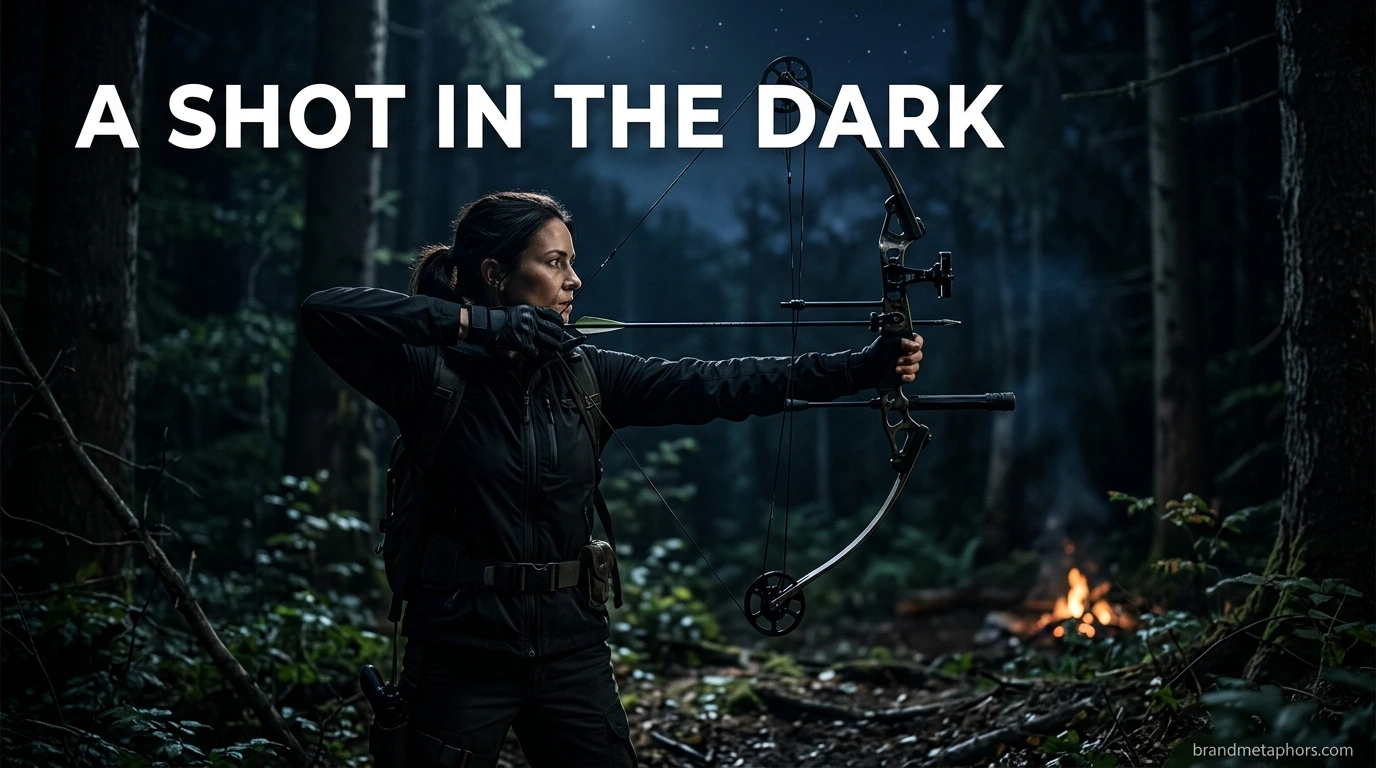
English is full of colourful expressions that make conversations more interesting. Some phrases describe emotions, while others explain situations in a creative way. One of the most common expressions people hear in everyday speech is “a shot in the dark.” Although it sounds like it has something to do with shooting, it is actually a figurative expression used when someone takes a guess or tries something without knowing whether it will work.
This idiom appears in business meetings, classrooms, sports discussions, interviews, books, movies, and casual conversations. Understanding its meaning can help English learners speak more naturally and understand native speakers more easily.
In this guide, you’ll learn what the expression means, where it came from, how to use it correctly, common mistakes to avoid, real-life examples, similar expressions, and much more.
What Does This Expression Mean?
The phrase refers to making a guess or attempting something when you have very little information or no certainty about the outcome.
It describes situations where success is possible, but there is no strong evidence that the attempt will work.
Simple definition
An uncertain guess or attempt made without enough facts or knowledge.
Easy examples
- I didn’t know the answer, so I made a guess.
- She sent her résumé to the company even though they weren’t hiring.
- We picked a random solution because nothing else worked.
In all these situations, people acted without knowing the result.
Origin and History of the Expression
The expression comes from the idea of firing a weapon in complete darkness.
Imagine trying to hit a target when you cannot even see it. You might succeed, but the chances are very low because you are aiming blindly.
Over time, English speakers began using this image to describe any uncertain attempt or educated guess.
Although the phrase has been around for many years, it remains popular because everyone experiences situations where they must act without complete information.
Why People Use This Idiom
This expression is useful because life often requires decisions before every fact is known.
People use it when discussing:
- Business decisions
- Scientific theories
- Job applications
- Sports predictions
- School exams
- Medical research
- Personal relationships
- Technology development
Instead of saying,
“I guessed without enough information,”
people simply use the idiom, making the sentence shorter and more expressive.
Common Situations Where It Is Used
The expression fits many everyday situations.
SituationExampleExamsGuessing an answer you don’t knowBusinessLaunching a product without market dataSportsPredicting the winner before the gameJob SearchApplying to a company with no openingsTechnologyTrying a possible software fixMedicineTesting a possible diagnosisRelationshipsGuessing someone’s feelingsTravelChoosing a route you’ve never taken
Each example involves uncertainty and limited information.
Different Types of Uncertain Attempts
Not every uncertain decision is the same. They usually fall into several categories.
Educated Guess
This is based on some knowledge.
Example:
- A teacher predicts exam questions after studying previous papers.
Blind Guess
There is almost no information.
Example:
- Choosing option C because you have no idea.
Creative Experiment
Someone tries a new idea hoping it succeeds.
Example:
- A company introduces an unusual advertising campaign.
Emergency Decision
Quick action is needed before all facts are available.
Example:
- Doctors choosing treatment while waiting for test results.
Risk-Based Attempt
A person accepts uncertainty because the reward could be worth it.
Example:
- Investing in a new business.
Examples in Everyday Conversations

Learning through examples makes idioms much easier to remember.
At School
Student A: “I don’t know number eight.”
Student B: “Just make your best guess.”
At Work
Manager: “We don’t have enough customer data.”
Employee: “This marketing plan is an uncertain attempt, but it might work.”
At Home
Mother: “Where did your brother go?”
Father: “I’m guessing he went to the library.”
Sports
Commentator:
“Predicting today’s winner is difficult because both teams are equally strong.”
Technology
“We restarted the computer because nothing else solved the problem.”
Benefits of Understanding This Expression
Learning common idioms improves more than vocabulary.
Better Communication
Native speakers frequently use idioms.
Understanding them helps conversations feel more natural.
Stronger Writing
Essays, blogs, and stories become more interesting.
Improved Listening Skills
Movies, TV shows, podcasts, and interviews become easier to understand.
Better Speaking Confidence
Using idioms correctly makes spoken English sound more fluent.
Higher Exam Scores
Many English exams test knowledge of figurative language and common expressions.
Similar Expressions and Related Idioms
English offers many expressions with similar meanings.
Best alternatives
- Wild guess
- Best guess
- Long shot
- Taking a chance
- Rolling the dice
- Playing the odds
- Hit or miss
- Trying your luck
- Testing the waters
- Going out on a limb
Small differences
Wild guess
- Almost no information.
Best guess
- Based on some evidence.
Long shot
- Success is unlikely but still possible.
Taking a chance
- Accepting risk.
Each phrase has its own shade of meaning.
Common Mistakes to Avoid
Many learners misunderstand this expression.
Mistake 1: Thinking it means violence
It has nothing to do with actual shooting.
Instead, it describes uncertainty.
Mistake 2: Using it for certain situations
Incorrect:
“I knew the answer exactly.”
Correct:
Use the idiom only when the outcome is uncertain.
Mistake 3: Confusing it with luck
Luck may be involved, but the expression focuses on making an attempt despite limited information.
Mistake 4: Overusing it
Using the same idiom repeatedly can make writing repetitive.
Mix it with related expressions.
Tips for Using Idioms Naturally

If you’re learning English, these habits will help.
Read regularly
Books and news articles contain many useful expressions.
Watch English movies
Notice how characters use figurative language.
Keep an idiom notebook
Write:
- Meaning
- Example sentence
- Similar phrases
Practise speaking
Create conversations using new vocabulary.
Learn in context
Understanding complete sentences is better than memorising definitions.
Real-Life Examples Across Different Fields
This expression appears in many areas of life.
Business
A startup launches an innovative product without knowing customer demand.
Science
Researchers test a new theory before enough evidence exists.
Medicine
Doctors sometimes begin treatment while waiting for additional results.
Education
Students answer difficult exam questions by making careful guesses.
Technology
Programmers test possible fixes when software bugs appear.
Sports
Coaches try unexpected strategies against stronger opponents.
Personal Life
Someone applies for a dream job despite having little experience.
All these examples involve uncertainty combined with hope.
Why This Idiom Remains Popular
Some expressions disappear over time.
This one continues to be widely used because uncertainty is part of everyday life.
People constantly make decisions without perfect knowledge.
Whether choosing a career, starting a business, solving a problem, or making predictions, everyone eventually faces situations where they must act before having all the answers.
That makes this expression timeless and easy for people around the world to understand.
Quick Summary
Here are the key points to remember.
- It describes an uncertain guess or attempt.
- It does not refer to actual shooting.
- It is commonly used in speaking and writing.
- It works well in business, education, sports, and daily life.
- It represents hope despite limited information.
- Native speakers use it frequently.
- It helps make English sound more natural.
- Learning related idioms improves fluency.
Frequently Asked Questions
1. What does this idiom mean?
It means making a guess or trying something without enough information to know if it will succeed.
2. Is it positive or negative?
It is neutral. Sometimes the attempt succeeds, and sometimes it does not.
3. Can it describe an educated guess?
Yes. It can describe both educated guesses and attempts made with very little information.
4. Is it commonly used in everyday English?
Yes. Native speakers use it in conversations, books, news articles, business discussions, and entertainment.
5. Is it formal or informal?
It is suitable for both informal conversations and many professional situations, although very formal academic writing may prefer more direct wording.
6. What is another way to say it?
Common alternatives include wild guess, best guess, taking a chance, long shot, and rolling the dice.
7. Can students use this expression in essays?
Yes. It can make writing more engaging when used appropriately and in the correct context.
8. How can I remember its meaning?
Imagine trying to hit a target in complete darkness. Since you cannot see where to aim, your attempt depends largely on chance. That mental picture makes the figurative meaning easy to remember.
Conclusion
Learning English idioms is one of the fastest ways to sound more natural and confident. This well-known expression captures the idea of making an attempt when the outcome is uncertain and information is limited. It appears in everyday conversations, business discussions, education, sports, science, and many other areas of life because people often have to make decisions before knowing every fact.
By understanding its meaning, history, correct usage, and common alternatives, you can recognise it easily when reading or listening and use it appropriately in your own speaking and writing. Like many figurative expressions, it reminds us that progress often begins with courage, curiosity, and a willingness to try—even when success is not guaranteed.