
Introduction
Good writing is more than using long words. It is about choosing the right word for the right situation. This is where figurative language, descriptive vocabulary, and precise word choice become important. Whether you are writing a school essay, a story, a poem, or a professional email, selecting accurate words helps readers understand your message clearly.
Many English learners confuse similar-looking verbs because they sound alike and often appear in the same topics. One common pair is afflict and inflict. Although both are connected to pain, suffering, or harm, they are not interchangeable. Knowing the difference can improve your vocabulary, strengthen your writing skills, and help you avoid common grammar mistakes.
This guide explains each word in simple language with meanings, comparison tables, sentence examples, literary uses, figurative language, creative writing ideas, common errors, exercises, and practical tips. By the end, you will confidently know which verb belongs in every sentence.
Why These Two Words Are Often Confused
These verbs create confusion because they have several similarities.
- Both describe suffering or harm.
- Both are formal English words.
- Both frequently appear in books, newspapers, and academic writing.
- Both are often used with illness, pain, injury, and emotional suffering.
However, they describe different actions.
- One focuses on experiencing suffering.
- The other focuses on causing suffering.
Remember this simple idea:
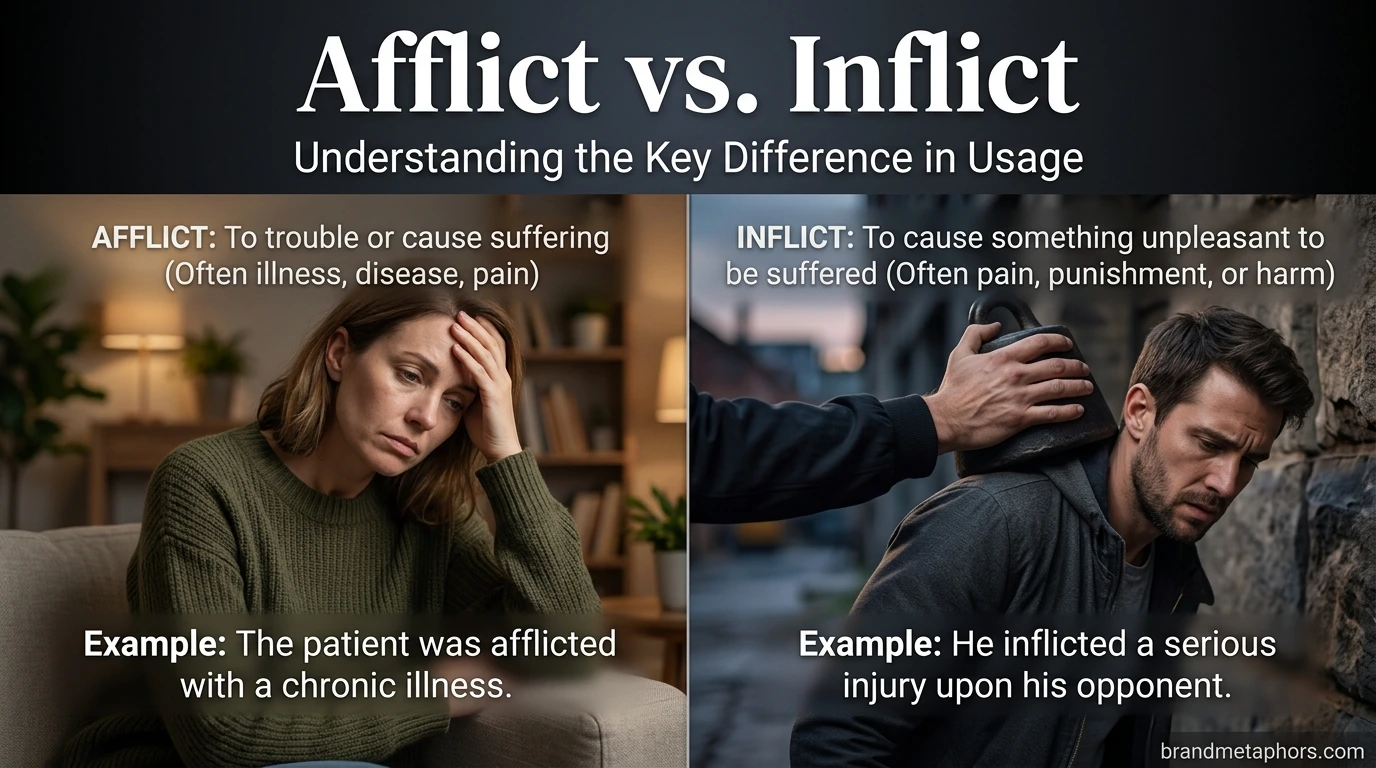
Afflict = suffer from
Inflict = cause to suffer
That single distinction makes choosing the correct word much easier.
Meaning of Afflict
The verb afflict means to cause someone or something to suffer from a problem, illness, difficulty, or pain. The focus is on the person, group, or thing experiencing hardship.
It is commonly used for:
- Diseases
- Natural disasters
- Poverty
- Emotional pain
- Long-term problems
- Misfortune
Simple Formula
Something afflicts someone.
Examples
- The disease afflicted thousands of people.
- Many farmers were afflicted by drought.
- She was afflicted with severe headaches.
- Anxiety afflicted him throughout college.
- The village was afflicted by flooding.
Notice that the subject is usually the thing causing suffering, while the object is the person or place suffering.
Meaning of Inflict
The verb inflict means to deliberately or directly cause harm, pain, punishment, or damage to someone or something.
Unlike the previous verb, this one emphasizes the action of causing harm.
It often appears with:
- Pain
- Injury
- Damage
- Punishment
- Defeat
- Emotional hurt
Simple Formula
Someone inflicts something on someone.
Examples
- The storm inflicted serious damage on the town.
- The bully inflicted emotional pain on his classmates.
- The court inflicted a heavy penalty.
- The accident inflicted lasting injuries.
- His words inflicted deep emotional wounds.
Notice that this verb often follows this pattern:
Inflict + harm + on someone
Quick Comparison Table
FeatureAfflictInflictMain meaningExperience sufferingCause sufferingFocusVictimPerson or thing causing harmCommon objectsDisease, poverty, anxietyPain, damage, punishmentCommon prepositionwith, byonUsually intentional?Not necessarilyOften yesCommon in academic writingYesYesUsed in medical contextsFrequentlySometimesUsed with punishmentRarelyVery common
Side-by-Side Comparison Examples
These examples show the difference clearly.
Correct SentenceWhy It WorksThe town was afflicted by famine.The town suffered.The war inflicted great suffering on civilians.The war caused suffering.Many children were afflicted with illness.They experienced illness.The explosion inflicted serious injuries.The explosion caused injuries.She was afflicted with sadness.She experienced sadness.His cruel remarks inflicted emotional pain.His remarks caused pain.
Notice how one describes the condition while the other describes the act of causing it.
When to Use Each Word
Use Afflict When Talking About
- Illness
- Disease
- Long-term suffering
- Natural disasters
- Poverty
- Stress
- Fear
- Emotional struggles
Examples
- Millions are afflicted by hunger.
- He is afflicted with arthritis.
- The city has long been afflicted by pollution.
- The family was afflicted by financial problems.
Use Inflict When Talking About
- Punishment
- Injury
- Damage
- Harm
- Pain
- Defeat
- Emotional wounds
Examples
- The judge inflicted a fine.
- The fire inflicted severe damage.
- The bully inflicted fear.
- The attack inflicted heavy losses.
Sentence Examples for Everyday English
Using Afflict
- Winter often afflicts elderly people with health problems.
- The crops were afflicted by insects.
- Stress can afflict anyone.
- The nation was afflicted by economic hardship.
- Many students are afflicted with exam anxiety.
- The forest was afflicted by disease.
- His family was afflicted by tragedy.
- Poor sleep can afflict your concentration.
- The athlete was afflicted with recurring injuries.
- The community was afflicted by unemployment.
Globe
Inflict
- The hurricane inflicted millions of dollars in damage.
- The coach inflicted strict punishments.
- Sharp criticism inflicted emotional pain.
- The explosion inflicted serious injuries.
- The accident inflicted permanent damage.
- The criminal inflicted fear on the neighborhood.
- The storm inflicted widespread destruction.
- Their decision inflicted financial losses.
- The attack inflicted severe wounds.
- The bully inflicted emotional scars.
Using These Words in Figurative Language and Creative Writing
Strong vocabulary makes stories, poems, and essays more expressive. Both verbs work well in figurative language when describing emotional experiences.
Metaphor Examples
- Regret afflicted his heart like an endless winter.
- Silence inflicted invisible wounds upon the family.
- Fear afflicted the village before sunrise.
- Jealousy inflicted chains upon his mind.
Simile Examples
- The sadness afflicted her like heavy rain.
- The insult inflicted pain like a sharp knife.
- Worry afflicted him like an endless storm.
- The criticism inflicted hurt like broken glass.
Poetic Expressions
- Darkness afflicted the lonely traveler.
- Time inflicted scars no one could see.
- Grief afflicted every corner of her soul.
- Betrayal inflicted wounds beyond healing.
These examples create vivid mental images while strengthening descriptive language.
Literary Devices and Descriptive Writing
Writers often use these verbs to increase emotional impact.
Imagery
“The cold afflicted every bone in his body.”
Readers can almost feel the discomfort.
Personification
“The storm afflicted the coast with endless fury.”
Nature is given human-like power.
Symbolism
“The cracked mirror inflicted memories of past mistakes.”
The mirror represents emotional pain.
Hyperbole
“The embarrassment afflicted him for a lifetime.”
The sentence exaggerates for dramatic effect.
Mood
These verbs help create moods such as:
- Fear
- Sadness
- Suspense
- Tragedy
- Sympathy
Common Mistakes Students Make
Mistake 1
❌ The accident afflicted damage.
✅ The accident inflicted damage.
Damage is caused, not experienced.
Mistake 2
❌ She inflicted with cancer.
✅ She was afflicted with cancer.
People experience diseases.
Mistake 3
❌ The teacher afflicted punishment.
✅ The teacher inflicted punishment.
Punishment is something someone gives.
Mistake 4
❌ Poverty inflicted many families.
✅ Poverty afflicted many families.
Families experience poverty.
Mistake 5
❌ He was inflicted by stress.
✅ He was afflicted by stress.
Stress is experienced.
Tips for Better Vocabulary and Writing Skills
Improving vocabulary requires understanding meaning, context, and tone.
Read More
Books expose you to natural word usage.
Learn Word Partnerships
Notice common combinations.
Examples
Afflicted with
Afflicted by
Dealt on
Inflicted damage
Inflicted pain
Practice Daily
Write five sentences using each word.
Replace Repetition
Instead of always writing “hurt,” try:
- wounded
- injured
- harmed
- troubled
- distressed
- burdened
- tormented
A varied vocabulary makes writing richer.
Check the Focus
Ask yourself:
Is someone suffering?
Use afflict.
Is someone causing suffering?
Use inflict.
Practice Exercises
Exercise 1
Choose the correct word.
- The earthquake ______ severe damage on the city.
- Many children were ______ with fever.
- The disease ______ thousands of people.
- The judge ______ a heavy penalty.
- Poverty has ______ this region for years.
Answers
- inflicted
- afflicted
- afflicted
- inflicted
- afflicted
Exercise 2
Correct the mistakes.
- She inflicted by stress.
- The storm afflicted destruction.
- The bully afflicted pain.
- Arthritis inflicted many elderly people.
- The coach afflicted punishment.
Correct Answers
- She was afflicted by stress.
- The storm inflicted destruction.
- The bully inflicted pain.
- Arthritis afflicted many elderly people.
- The coach inflicted punishment.
Exercise 3
Fill in the blanks.
- The hurricane ______ massive destruction.
- The patient was ______ with pneumonia.
- His comments ______ emotional pain.
- The village was ______ by drought.
- The war ______ heavy losses.
Answers
- inflicted
- afflicted
- inflicted
- afflicted
- inflicted
How These Words Improve Communication

Precise vocabulary improves every type of writing.
Academic Writing
Correct word choice makes essays more professional.
Story Writing
Readers understand characters’ emotions more clearly.
Poetry
These verbs add emotional depth and vivid imagery.
Journalism
Accurate vocabulary makes reports more precise.
Public Speaking
Strong verbs communicate ideas with greater impact.
Good writers choose words carefully because each verb carries a different meaning and emotional tone.
Frequently Asked Questions
What is the easiest way to remember the difference?
Think of it this way:
- Afflict = someone suffers.
- Inflict = someone causes suffering.
Can both words describe emotional pain?
Yes. One describes experiencing emotional pain, while the other describes causing it.
Example:
- She was afflicted with grief.
- His betrayal inflicted grief on the family.
Are these words formal?
Yes. Both are more common in formal writing, literature, news articles, and academic texts than in casual conversation.
Which prepositions usually follow these verbs?
Common patterns include:
- afflicted with
- afflicted by
- inflicted on
Learning these combinations helps you write naturally.
Can they be used in creative writing?
Absolutely. They appear frequently in novels, poetry, historical writing, fantasy stories, and dramatic narratives because they convey powerful emotions and vivid imagery.
Conclusion
Learning the difference between these two verbs is an important step toward becoming a stronger English writer. Although both relate to pain and suffering, they focus on different ideas. One describes the experience of hardship, while the other describes the act of causing harm. Keeping this distinction in mind will help you avoid common mistakes and write with greater accuracy.
Whether you are preparing for exams, improving your vocabulary, writing stories, or creating essays, choosing the correct word makes your communication clearer and more effective. Practice using them in everyday sentences, notice how they appear in books and articles, and experiment with them in descriptive and creative writing. Over time, these verbs will become a natural part of your vocabulary, helping you express ideas with confidence, precision, and impact.